History of Winston-Salem North Carolina
Winston-Salem is a place where history feels layered rather than linear. The city’s identity is rooted in two neighboring communities that grew up with different cultures, different priorities, and different rhythms of daily life. Over time, those separate communities became a single city, but the older names never faded. They still signal the way Winston-Salem’s story blends faith, commerce, industry, education, and art into something distinct in North Carolina’s Piedmont.
Long before the city existed, the area was home to Indigenous peoples whose presence shaped the region through hunting routes, trading networks, and deep knowledge of the land. As European settlement expanded into the Piedmont, waves of newcomers brought their own traditions and ambitions, setting the stage for two towns that would eventually become one.
The Moravian Vision and the Founding of Salem
The story of Salem begins with the Moravians, a Protestant group known for disciplined community life, craftsmanship, music, and education. In the mid eighteenth century, Moravians purchased a large tract of land in the Piedmont and organized it as a religious settlement. They established Bethabara first as an early base and then planned a more permanent town that became Salem.
Salem was designed with purpose. Moravian leaders emphasized order, shared responsibility, and a strong spiritual foundation. Work and worship were tightly connected, and daily life reflected a belief that excellence in craft and care for neighbors honored God. The Moravians recorded community life in detailed diaries, leaving a rich historical footprint that still informs how Salem is understood today.
Trades and skilled labor became central to the town’s growth. Salem developed a reputation for artisans, including potters, blacksmiths, carpenters, and other craftspeople who built a local economy rooted in quality and practicality. Even as the wider region changed, Salem maintained a cohesive identity that valued education, music, and communal support.
Winston and the Rise of Commerce and Industry
Winston developed later and with a different character. While Salem was shaped by a religious community and planned settlement, Winston grew as a commercial town influenced by transportation routes and regional trade. As roads and rail connections improved, Winston became a natural hub for business. Merchants, entrepreneurs, and industrialists saw opportunity in the Piedmont’s position between coastal markets and inland resources.
The nineteenth century brought increasing economic energy. Factories and warehouses expanded, and Winston gained momentum as an industrious neighbor to Salem. The two towns, close in geography but distinct in culture, began to interact more frequently through trade, employment, and shared civic concerns. Over time, the practical advantages of cooperation became clear, even if each town took pride in its own identity.
Tobacco, Manufacturing, and a National Reputation
Winston’s greatest surge came through tobacco, which transformed the local economy and put the area on the national map. Tobacco processing and related manufacturing generated jobs, attracted investment, and encouraged growth in banking, transportation, and real estate. A rising industrial class supported civic institutions, built neighborhoods, and helped shape the region’s public life.
With the growth of manufacturing came the complexity that industrial cities often face. Rapid expansion could create prosperity, but it also raised questions about labor conditions, housing, health, and inequality. Winston-Salem’s history includes stories of opportunity and innovation alongside the hard realities of industrial work and the social divisions of the era.
As the tobacco economy expanded, Winston and Salem became more intertwined. Workers lived across town lines, businesses depended on shared infrastructure, and families moved throughout the area for employment and community ties. The practical separation between the towns began to feel less meaningful as daily life blended.
The 1913 Merger and the Birth of Winston-Salem
On 11 01, 1913, Winston and Salem officially merged into the city of Winston-Salem. The decision reflected a belief that a unified city could better support modern growth, attract investment, and coordinate services. The merger created a larger municipal identity while still preserving the distinct legacy of each town.
Even after consolidation, the dual heritage remained visible in neighborhoods, institutions, and local traditions. Salem continued to represent a historic and cultural anchor, while Winston’s industrial and commercial footprint influenced the city’s economic direction. The combined city carried forward both histories, forming a broader identity that felt simultaneously old and new.
African American History, Community Building, and Civil Rights
Any honest history of Winston-Salem must include the experiences, contributions, and leadership of African American residents. From the nineteenth century onward, Black communities built churches, schools, businesses, and civic organizations that sustained families and created pathways for progress, even in the face of segregation and discrimination.
During the Jim Crow era, African Americans navigated restricted opportunities while building vibrant institutions and cultural life. Neighborhoods became centers of resilience and self determination, with churches often serving as pillars for social support and political organization. Education remained a vital focus, and Black leaders worked to expand access and representation across city life.
In the twentieth century, Winston-Salem played a role in the broader Civil Rights Movement as students, clergy, and community organizers pushed for integration and equal rights. The city’s history includes demonstrations, legal challenges, and local efforts to dismantle segregation. These movements changed public life in lasting ways, reshaping schools, workplaces, and civic institutions while leaving ongoing work for later generations.
Education, Innovation, and the Growth of Institutions
As the city matured, education became one of Winston-Salem’s defining strengths. Schools, colleges, and specialized training programs helped develop a skilled workforce and a strong cultural environment. Institutions of higher education contributed to research, health care, entrepreneurship, and the arts, strengthening the region beyond its industrial roots.
Medical and scientific development became increasingly important as the economy diversified. Health systems expanded, research gained visibility, and innovation began to play a larger role in local identity. This shift helped the city adapt as traditional manufacturing faced national and global changes.
Over time, Winston-Salem became known not only for its past industries but also for its capacity to reinvent itself through education, health care, and technology. The city’s institutions helped attract new residents and new investment, encouraging neighborhoods and downtown areas to evolve.
The Arts, Old Salem, and a Living Sense of Place
Winston-Salem’s connection to the arts is one of its most recognizable modern features, but it also grows naturally out of older traditions. The Moravian emphasis on music, craft, and careful record keeping created an early cultural foundation. That legacy continues through preservation efforts and through the city’s commitment to museums, performance spaces, and community arts.
Old Salem stands as one of the most visible links to the past. It reflects an approach to preservation that does not treat history as distant. Instead, it invites people to experience how daily life, work, and faith shaped the early community. This connection to place gives Winston-Salem a rare ability to show its origin story through buildings, streetscapes, and long held traditions.
The city’s arts scene also reflects its broader diversity. Newer creative communities, festivals, galleries, and public art add modern layers to the older architecture and historical districts. In Winston-Salem, creativity is not simply entertainment. It is part of how the city understands itself and how it invites others to understand it.
Economic Transitions and the Modern City
Like many American cities rooted in manufacturing, Winston-Salem faced major economic shifts in the late twentieth century and early twenty first century. Industries that once anchored local employment changed rapidly due to consolidation, automation, and global competition. These transitions challenged families and reshaped neighborhoods, but they also pushed the city toward diversification.
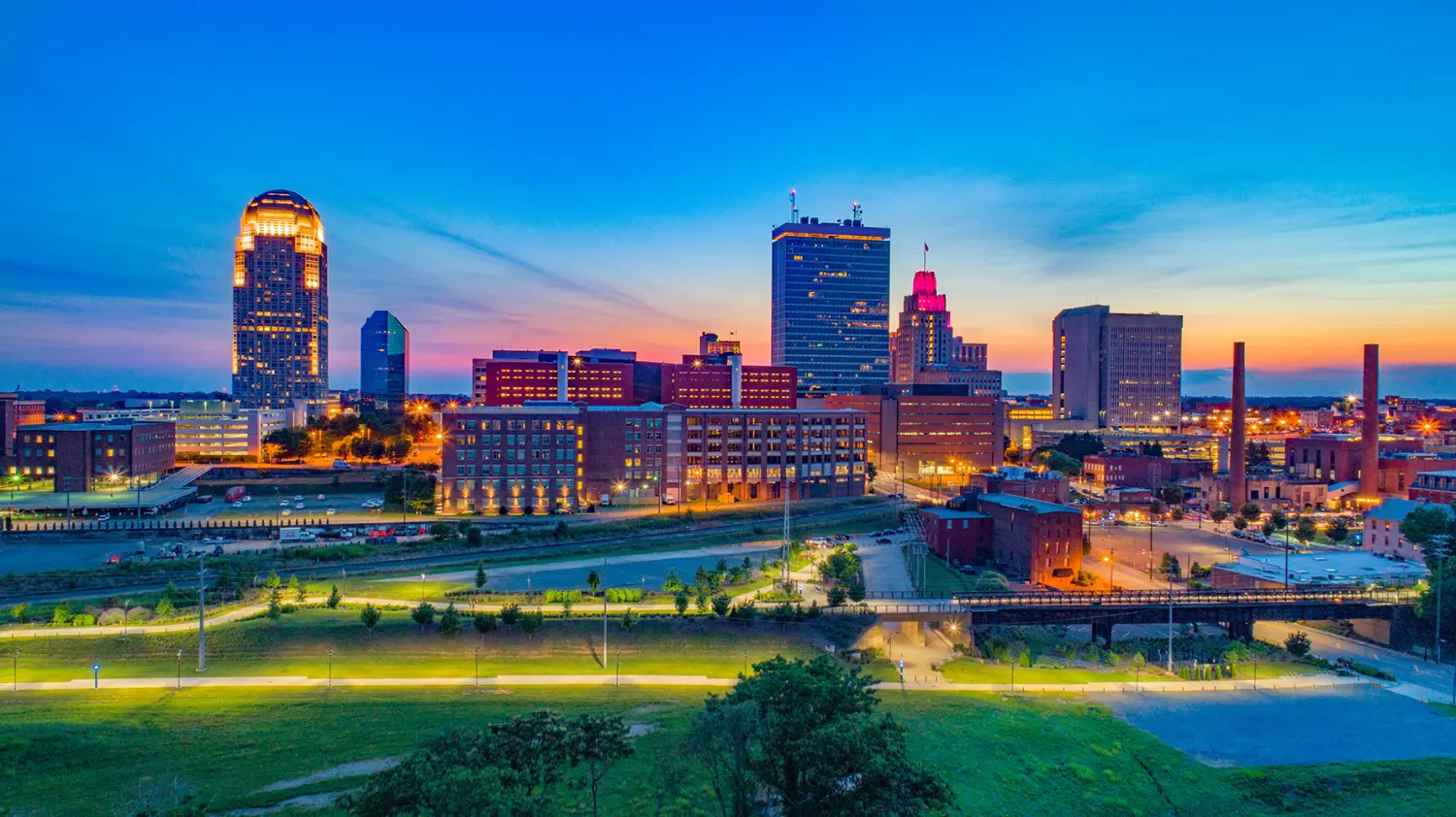
Downtown revitalization, adaptive reuse of historic industrial buildings, and the growth of new business sectors signaled a new era. The city’s past did not disappear. Instead, older structures and legacy institutions were repurposed to fit new economic realities. Former industrial spaces became offices, apartments, studios, and gathering places, turning the physical history of the city into part of its modern identity.
Winston-Salem’s story in this period is one of adjustment and resilience. Community leaders, educators, entrepreneurs, and residents all played roles in redefining what the city could be. The result is a city still aware of its industrial roots but less dependent on a single economic engine.
Winston-Salem Today as a Continuation of Its Past
Winston-Salem today carries its history forward in ways that feel tangible. The Moravian influence still shows up in preservation, music, and a respect for craftsmanship. The industrial era remains visible in the city’s layout, architecture, and the long memory of work that built neighborhoods and institutions. The merger story remains a reminder that local identity can hold multiple truths at once, preserving distinct heritage while shaping a shared future.
The city’s ongoing challenge is the same as its ongoing opportunity: honoring the past without being limited by it. Winston-Salem’s history is not just a series of milestones. It is a continuing conversation between tradition and change, between two founding communities, and between the people who built the city and those who are still building it.
Discover more from City Towner
Subscribe to get the latest posts sent to your email.