History of Grand Rapids Michigan
The history of Grand Rapids, Michigan begins with the Grand River, the longest river entirely within the state. Long before streets, factories, bridges, and neighborhoods appeared, the river shaped the lives of the Indigenous peoples who occupied western Michigan. It provided drinking water, fish, fertile land, transportation, and a natural route connecting inland communities to Lake Michigan.
Archaeological evidence shows that people lived in the Grand River Valley thousands of years before European settlement. Ancient communities sometimes identified with the Hopewell cultural tradition built burial mounds throughout the region. These earthworks reflected organized societies with spiritual customs, trade networks, and established relationships with the land.
In later centuries, the Ottawa, also known as the Odawa, became one of the principal Indigenous nations in the area. The Ottawa traveled, traded, hunted, fished, and established villages along the river. The Potawatomi and Ojibwe were also connected to the region through family relationships, diplomacy, commerce, and shared territory. Together, these nations were part of the Council of Three Fires, an important political and cultural alliance in the Great Lakes.
The natural rapids that eventually gave Grand Rapids its name stretched for approximately a mile along the river. The shallow, fast moving water created a recognizable landmark and made the location an important gathering and trading place. Although later construction altered the river, its presence remained central to the development and identity of the city.
Early European Contact and the Fur Trade
French explorers, missionaries, and traders began moving through the Great Lakes during the seventeenth century. Their arrival introduced new commercial relationships, religious influences, diseases, weapons, and political pressures. The fur trade became one of the most important economic activities in the region, particularly the trade in beaver pelts.
European traders depended heavily on Indigenous knowledge and cooperation. Native communities understood the waterways, seasonal conditions, hunting grounds, and transportation routes. French traders often formed personal and family relationships with Indigenous people, creating communities with blended cultural traditions.
After France lost control of much of its North American territory during the eighteenth century, Great Britain gained greater influence over Michigan. The region later became part of the United States, although federal control developed gradually. Indigenous nations continued to live, travel, and conduct business throughout western Michigan even as American settlers began claiming more land.
Louis Campau, a French Canadian trader, is generally recognized as the founder of Grand Rapids. He established a trading post near the Grand River in 1826. Campau had previously worked in the region and understood the commercial value of the location. His post traded goods with Ottawa communities and became a center of early settlement.
Lucius Lyon, a land surveyor and future political leader, arrived several years later and purchased land on the opposite side of the river. Competition developed between Campau and Lyon over the direction of the growing community. Campau eventually purchased a large portion of the land that became the central business district.
The Founding of Grand Rapids
The settlement grew steadily during the 1830s as farmers, merchants, missionaries, craftspeople, and laborers arrived. Michigan became a state on January 26, 1837, and Grand Rapids was incorporated as a village in 1838.
The community’s location gave it several advantages. The Grand River provided transportation, waterpower, and access to surrounding forests and farmland. Roads connected the settlement to other communities, while river traffic carried people and supplies between Grand Rapids and Lake Michigan.
Kent County had been organized in 1831 and named for James Kent, a prominent American jurist. Grand Rapids became the county seat and developed into the political and commercial center of the surrounding region. Government offices, stores, churches, mills, workshops, hotels, and homes appeared as the population increased.
Grand Rapids was incorporated as a city on April 2, 1850. By that time, it was no longer a small frontier outpost. It had become a growing urban community with ambitions to serve as the leading city of western Michigan.
Immigration played a major role in this expansion. Dutch immigrants began arriving in western Michigan during the middle of the nineteenth century, with many settling in Grand Rapids and nearby communities. German, Irish, Polish, and other European immigrants also established neighborhoods, businesses, churches, schools, and social organizations.
Each community contributed to the city’s developing identity. Religious beliefs, languages, foods, political traditions, and working customs varied widely, but industrial growth increasingly connected residents through shared employment and urban life.
The Rise of Lumber and Manufacturing
Western Michigan contained enormous forests of white pine, hardwood, and other valuable timber. During the nineteenth century, logging became one of the region’s most important industries. Trees were cut in northern and western Michigan and transported through rivers to sawmills.
Logs floated down the Grand River, where mills converted them into lumber for construction, manufacturing, and shipment. The river’s current powered early machinery and supported industrial development. Grand Rapids became an important center for processing the natural resources of the surrounding region.
The availability of lumber encouraged entrepreneurs to manufacture products from wood. Local businesses produced doors, wagons, cabinets, farming equipment, barrels, and household goods. Furniture manufacturing gradually emerged as the city’s most famous industry.
Several conditions helped the furniture business succeed. Manufacturers had access to timber, skilled immigrant labor, waterpower, transportation routes, and expanding national markets. Railroads later made it possible to ship finished products throughout the United States.
Furniture production required numerous specialized workers. Designers prepared patterns, cabinetmakers shaped wood, carvers created decorative details, upholsterers covered chairs and sofas, finishers applied stains and varnishes, and sales representatives promoted the completed products. The industry supported thousands of families while creating additional employment in transportation, machinery, banking, printing, and retail.
Grand Rapids Becomes Furniture City
Grand Rapids furniture gained wider attention during the second half of the nineteenth century. Local companies displayed their work at major exhibitions, including the Centennial International Exhibition held in Philadelphia in 1876. The quality and craftsmanship of the city’s furniture helped establish a national reputation.
By the late 1800s, Grand Rapids was widely known as Furniture City. Manufacturers produced bedroom sets, dining room tables, chairs, desks, cabinets, and decorative pieces in many styles. Some companies created elaborate furniture inspired by European traditions, while others focused on practical products for middle class households.
The city’s furniture markets attracted buyers from across the country. Showrooms allowed merchants to examine products and place large orders. Trade publications promoted Grand Rapids manufacturers and helped connect local businesses with national retailers.
Furniture factories transformed the physical appearance of the city. Large brick industrial buildings rose near rail lines and the river. Warehouses, workshops, and shipping facilities occupied entire blocks. Neighborhoods developed near factories so workers could walk or take streetcars to their jobs.
The success of the furniture industry generated substantial wealth. Business owners built impressive homes, supported cultural institutions, and invested in civic improvements. Heritage Hill, one of the city’s best known historic neighborhoods, contains houses representing numerous architectural styles from the nineteenth and early twentieth centuries.
However, industrial success did not benefit everyone equally. Factory work could be exhausting and dangerous. Employees often worked long hours around sharp tools, heavy machinery, chemicals, dust, and fire hazards. Wages and working conditions became recurring sources of conflict between laborers and company owners.
The Furniture Workers’ Strike of 1911
Labor tensions reached a major turning point during the furniture workers’ strike of 1911. Thousands of workers left their jobs after manufacturers resisted demands involving wages, hours, workplace representation, and union recognition.
The strike exposed divisions within Grand Rapids. Many workers came from immigrant communities and believed they were treated unfairly by powerful factory owners. Religious leaders, business organizations, elected officials, and newspapers took different positions on the dispute.
The conflict lasted for several months. Strikers organized meetings, marches, and public demonstrations, while manufacturers attempted to continue production. Although the workers did not achieve all their objectives, the strike became an important chapter in the city’s labor history.
It revealed that the prosperity associated with Furniture City rested on the labor of people who had limited power over their workplaces. The strike also encouraged later discussions about wages, safety, representation, and the responsibilities of employers.
Transportation and Urban Expansion
Transportation improvements helped Grand Rapids become a regional center. Railroads connected the city to Detroit, Chicago, Lake Michigan ports, and smaller communities throughout Michigan. Passenger trains brought visitors, workers, and businesspeople, while freight trains carried lumber, furniture, agricultural products, machinery, and manufactured goods.
Streetcars supported expansion beyond the downtown area. Residents could live farther from their workplaces, encouraging the development of new neighborhoods. Bridges linked both sides of the Grand River, allowing people and goods to move more efficiently across the city.
Automobiles gradually replaced streetcars and transformed urban planning. Roads widened, parking areas appeared, and businesses began serving customers who traveled by car. Aviation also became part of the local economy. In 1928, an aircraft named Miss Grand Rapids transported furniture by air, demonstrating how the city’s signature industry adapted to new technology.
Population growth brought additional public services. Schools, hospitals, libraries, parks, police stations, fire departments, and water systems expanded. Churches and neighborhood organizations remained influential, particularly within the city’s Dutch, Polish, German, Irish, and African American communities.
Grand Rapids During the World Wars
World War I changed production patterns as factories contributed to the national war effort. Local businesses manufactured military supplies, equipment, and materials while residents served in the armed forces. Families purchased war bonds, joined relief organizations, and participated in conservation campaigns.
The years after World War I brought both prosperity and instability. Automobile ownership increased, consumer culture expanded, and new forms of entertainment became popular. At the same time, racial discrimination, immigration restrictions, labor conflict, and economic inequality affected the city.
The Great Depression created severe hardship after 1929. Factories reduced production, businesses closed, and unemployment rose. Families depended on churches, charitable organizations, neighborhood assistance, and government relief programs. Public construction projects created jobs and improved roads, parks, public buildings, and other infrastructure.
World War II restored industrial demand. Grand Rapids companies converted portions of their production to military needs. Furniture manufacturers used their woodworking experience to produce equipment, containers, aircraft components, and other essential goods. Women entered industrial jobs in larger numbers as men joined the armed forces.
After the war, returning veterans pursued education, purchased homes, started families, and entered the workforce. The city experienced new residential development, particularly in suburban areas surrounding Grand Rapids.
African American History and the Struggle for Equality
African Americans have been part of Grand Rapids history since the nineteenth century. Some early Black residents arrived through migration from other states, while others came through connections to the Underground Railroad and antislavery movement.
The Black population grew significantly during the twentieth century, particularly during and after the Great Migration. African American families moved north seeking industrial employment, educational opportunities, and freedom from the severe racial oppression of the South.
Despite these hopes, Black residents encountered discrimination in housing, employment, education, lending, policing, and public accommodations. Restrictive practices limited where families could purchase or rent homes. Some companies denied Black workers access to skilled positions or advancement opportunities.
African American churches became essential centers of spiritual life, civic organization, education, and political action. Local leaders, business owners, ministers, educators, and community groups challenged segregation and demanded equal treatment.
Civil rights activism in Grand Rapids addressed housing discrimination, school inequality, police conduct, employment barriers, and access to public institutions. These struggles demonstrated that the city’s reputation for civility and progress did not always reflect the daily experiences of Black residents.
The national civil rights movement inspired additional local organizing during the 1950s, 1960s, and 1970s. Activists pushed government officials and business leaders to confront structural inequality. Although important reforms occurred, racial disparities remained a serious part of the city’s social history.
Gerald R. Ford and His Grand Rapids Legacy
Grand Rapids is closely associated with Gerald R. Ford, the thirty eighth president of the United States. Ford was born Leslie Lynch King Jr. in Omaha, Nebraska, on July 14, 1913. After his parents separated, his mother moved to Grand Rapids, where she later married Gerald Rudolff Ford.
The future president grew up in Grand Rapids, attended local schools, participated in athletics, and developed strong connections to the community. After graduating from the University of Michigan and Yale Law School, he returned to Grand Rapids and began practicing law.
Ford served in the United States Navy during World War II and later represented the Grand Rapids area in the United States House of Representatives. He became vice president in 1973 following the resignation of Spiro Agnew. Ford became president on August 9, 1974, after Richard Nixon resigned during the Watergate scandal.
Ford’s presidency occurred during a period of political distrust, inflation, international tension, and social change. His decision to pardon Nixon became one of the most controversial actions of his administration.
The Gerald R. Ford Presidential Museum stands along the Grand River in downtown Grand Rapids. The museum preserves documents, artifacts, exhibits, and personal objects connected to Ford’s life and presidency. Ford and his wife, Betty Ford, are buried on the museum grounds.
Public Art and the Calder Sculpture
Grand Rapids entered a new cultural period during the second half of the twentieth century. One of the most important symbols of this transformation was La Grande Vitesse, a large red sculpture created by Alexander Calder.
The sculpture was installed in 1969 at the plaza now known as Calder Plaza. Its title means great swiftness in French, a phrase connected to the meaning of Grand Rapids. The work became one of the city’s most recognizable landmarks.
La Grande Vitesse was significant because it represented a major partnership involving public funding, private support, and modern art. It demonstrated that public art could become central to a city’s identity rather than remaining confined to museums or private collections.
The sculpture’s bright red form inspired the city’s logo and helped establish Grand Rapids as a supporter of contemporary art. Additional cultural institutions, performances, galleries, festivals, and public installations expanded the city’s artistic reputation.
Economic Change and Downtown Decline
Like many American cities, Grand Rapids experienced economic and social changes after World War II. Families and businesses moved toward suburban communities, shopping centers replaced some traditional downtown commerce, and highways altered established neighborhoods.
Urban renewal projects demolished older buildings and displaced residents. Some historically significant structures were lost as officials attempted to modernize the downtown area. Large roads, parking facilities, office buildings, and government complexes replaced portions of the older urban landscape.
The traditional household furniture industry also changed. Competition from lower cost producers, shifting consumer preferences, new materials, and overseas manufacturing reduced the dominance of many Grand Rapids companies. Some factories closed, merged, relocated, or changed their products.
However, the region remained important in furniture design and manufacturing. Businesses increasingly specialized in office furniture, institutional products, ergonomic design, and modern work environments. Companies throughout western Michigan helped preserve the region’s international reputation for innovation and craftsmanship.
Grand Rapids also developed strengths in health care, education, food processing, insurance, technology, professional services, and advanced manufacturing. This diversification helped the city adjust to changes that damaged many other industrial communities.
The Revitalization of Downtown Grand Rapids
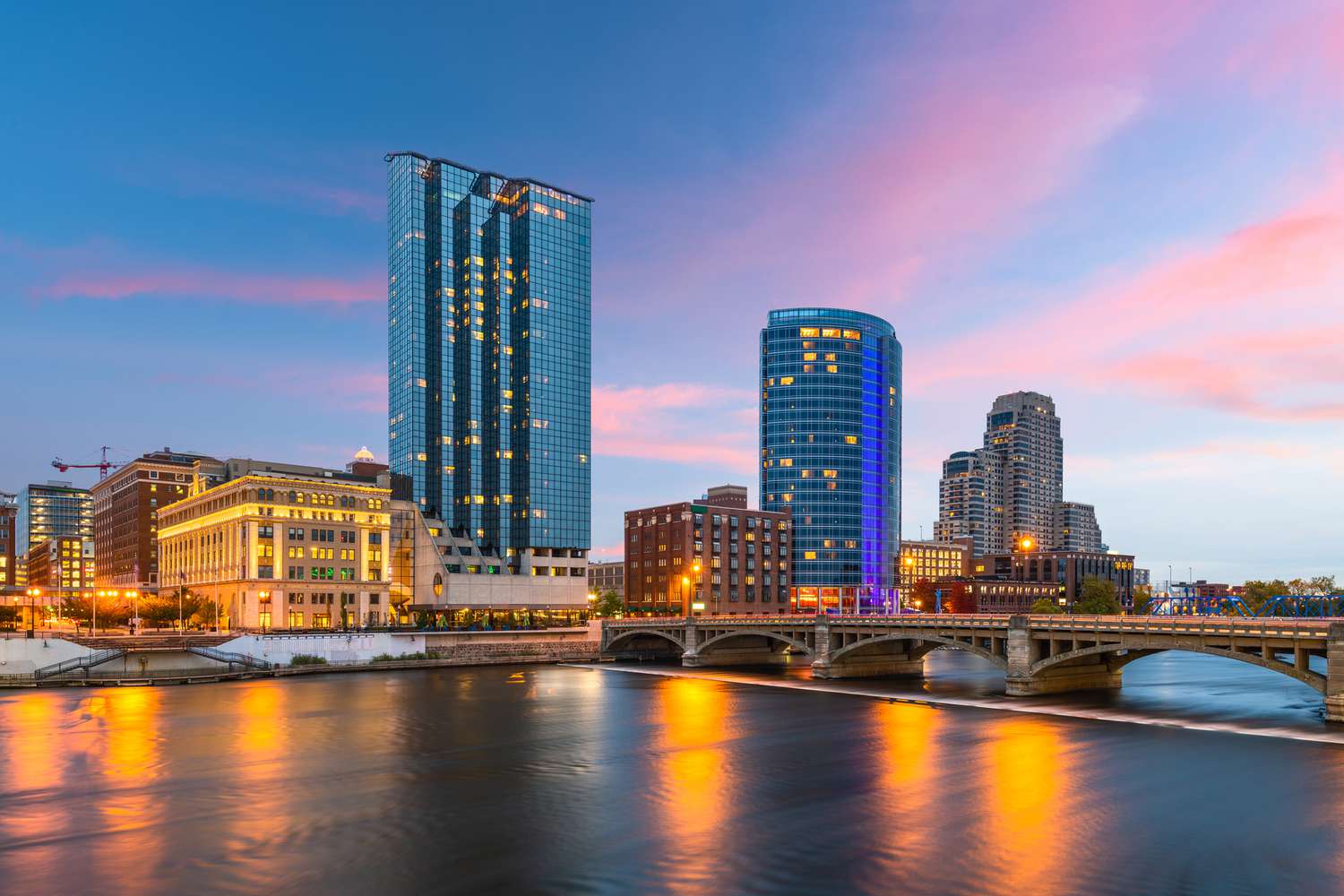
Beginning in the late twentieth century, Grand Rapids experienced a major downtown revival. Public and private investments brought new museums, hotels, restaurants, entertainment venues, offices, apartments, parks, and educational facilities.
The Van Andel Arena opened in 1996 and became a major destination for concerts, sporting events, and community gatherings. The facility helped attract visitors and encouraged additional development nearby.
The Grand Rapids Public Museum moved to a prominent riverfront facility, while the Gerald R. Ford Presidential Museum continued drawing tourists and researchers. The Grand Rapids Art Museum later opened a major downtown building, strengthening the city’s cultural district.
Medical development became another powerful force. Hospitals, research institutions, medical schools, laboratories, and health related businesses expanded along the Michigan Street corridor. This area became known as the Medical Mile and represented the city’s movement toward a knowledge based economy.
Historic buildings found new uses as apartments, offices, restaurants, breweries, studios, and event spaces. Preservation efforts protected significant homes and neighborhoods while encouraging people to recognize the value of the city’s architectural heritage.
Beer City and a Changing Cultural Identity
Grand Rapids developed a strong craft brewing industry during the late twentieth and early twenty first centuries. Local breweries attracted residents and tourists, supported restaurants, and contributed to neighborhood redevelopment.
The nickname Beer City became an important part of the city’s modern identity. Brewing connected Grand Rapids to Michigan agriculture, entrepreneurship, tourism, and food culture. Festivals and tasting events brought attention to the region’s growing number of breweries.
The city also became known for ArtPrize, a large public art competition first held in 2009. Artwork appeared in museums, businesses, parks, sidewalks, churches, hotels, and other public spaces. Visitors could explore the city while viewing works created by artists from many locations.
These developments expanded the public image of Grand Rapids. Once known primarily as Furniture City, it increasingly became recognized for art, dining, brewing, medicine, education, design, and urban recreation.
Neighborhoods and Community Traditions
Grand Rapids has always been shaped by its neighborhoods. Each area reflects different periods of immigration, industrial development, migration, architecture, and community organization.
Heritage Hill contains hundreds of historic homes representing Greek Revival, Italianate, Queen Anne, Prairie, Colonial Revival, and other architectural styles. The neighborhood reflects the wealth created during the city’s industrial rise while also demonstrating the importance of historic preservation.
The West Side developed strong Polish, German, Irish, and Lithuanian traditions. Churches, halls, markets, bakeries, taverns, and family businesses helped immigrants preserve their identities while adapting to American life.
Southeast Grand Rapids became an important center of African American culture, business, worship, and political organizing. Other neighborhoods developed substantial Latino communities, including families with Mexican, Puerto Rican, Central American, and South American roots.
Grand Rapids has also welcomed refugees and immigrants from Vietnam, Bosnia, Somalia, Sudan, Myanmar, and numerous other places. Their arrival has introduced new languages, restaurants, businesses, religious communities, and cultural traditions.
These communities demonstrate that Grand Rapids history is not simply the story of powerful industrialists or famous political figures. It is also the history of workers, families, teachers, ministers, artists, immigrants, activists, entrepreneurs, and neighborhood leaders.
The Continuing Importance of the Grand River
The Grand River remains the physical and symbolic center of Grand Rapids. For Indigenous communities, it was a source of life, transportation, food, and trade. For early settlers, it powered mills and carried lumber. For manufacturers, it supported industrial growth. For modern residents, it offers recreation, public space, environmental value, and a connection to the past.
Industrial development and dam construction changed the natural rapids that originally gave the city its name. Over time, pollution and habitat loss also damaged the river. Environmental groups, Indigenous leaders, government agencies, and residents have worked to improve water quality and restore natural features.
Modern riverfront projects have focused on trails, parks, public access, ecological restoration, and opportunities for recreation. Plans to reshape portions of the river reflect a broader effort to reconnect the city with the waterway responsible for its location and identity.
The river tells the complete story of Grand Rapids. It represents Indigenous history, settlement, industry, environmental change, urban development, and renewal.
A City Built on Work, Design, and Reinvention
Grand Rapids developed from an Indigenous gathering place into a trading settlement, manufacturing center, regional capital, and modern metropolitan community. Its growth was powered by the Grand River, surrounding forests, immigrant labor, industrial ambition, and an ability to adapt to economic change.
The furniture industry gave the city an international reputation and left a lasting influence on its architecture, workforce, institutions, and design culture. Labor struggles revealed the human cost of industrial prosperity, while civil rights activism challenged the racial barriers that prevented many residents from sharing equally in the city’s success.
Grand Rapids has repeatedly reinvented itself. It moved from fur trading to lumber, from lumber to furniture, from household furniture to office design, and from traditional manufacturing toward health care, education, technology, tourism, and creative industries.
Its history contains periods of impressive achievement as well as discrimination, displacement, labor conflict, and economic uncertainty. Understanding both sides of that history provides a more complete picture of the city.
Today, Grand Rapids remains closely connected to the river, neighborhoods, industries, and communities that shaped it. The city’s past can be seen in former factories, historic houses, church towers, bridges, museums, public art, cultural institutions, and the continuing traditions of the people who call western Michigan home.
Discover more from City Towner
Subscribe to get the latest posts sent to your email.