History of Norfolk Virginia
The story of Norfolk begins with water. The deep channels of the Chesapeake Bay and the sheltered reach of the Elizabeth River created a natural harbor that could serve small colonial shallops, merchant brigs, and eventually the steel gray silhouettes of modern naval fleets. Long before streets were named and lots were surveyed, the tide and the shoreline determined what Norfolk could become: a place where trade, shipbuilding, and military strategy would meet again and again.
Indigenous peoples lived and traveled throughout the Tidewater region for centuries, using the rivers and marshes as lifelines for food, transportation, and community. When English colonization expanded after Jamestown, the wider region around Norfolk became part of a fast changing world, shaped by new markets and new conflicts. Norfolk’s eventual rise was not accidental. It was rooted in geography, then accelerated by the ambitions of a colony that needed ports, warehouses, and ships.
From Colonial Outpost to Port Town
Norfolk’s earliest European era development grew out of the economic needs of colonial Virginia. Tobacco dominated export commerce, and the colony depended on navigable waterways to move goods from plantations to markets. Communities that could organize docks, inspection points, and reliable shipping routes gained influence quickly. As a port town, Norfolk became a place where buyers, sailors, planters, laborers, and craftsmen mixed in a busy, practical rhythm.
Over time, Norfolk’s identity settled into something distinct: less plantation centered than the rural counties around it, and more oriented toward the movement of goods and people. Warehouses, taverns, ropewalks, and small shipyards supported maritime life. The town’s prosperity rose and fell with trade cycles, wars, and weather, but its role as a port anchored its importance.
Colonial towns were also political spaces. Local governance, militia organization, and commerce were intertwined. In Norfolk, leadership and wealth tended to flow toward those who controlled shipping, land near the waterfront, and access to credit. Even early on, the city’s history carried the contradictions that marked the wider colony: expansion and opportunity for some, harsh exploitation and limited rights for others, especially enslaved Africans and their descendants whose labor helped build the local economy.
Revolution, Privateers, and the Shock of War
The American Revolution hit Norfolk with particular force because port towns were strategic targets. Control of waterways meant control of supplies, intelligence, and movement. Norfolk’s waterfront economy made it valuable, but that value came with risk. Military pressure, political divisions, and shifting occupations could disrupt everyday life in a matter of weeks.
During the revolutionary period, Norfolk experienced destruction that reshaped its built environment and its collective memory. Fires and bombardments were not just dramatic episodes, they were turning points that forced rebuilding and reimagining. When a port town burns, the loss is not only homes and warehouses, but also records, tools, boats, and the fragile networks of trust that commerce depends on.
Yet Norfolk’s location ensured it would return. The harbor still existed. The river still carried ships. Rebuilding after crisis became part of the city’s pattern: damage, recovery, growth, and then the next test.
Nineteenth Century Growth and Maritime Muscle
In the decades after independence, Norfolk expanded as the young United States pushed commerce outward. Coastal shipping, international trade, and regional markets all fed the port. The surrounding region’s agricultural output still mattered, but Norfolk increasingly looked beyond local plantations. Merchants followed demand, shipbuilders followed contracts, and the city’s workforce diversified across the many trades required to keep a port functioning.
This period also laid foundations for Norfolk’s enduring relationship with the sea as an industry. Ship repair, construction, and naval logistics were not separate lanes, they overlapped. A working waterfront attracts capital investments in piers, dry docks, storage, and transport connections. As the century advanced, rail links helped tie Norfolk more tightly to inland markets, strengthening its position as a gateway between the interior and the Atlantic world.
But growth also magnified social divides. The city’s free Black population, enslaved laborers, immigrants, and working class whites navigated an environment where opportunity existed alongside discrimination and exploitation. Norfolk’s history cannot be separated from the broader story of Virginia and the South, where law and custom often constrained who could build wealth, who could move freely, and who could claim protection.
Civil War Upheaval and a City Remade
The Civil War era was another seismic shift. Norfolk’s strategic location in Tidewater made it militarily significant, and the presence of naval facilities and shipbuilding capacity raised the stakes. The war brought uncertainty, occupation, and the transformation of the local economy under wartime demands.
This era is often remembered for the dramatic evolution of naval warfare and the contests over control of waterways. Even when specific battles occurred nearby, the larger impact on Norfolk was the way the conflict rearranged power. The end of slavery and the contested promise of freedom reshaped families, labor systems, and politics. Reconstruction offered new possibilities while also triggering backlash and the emergence of systems designed to limit Black political and economic power.
Norfolk, like many Southern cities, faced the challenge of building a postwar economy while struggling over whose vision would guide it. The port remained a vital asset, but the rules of labor, citizenship, and governance were changing, and those changes were fought over in courts, streets, workplaces, and ballot boxes.
The Rise of Hampton Roads as a Strategic Region
Norfolk’s story is inseparable from the growth of Hampton Roads as a larger strategic hub. As the United States expanded its naval reach, it needed deepwater ports, repair capacity, and staging areas. Norfolk was positioned to become a cornerstone of that system.
The development of naval infrastructure brought stable employment and federal investment, but it also linked the city’s fortunes to national defense priorities. When naval spending increased, Norfolk surged. When budgets tightened, the city felt it. This connection created a local culture that often saw the military not as an occasional visitor but as a permanent neighbor and employer.
Over time, Norfolk grew into one of the most recognizable navy towns in America. That identity shaped neighborhoods, schools, family life, and civic pride. It also influenced the city’s diversity, since military assignments bring people from across the country and around the world into the same streets and stores.
Twentieth Century Transformation and the Pressure of Modernity
The twentieth century brought Norfolk into the age of mass industry, global war, and rapid urban change. The two world wars created intense demand for ships, repair work, training, and logistics. During these surges, the city’s population and activity expanded, and the waterfront became an engine of round the clock effort.
With growth came strain. Housing shortages, segregated services, and unequal access to opportunity shaped daily life. Norfolk reflected the era’s injustices, including Jim Crow laws and discriminatory practices that limited where Black residents could live, work, and invest. These pressures were not abstract. They affected whether families could build generational wealth, whether children had equal educational resources, and whether neighborhoods received investment or neglect.
At the same time, Norfolk was modernizing. Automobiles changed street patterns. New bridges, tunnels, and highways reshaped regional mobility. Older areas faced decline as newer suburbs expanded outward. Many American cities confronted the hard question of what to preserve and what to replace, and Norfolk was no exception.
Urban Renewal, Loss, and Reinvention
Mid century urban renewal policies changed Norfolk’s landscape dramatically. Across the country, projects promised modernization but often resulted in the demolition of historic neighborhoods, especially those occupied by minority and working class residents. Norfolk experienced this tension as planners pursued wider roads, new developments, and large scale redevelopment.
The result was complex. Some areas gained new facilities and new investment. Other communities lost churches, businesses, and the dense social networks that made neighborhoods resilient. When a district is cleared, the cost is not only physical displacement but also the erosion of memory and local institutions.
Yet Norfolk also began to reinvent its downtown and waterfront identity. As port and military functions remained strong, civic leaders and residents looked for ways to create a more vibrant urban core, balancing tourism, business, arts, and everyday life. This reinvention did not erase old problems, but it added new possibilities.
A Modern Naval City with a Civic Heart
In the contemporary era, Norfolk’s global identity is deeply tied to the U.S. Navy and especially to Naval Station Norfolk, which stands as a symbol of the city’s strategic role. The military presence supports a wide ecosystem of contractors, logistics companies, ship repair operations, and service industries. It also contributes to the city’s cultural mix, bringing new residents who blend local traditions with experiences from elsewhere.
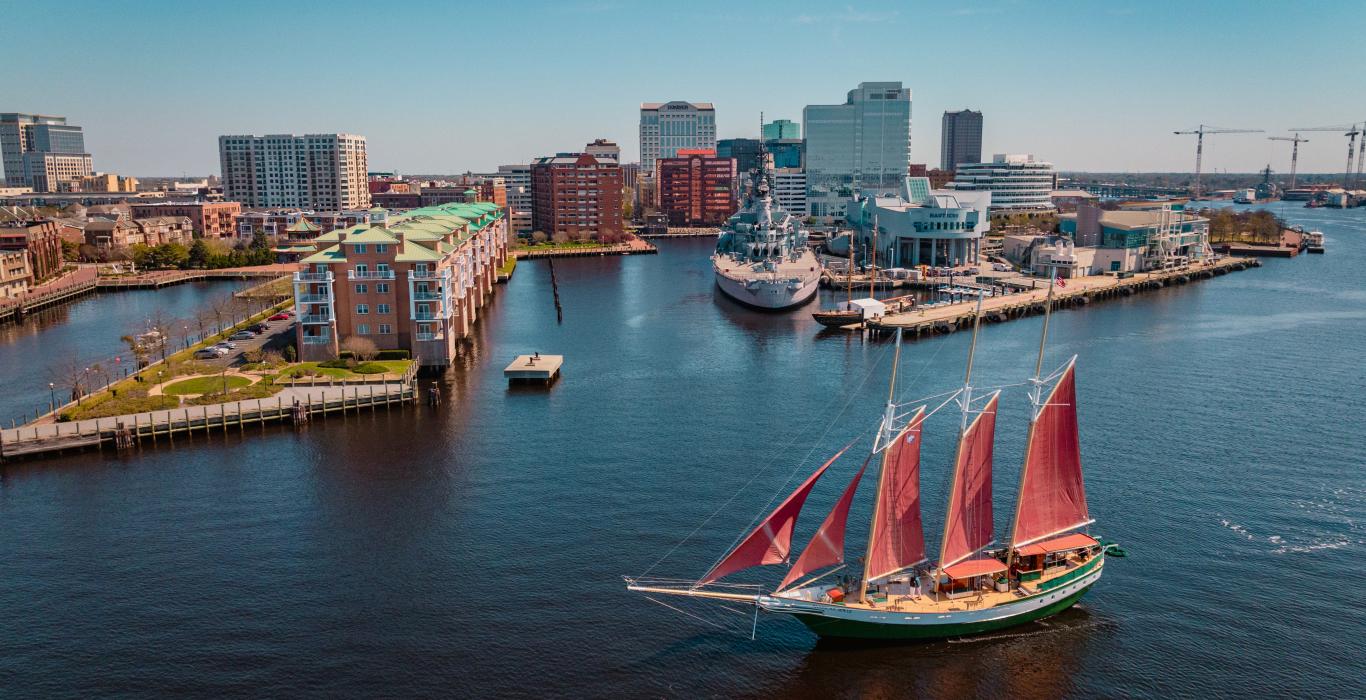
Norfolk’s civic life extends beyond defense. The city has built a reputation for waterfront experiences, festivals, museums, and a growing emphasis on urban living. The presence of USS Wisconsin reflects how Norfolk preserves maritime history while also inviting the public into it. Historic architecture, neighborhoods with deep roots, and a continuing relationship with the water give Norfolk a distinctive character within Virginia.
Modern Norfolk also faces modern challenges. Sea level rise and recurrent flooding are not distant concerns for a coastal city. Economic inequality, housing affordability, and infrastructure demands require long term planning and political will. Norfolk’s history suggests it has the capacity to adapt, but adaptation always raises questions about fairness: who is protected, who is displaced, and who benefits from investment.
Norfolk’s History as a Pattern of Resilience
Norfolk’s past is not a straight line of progress. It is a pattern of cycles driven by geography, trade, war, and rebuilding. Fire and conflict damaged the city more than once, yet the harbor pulled it back into relevance. Industry and military investment helped it grow, yet those same forces could create dependency and disruption. Social change opened doors for some while being resisted by others, leaving a legacy still visible in neighborhoods and opportunity gaps.
What endures is the city’s relationship with the water and its ability to keep remaking itself around that relationship. Norfolk is a place shaped by ships and storms, by migration and labor, by military strategy and civic ambition. Its history is a reminder that ports are never just economic engines. They are crossroads where the world arrives, where culture mixes, and where the future is constantly negotiated.
Discover more from City Towner
Subscribe to get the latest posts sent to your email.