
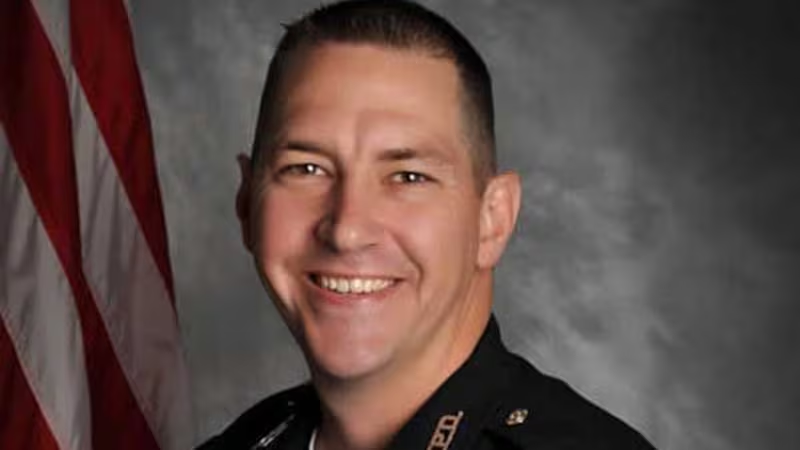
Police Officer Jason Ellis Ambushed and Killed in Bardstown Kentucky
The murder of Bardstown Police Officer Jason Ellis shocked Kentucky and left a wound that has never fully healed. What should have been an ordinary drive home after a late shift became one of the most haunting crimes in the history of Bardstown. In the early hours of May 25, 2013, Ellis was killed in what authorities have long described as a carefully planned ambush. The attack was sudden, brutal, and deeply unsettling because of the level of preparation it appeared to involve. More than a decade later, the case still stands as one of the most troubling unsolved killings of a law enforcement officer in the state.
Jason Ellis was not just a badge and a uniform. He was a husband, a father, a respected officer, and a familiar presence in the Bardstown community. His death did not only take a public servant from the town. It took a man from his family and a friend from those who knew him personally. The killing also became one of the major mysteries connected to Bardstown, a city that would later draw even more national attention because of other violent and unexplained cases.
To understand why the murder of Jason Ellis continues to resonate, it is important to look beyond the basic facts of the crime. His life, the circumstances of that night, the intense investigation, and the enduring frustration over the lack of answers all help explain why this case still holds such a powerful grip on public memory.
Who Jason Ellis Was
Jason Ellis was known as a dedicated police officer and K 9 handler with the Bardstown Police Department. He had built a reputation as someone committed to his job and to the safety of the community he served. Those who remembered him often described him as hardworking, dependable, and deeply invested in both his family life and his law enforcement career.
Before becoming a police officer, Ellis had also shown strong athletic promise. He had a background in baseball and had pursued sports seriously before moving into police work. That competitive drive and discipline later carried over into his law enforcement career, where he earned respect for his professionalism and service.
Outside the department, Ellis was a family man. He was married and had children, and his death created a personal loss that extended far beyond the headlines. Public attention often focuses on the crime scene, the weapons, and the suspects, but at the center of the case was a man whose family had their future shattered in a single moment. That human element remains one of the most painful parts of the story.
His death also carried special weight because he was serving in a visible public role. When a police officer is killed in the line of duty, the impact reaches into the wider community in a unique way. It creates grief, fear, anger, and uncertainty all at once. In Bardstown, that emotional shock was immediate.
The Events of May 25, 2013
On May 25, 2013, Jason Ellis had finished his shift and was heading home. Sometime after midnight, he traveled along the Bluegrass Parkway near Bardstown. At Exit 34, his path was blocked by tree limbs that had been placed across the road. The obstruction forced him to stop.
What happened next is one of the most chilling aspects of the case. Investigators believe the branches were deliberately positioned to lure Ellis out of his cruiser. Once he got out to clear the road, he was shot. The scene suggested planning, patience, and intent. This was not described as a random confrontation or a spontaneous burst of violence. It appeared to be an ambush laid in advance.
The attack took place in a dark and isolated area, which only added to the sense that the killer or killers had chosen the location carefully. Ellis was alone, vulnerable for those brief moments outside his vehicle, and caught in a trap that gave him little chance to react. The scene left investigators with the unmistakable impression that someone had studied the area, understood traffic patterns, and knew how to create a deadly setup.
The murder immediately stood out because of its precision. Law enforcement officers face danger every day, but the facts in this case pointed to a targeted attack with a level of calculation that was especially disturbing. It raised the question of whether the killer had a specific grievance, whether Ellis himself was the intended target, or whether the attacker simply wanted to kill a police officer.
A Crime Scene That Raised Hard Questions
From the beginning, the crime scene presented investigators with an unusual and difficult puzzle. The placement of the branches suggested forethought. The isolated exit ramp reduced the likelihood of witnesses. The timing, shortly after Ellis ended his shift, hinted that the person responsible may have known his routine or at least had some understanding of when an officer might pass through the area.
These details fueled immediate speculation. Was Ellis specifically chosen, or was the ambush meant for any officer who happened upon the obstruction? Was the killer familiar with Bardstown and the local roads? Did the attacker act alone, or did more than one person take part in setting the scene and carrying out the shooting? Those questions became central to the investigation and remain central to discussions about the case to this day.
The method used in the killing made the murder feel personal to many observers, even though the motive was not clear. The act of setting a trap and waiting for an unsuspecting officer to exit his vehicle suggested a cold willingness to plan another man’s death in advance. That detail separated the murder of Jason Ellis from many other crimes and made it especially hard for the community to process.
For Bardstown residents, the scene also carried a frightening message. If a police officer could be lured and murdered in such a deliberate way while simply driving home, then the sense of normal safety in the town had been broken. That fear lingered long after the first news reports faded.
The Investigation and the Search for a Motive
The killing of Jason Ellis prompted a major investigation involving local, state, and federal authorities. Investigators worked to reconstruct his final moments, analyze the crime scene, and trace any clues that could explain who had planned and carried out the ambush. The case drew considerable attention because of both the victim’s role as a police officer and the apparent sophistication of the attack.
Authorities pursued numerous leads over the years. They looked into possible personal grudges, professional conflicts, and broader criminal connections. They examined whether Ellis had been targeted because of his work in law enforcement, whether he had crossed paths with someone seeking revenge, and whether the murder could be tied to criminal activity in or around Bardstown.
As with many unsolved cases, the public learned only part of what investigators uncovered. Certain details were withheld in hopes of preserving the integrity of the case and testing the truthfulness of any future statements from suspects or witnesses. This secrecy, while understandable, also created a vacuum that invited rumors and theories.
A major challenge in the case has always been the lack of a publicly identified suspect who could be charged and brought to trial. Law enforcement agencies have announced developments and followed promising leads, but the case has remained open. That unresolved status has prolonged the pain for Ellis’s family and left Bardstown with a continuing sense of unfinished business.
The unanswered question of motive has been especially frustrating. People naturally want to know why a crime happened, especially when it is as calculated as this one. Yet the reason behind the attack has never been clearly established in a courtroom. Whether the motive was revenge, hatred of law enforcement, personal anger, or something else entirely, that missing explanation continues to haunt the case.
The Impact on Bardstown
Bardstown is often celebrated for its beauty, heritage, and small town character. The murder of Jason Ellis disrupted that image in a profound way. It reminded residents that violence can strike even places that seem peaceful and close knit. The shock was not only emotional but cultural. It changed how many people viewed their town.
The killing quickly became more than a local tragedy. It became a defining event in Bardstown’s modern history. As years passed and other high profile cases emerged in the area, the murder of Jason Ellis became part of a larger and darker narrative surrounding the town. That broader pattern only intensified public interest and increased the pressure on investigators to find answers.
For local law enforcement, the murder carried professional and personal consequences. Officers lost one of their own in a brutal way, and they had to continue serving the public while also grieving and navigating the fear that comes from an unsolved attack on a colleague. Cases involving murdered officers can have a lasting effect on morale because they strike at the shared identity and risks of the profession.
For ordinary residents, the case became a symbol of uncertainty. Even those who did not know Ellis personally often felt a connection to the loss because he represented order, protection, and service. His murder felt like an assault on those values.
The Family’s Grief and the Weight of Time
Behind every unsolved homicide is a family forced to live with absence and uncertainty. In the case of Jason Ellis, that burden has stretched across many years. His loved ones were left to mourn a sudden and violent death while also enduring the frustration of not seeing the person responsible held accountable.
Time has a strange effect on unresolved crimes. It can dull the intensity of public attention, but it often sharpens the pain for those closest to the victim. Each anniversary becomes a reminder not only of the loss itself but of the justice that has yet to come. The passing years can bring new leads and renewed attention, but they can also deepen exhaustion and grief.
The family of Jason Ellis has had to carry both public and private sorrow. Publicly, his death is remembered as a line of duty killing and a major unsolved case. Privately, it is the loss of a husband, father, son, and friend. That distinction matters because the headlines only capture part of what was taken away.
In communities like Bardstown, memory often becomes part of the pursuit of justice. Memorial services, public tributes, and ongoing discussions keep the victim’s name alive. In that sense, remembrance is not only an act of honor. It is also a refusal to let the case disappear.
Why the Case Still Matters
The murder of Jason Ellis still matters because it represents more than a single act of violence. It is a case about planning, vulnerability, and the long shadow left by unanswered questions. It is about what happens when a community loses trust in the idea that every terrible crime will eventually be solved. It is also about the enduring duty to keep seeking truth even when years have passed.
Unsolved murders often remain powerful because they resist closure. They leave behind facts but not resolution, grief but not justice, memory but not peace. The killing of Jason Ellis fits that pattern in the most painful way. The public knows the broad outline of what happened, but the missing final pieces have prevented the story from reaching its rightful end.
There is also a broader significance to cases like this one because they test institutions. They test the patience of the public, the endurance of investigators, and the promise that even the most difficult crimes are worth pursuing. When the victim is a police officer, that meaning becomes even more layered. Solving the case becomes not only a matter of justice for one family but also a statement about whether the system can answer an attack on one of its own.
For many people, Jason Ellis is remembered not only for the way he died but for the life he lived and the service he gave. That memory remains important because it pushes back against the way violence can reduce a person to the circumstances of their death.
A Murder That Still Awaits Resolution
The murder of Jason Ellis on May 25, 2013 remains one of the most haunting crimes in Kentucky. The facts that are known are chilling enough on their own. A police officer finished his shift, drove into the darkness, stopped for an obstruction placed in his path, stepped out, and was killed in an ambush. It is a story that feels almost impossible in its cruelty, yet it happened in real life on a quiet stretch of road outside Bardstown.
What has followed is a long period of mourning, investigation, speculation, and waiting. The case has never fully left public consciousness because it combines so many disturbing elements. It involves a respected officer, a carefully arranged trap, an isolated roadway, and a mystery that has resisted resolution for years.
Jason Ellis’s death continues to stand as both a personal tragedy and a public challenge. The personal tragedy lies in the family and community left behind. The public challenge lies in the unfinished search for justice. Until the person or people responsible are fully identified and held accountable, the story remains open, and so does the pain attached to it.
The passage of time does not lessen the seriousness of the crime. If anything, it deepens the need for answers. The murder of Jason Ellis remains a reminder that some cases do not fade because they are too important, too cruel, and too unresolved to be forgotten.
Discover more from City Towner
Subscribe to get the latest posts sent to your email.