
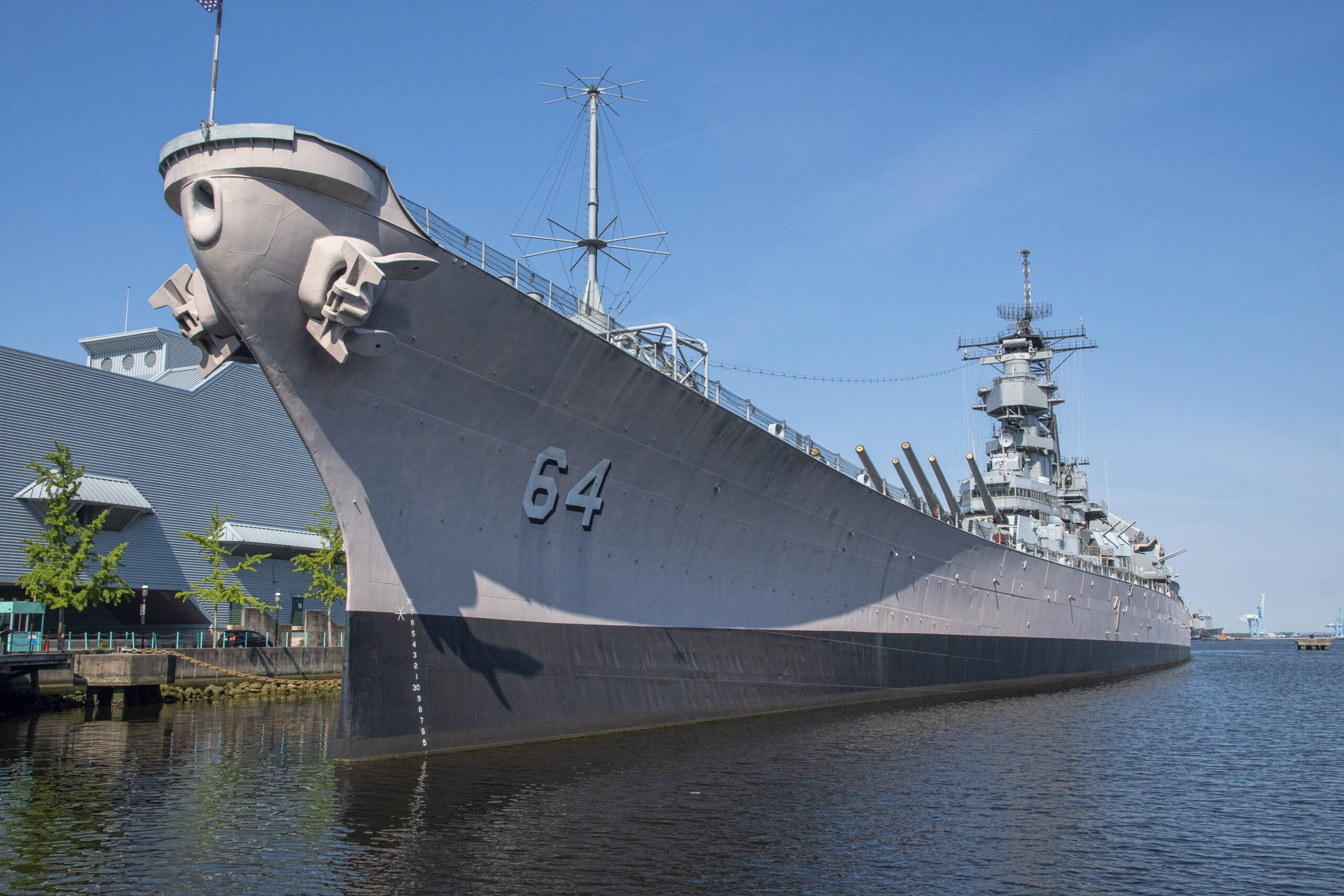
Battleship Wisconsin in Norfolk Virginia
Seeing the Battleship Wisconsin in Norfolk, Virginia is one of those experiences that resets your sense of scale. From a distance it already looks enormous, but the moment you step closer you realize it is not just a ship, it is a floating city built for war. The steel hull rises like a wall beside the water, and every angle feels purposeful. Even before you learn a single detail, the ship’s presence tells you it was designed to endure, to move through rough seas, and to deliver overwhelming power when called upon.
In Norfolk, the Wisconsin feels perfectly placed. This is a city where maritime life is not a theme, it is a reality. The waterfront has long been shaped by commerce, naval strategy, and ship work, and the Wisconsin sits there like a physical summary of that identity. Visitors arrive with different motivations. Some come for military history, some come for the spectacle, and others come because they simply want to walk the deck of something legendary. The ship meets all those expectations and then adds something unexpected: quiet moments where you can imagine the everyday life of the people who served aboard.
The Wisconsin is a museum, but it does not feel like an ordinary museum. It feels like an environment. You are not just looking at artifacts behind glass. You are stepping into passageways, standing under massive guns, and moving through spaces that were built for strict routines, quick decisions, and long stretches of waiting. It is immersive in a way that makes history feel close enough to touch.
Why Norfolk and Wisconsin Fit Together
Norfolk’s identity is deeply tied to the sea, and the Wisconsin amplifies that connection. The ship is docked in a setting where large vessels are part of the city’s visual language. You might see modern naval ships in the distance, tugboats moving along the water, and a steady rhythm of port activity that reminds you Norfolk remains a working maritime place. That context makes the Wisconsin more than a display. It becomes part of the waterfront’s living story.
For Norfolk, the ship also serves as a landmark that draws people into the downtown area. Many visitors plan a full day around the Wisconsin, pairing the tour with nearby attractions and a walk along the water. That combination is one of the best ways to experience the city. You get a sense of Norfolk’s past, its ongoing military connections, and its modern waterfront energy all in the same stretch of time.
The Wisconsin also fits Norfolk because it speaks to the city’s relationship with service. Norfolk has long been a place shaped by military families and naval culture. The presence of a battleship museum is not out of place, it is part of the community’s broader connection to the Navy and to maritime work. Visiting the ship often feels personal for people with family histories of service. Even for those without that connection, it is hard to leave without a deeper respect for what life aboard a warship demanded.
The Power of Battleship Design
The Wisconsin is famous for its sheer size, but what makes it truly impressive is how every part of it reflects purpose. Battleships were engineered to project power and survive hits, and you can sense that philosophy everywhere. The thick armor, the heavy steel structures, and the compartmentalized layout all hint at the realities of naval combat. This was not built for comfort. It was built for endurance, survivability, and coordinated action.
Walking around the ship, you begin to notice how many systems had to work together to make it operate. Navigation, communications, engineering, weapons, and logistics all had to function with discipline. The ship’s design was not only about big guns. It was about the ability to travel far, stay at sea, and support complex operations with a large crew living and working in close quarters.
That complexity is part of what makes touring the Wisconsin so fascinating. It is easy to be stunned by the main guns, but the deeper story is how many people and procedures were required to run the ship. Every corridor, ladder, and hatch suggests routines that kept the ship ready, day after day. The Wisconsin feels like a lesson in organization and teamwork as much as it is a lesson in military history.
Life Aboard: The Human Side of a Steel Giant
One of the most memorable parts of touring the Wisconsin is realizing how human life fit into such a rigid structure. There were sleeping areas, eating spaces, medical facilities, workrooms, and command spaces all stacked and connected like a maze. The ship had to be self sufficient for long periods, which meant carrying supplies, maintaining equipment, and keeping morale steady even when conditions were demanding.
The crew’s daily life involved constant maintenance. A battleship is not something you run casually. It requires nonstop attention, cleaning, inspections, repairs, drills, and procedures that keep everything functioning. Even during quiet moments, readiness mattered. That rhythm shaped the culture aboard. Discipline was not just a rule, it was survival.
Touring the interior spaces gives you a sense of that reality. You move through tight passageways and see how the ship was designed to maximize function. Space was used efficiently, not generously. People lived close together, worked long hours, and had to trust each other completely. That kind of environment creates a unique bond, and the Wisconsin’s preserved spaces help visitors imagine what that bond felt like.
The Main Deck Experience: Views, Wind, and Presence
Stepping onto the deck changes the mood immediately. You feel the wind, the openness, and the visual dominance of the ship’s structure. From the deck, the city and water form a backdrop, making it easy to picture the Wisconsin in motion, cutting through waves rather than sitting still beside a pier.
The deck also highlights the ship’s layered scale. The superstructure rises above you with platforms, ladders, and equipment that look like an industrial skyline. You see how observation, communication, and defense were all built into the ship’s physical shape. Nothing looks decorative. Everything looks engineered.
This is often where visitors take their time. The deck invites pauses. You can look down the length of the ship and appreciate how long it is. You can stand near the gun turrets and feel how massive they are. You can look toward the water and imagine a horizon filled with nothing but sea. These moments are part of the Wisconsin’s emotional impact. It is not only informative, it is stirring.
The Story of Service and the Meaning of Preservation
The Wisconsin represents more than one era of American naval history. Its career connects to major global events, shifts in military strategy, and changing technology. It stands as a reminder of a time when battleships were symbols of national power and when naval combat shaped world outcomes. Even if you do not know the full timeline before you arrive, the ship pushes you to ask questions. What did this ship see. Where did it go. What did it mean to the people who served on it.
Preserving a battleship is also a choice about memory. It is expensive, complex, and labor intensive to keep a ship like this in good condition. The fact that it remains accessible speaks to the value placed on tangible history. Books and photos can teach you, but walking a deck and seeing the scale in person teaches you in a different way. It turns history into something physical.
In Norfolk, that preservation also adds a layer to the city’s cultural identity. The Wisconsin is not hidden away. It is integrated into the waterfront experience. It is part of what makes downtown Norfolk feel anchored to its maritime past and present. It invites visitors to engage with the city’s relationship to the sea in a direct, memorable way.
Making the Visit a Full Norfolk Day
A visit to the Wisconsin naturally pairs with the surrounding waterfront. Many people plan time to walk nearby, grab food, and continue exploring downtown afterward. The ship gives you a strong centerpiece experience, and the area around it provides the softer side of the day: casual dining, scenic views, and the kind of relaxed pace Norfolk does well.
It is also the kind of attraction that works for many kinds of visitors. History enthusiasts can dive deep into details. Families can enjoy the wow factor and the hands on feeling of exploring a ship. Couples can treat it as a unique outing that blends learning with scenery. Solo travelers often enjoy the way the ship encourages slow wandering and reflection.
No matter how you approach it, the Wisconsin tends to leave you with a stronger sense of Norfolk. It reinforces the city’s naval roots, highlights its waterfront character, and gives you a story you can feel in your bones. You walk away understanding that this is not just a museum piece. It is a living artifact of a larger era, preserved in a city that understands ships.
Discover more from City Towner
Subscribe to get the latest posts sent to your email.