The Blue Bridge in Grand Rapids Michigan
The Blue Bridge is one of the most recognizable landmarks in Grand Rapids, Michigan. Stretching across the Grand River in the heart of downtown, the vivid blue structure connects the east and west sides of the city while providing pedestrians and cyclists with a scenic route above the water.
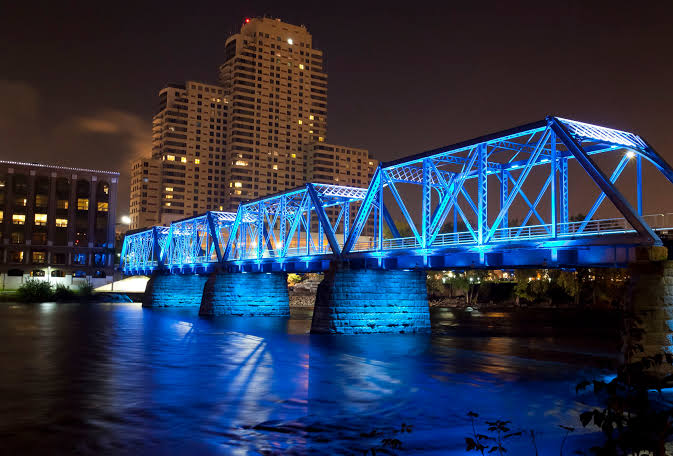
At first glance, the bridge stands out because of its striking color. The blue steel framework creates a dramatic contrast with the dark river, surrounding brick buildings, modern towers, and open sky. During daylight, sunlight reveals the geometric details of the metal trusses. After sunset, decorative lighting gives the bridge an entirely different personality and creates reflections that shimmer across the surface of the river.
The Blue Bridge is more than a convenient crossing. It is a preserved piece of transportation history, a popular photography location, a public gathering place, and an important feature of the downtown landscape. It represents the industrial past of Grand Rapids while also reflecting the city’s transformation into a center for recreation, public art, tourism, education, and entertainment.
Residents regularly use the bridge while walking to work, attending events, exercising, meeting friends, or traveling between downtown attractions. Visitors often discover it while exploring the riverfront, visiting nearby museums, or searching for one of the best views of the Grand Rapids skyline.
The Railroad Origins of the Blue Bridge
Long before the Blue Bridge became a pedestrian attraction, it served the railroad industry. The present structure was built in 1892 as a railroad bridge for the Grand Rapids and Indiana Railroad, a company that played an important role in connecting western Michigan with communities to the north and south.
Railroads were essential to the growth of Grand Rapids during the nineteenth century. They transported passengers, lumber, furniture, agricultural products, machinery, and manufactured goods. The city’s position along several important rail lines helped it become a major commercial and industrial center.
Furniture manufacturers relied on trains to bring raw materials into the city and carry finished products to stores and customers throughout the country. Railroads also brought workers, investors, tourists, merchants, and new residents into Grand Rapids.
The bridge carried trains across the Grand River during a period when steam locomotives, freight cars, and passenger coaches were familiar sights downtown. The heavy steel construction was designed to support the weight and movement of railroad traffic while resisting wind, changing temperatures, and the force of the river below.
Its stone supports and steel trusses reflected the engineering knowledge of the period. The bridge was not designed as a decorative attraction. It was industrial infrastructure created to keep people, products, and businesses moving.
As transportation patterns changed and railroad activity declined in the central city, the bridge eventually stopped serving its original purpose. Instead of demolishing the structure, Grand Rapids preserved and adapted it for public use.
A Classic Steel Truss Design
The Blue Bridge is a steel truss bridge, a design that uses interconnected metal sections to distribute weight and provide structural stability. Its framework creates a repeating pattern of triangles, vertical supports, and horizontal beams.
These geometric shapes are not merely decorative. Triangles help transfer pressure throughout the structure and prevent the bridge from bending under weight. The design allowed engineers to create a strong crossing using a practical amount of steel.
Walking through the bridge gives visitors a close view of its construction. Steel beams rise on both sides of the walkway and connect overhead, forming a tunnel like passage without completely enclosing the bridge. Open spaces between the beams reveal changing views of the river and skyline.
The structure’s industrial appearance connects it to the manufacturing history of Grand Rapids. Steel, stone, rivets, and carefully arranged supports create a visual reminder of an era when factories, rail yards, warehouses, and workshops dominated much of the downtown area.
The bridge also demonstrates the durability of well designed infrastructure. Although its purpose has changed, the basic structure continues to serve the city more than a century after its construction.
The Transformation Into a Pedestrian Crossing
Converting the former railroad bridge into a pedestrian crossing gave the historic structure a new role in downtown Grand Rapids. Instead of carrying locomotives and freight cars, the bridge now welcomes walkers, runners, cyclists, families, students, photographers, and tourists.
This transformation reflects a broader approach to urban development in which older industrial structures are preserved and reused. Former factories can become apartments, warehouses can become restaurants, and railroad bridges can become public walkways.
Adaptive reuse allows cities to maintain visible connections to their past while meeting modern needs. It also prevents historically significant structures from being lost simply because their original functions are no longer necessary.
The Blue Bridge now connects important areas on both sides of the Grand River. Its wide walkway offers enough room for people moving in both directions, although visitors should remain aware of cyclists and others traveling at different speeds.
Benches along or near the crossing provide places to rest, observe the river, and enjoy the surrounding scenery. The absence of automobile traffic creates a calmer environment than the city’s vehicle bridges.
The experience of walking across the Blue Bridge is both practical and recreational. Some people cross it as part of a daily routine, while others visit specifically to explore the landmark and take photographs.
Why the Bridge Was Painted Blue
The bridge’s intense blue color transformed an ordinary piece of industrial infrastructure into a visual symbol. The shade makes the bridge instantly recognizable from the riverfront, surrounding buildings, nearby bridges, and elevated viewpoints.
Blue also creates a natural relationship with the Grand River and the sky. On a clear day, the bridge appears to connect the blue above with the moving water below. During cloudy weather, its color remains bright enough to stand out against the gray atmosphere.
The paint serves an important practical purpose by protecting the steel from moisture and corrosion. Michigan weather exposes outdoor structures to rain, snow, ice, humidity, and changing temperatures. A protective coating helps preserve the metal and extend the life of the bridge.
However, the color does more than protect the steel. It gives the structure character. Without its blue appearance, the bridge might be viewed simply as another former railroad crossing. The color turned it into one of the most photographed and easily identified features of downtown Grand Rapids.
The name Blue Bridge is direct and uncomplicated, but it has become inseparable from the city’s modern image. Residents do not need a formal title to understand which bridge is being discussed.
The Blue Bridge at Night
The Blue Bridge becomes especially dramatic after sunset. Lighting installed along the structure highlights the steel framework and creates a glowing pathway across the river.
From a distance, the illuminated bridge appears to float above the dark water. Reflections stretch across the river and move with the current, producing an attractive scene for evening walks and photography.
Nearby buildings add more light to the landscape. Hotel windows, office towers, streetlights, restaurants, museums, and other bridges create layers of color around the riverfront. The Blue Bridge remains the visual center because its lighting emphasizes the entire structure rather than a single section.
Walking across the bridge at night offers a different experience from visiting during the day. The downtown skyline feels more dramatic, the river appears darker and deeper, and the illuminated steel creates a tunnel of blue light.
Couples often use the bridge as part of an evening downtown, while photographers position themselves on the riverbank or nearby walkways to capture long exposure images. Event crowds may also cross the bridge before or after concerts, festivals, sporting events, and performances.
Visitors exploring after dark should remain aware of their surroundings and follow normal city safety practices. The bridge is an active public space, particularly during busy downtown events.
A Popular Place for Photography
The Blue Bridge is one of the best known photography locations in Grand Rapids. Its color, symmetry, industrial design, and position over the river provide many possibilities for creative images.
A photograph taken directly along the center of the walkway can emphasize repeating steel frames and create a strong sense of depth. Side views reveal the truss design stretching across the river. Lower riverfront viewpoints can capture the stone supports, flowing water, and entire bridge structure.
Sunrise and sunset create particularly attractive lighting. Early morning may provide softer light and fewer pedestrians, while sunset can add warm colors behind the cool blue steel.
Night photography allows the bridge lighting and skyline reflections to become the main subjects. Rain can produce additional reflections on the walkway, while snow gives the bridge a dramatic winter appearance.
The location is also popular for engagement photographs, graduation portraits, family sessions, fashion photography, wedding pictures, and travel images. People frequently use the bridge as a background because it clearly identifies Grand Rapids without requiring a sign or written label.
Each season changes the setting. Spring brings fresh greenery along the river. Summer creates bright skies and active riverfront scenes. Fall adds colorful trees, while winter surrounds the blue steel with snow, ice, and gray skies.
A Connection Between Major Downtown Destinations
The Blue Bridge is conveniently located near several of the city’s leading attractions. Visitors can include the crossing in a larger downtown walking route without making a separate trip.
The Grand Rapids Public Museum stands near the river and offers exhibits related to science, history, culture, transportation, and the development of western Michigan. The Gerald R. Ford Presidential Museum is also located along the riverfront and explores the life and presidency of Gerald R. Ford.
Grand Valley State University’s downtown campus occupies property near the western end of the bridge. Students, faculty members, employees, and visitors regularly use the bridge to move between the campus and the eastern side of downtown.
Restaurants, hotels, entertainment venues, public spaces, and additional museums are within walking distance. Visitors can cross the Blue Bridge, continue along the river, stop for a meal, and attend an event without moving their vehicle.
This location gives the bridge practical importance. It is not isolated from the rest of downtown. It functions as part of a connected network of sidewalks, trails, attractions, and public spaces.
The Bridge and Grand Valley State University
The downtown presence of Grand Valley State University has increased pedestrian activity around the Blue Bridge. The university’s Pew Grand Rapids Campus is located on the west side of the Grand River, near the bridge.
Students use the crossing to reach restaurants, shops, internships, jobs, cultural attractions, and entertainment destinations on the east side. The bridge helps make the downtown campus feel connected to the larger city rather than separated by the river.
The sight of students crossing with backpacks, bicycles, books, and laptops demonstrates how the former railroad structure continues to support transportation. Its users have changed, but the bridge remains part of the movement and daily life of Grand Rapids.
University events also bring visitors to the area. Families attending graduation activities, prospective students touring the campus, and guests visiting academic programs may encounter the bridge during their time downtown.
The connection between historic infrastructure and modern education reflects the larger evolution of the riverfront. Land once dominated by railroads and industry now supports classrooms, public spaces, museums, housing, recreation, and cultural institutions.
Public Events and Community Gatherings
The Blue Bridge frequently serves as more than a route across the river. Its central location and distinctive appearance make it a natural setting for public events and community gatherings.
During major festivals, the bridge may become part of a larger pedestrian route connecting activities on both sides of the river. Art installations, performances, community celebrations, and special lighting displays have brought additional attention to the structure.
The bridge has also been associated with ArtPrize, the large public art event that transformed buildings, parks, sidewalks, and public spaces throughout Grand Rapids into exhibition locations. The bridge’s open walkway and strong visual identity make it well suited for creative installations and public interaction.
Wedding parties, school groups, tourists, runners, and organized walking groups regularly use the crossing. On warm evenings, people may stop to talk, take photographs, watch activity on the river, or listen to sounds from nearby events.
Its openness helps the bridge function as a democratic public space. A person does not need to purchase a ticket, enter a building, or attend a formal program to enjoy it. The experience is available to anyone who walks or rides across.
The Grand River Below the Bridge
The Grand River is the reason Grand Rapids developed where it did. Long before the Blue Bridge existed, the river supported Indigenous communities by providing water, food, transportation, and access to surrounding land.
During the nineteenth century, the river helped power mills and transport timber. Lumber floated downstream toward processing centers, while factories and warehouses developed along the banks.
Industrial activity eventually damaged the river through pollution, construction, and habitat changes. Over time, environmental awareness encouraged efforts to improve water quality, restore natural areas, and provide better public access.
Today, the river beneath the Blue Bridge supports recreation, wildlife, tourism, and community life. Visitors may see kayaks, fishing activity, birds, and changing water levels depending on the season and weather.
The view from the bridge encourages people to consider the relationship between the city and the natural landscape. Downtown buildings rise on both sides, but the river remains the central feature connecting them.
Looking north or south from the bridge reveals additional crossings, pathways, and riverfront developments. The scenery shows how the Grand River continues to influence the shape and movement of the city.
The Bridge as a Symbol of Reinvention
Grand Rapids has repeatedly changed its economy and identity. It grew from a trading settlement into a lumber center, furniture manufacturing capital, regional business hub, and modern center for health care, education, design, tourism, and technology.
The Blue Bridge reflects this pattern of reinvention. It began as railroad infrastructure created for an industrial economy. When trains no longer needed the crossing, the bridge was not treated as useless. It was adapted to serve pedestrians, cyclists, students, residents, and visitors.
Its bright color also represents a shift in how the city views older structures. Industrial infrastructure does not have to remain dull or inaccessible. It can become part of the city’s cultural landscape.
The bridge preserves history without remaining trapped in the past. People can appreciate its railroad origins while using it for modern transportation and recreation.
This balance between preservation and progress is visible throughout Grand Rapids. Former factories now contain apartments and businesses. Historic neighborhoods stand near modern medical buildings. Public art appears beside industrial architecture. The Blue Bridge fits naturally within this changing city.
Visiting the Blue Bridge During Each Season
Every season creates a different experience on the Blue Bridge. Spring brings warmer temperatures, longer days, and new growth along the riverbanks. Rain may raise the river level and deepen the colors of the steel and stone.
Summer is one of the busiest times to visit. Warm weather brings walkers, cyclists, tourists, event crowds, and people enjoying nearby patios and attractions. Early morning or evening visits may be more comfortable during especially hot days.
Fall creates some of the most colorful views. Trees along the river and surrounding areas display shades of yellow, orange, and red. The blue steel forms a striking contrast with the autumn landscape.
Winter transforms the bridge into a colder and more dramatic landmark. Snow may collect along the walkway and steel beams, while ice forms near portions of the river. The blue structure stands out strongly against white snow and cloudy skies.
Visitors should dress appropriately and watch for slippery conditions during winter. Wind can feel stronger over the open river than it does between downtown buildings.
The bridge remains accessible as an outdoor public crossing, but weather, maintenance, events, and temporary restrictions can affect conditions.
Tips for Experiencing the Blue Bridge
The Blue Bridge can be enjoyed quickly, but allowing additional time makes the experience more meaningful. Visitors should walk across in both directions because the skyline and river views change depending on the direction of travel.
Comfortable shoes are useful when combining the bridge with a larger downtown walking tour. Bringing a camera or fully charged phone is also recommended because the location offers numerous photography opportunities.
Morning visits may provide a quieter atmosphere, while afternoons bring more activity. Sunset is ideal for changing light, and evening visits showcase the bridge illumination.
Visitors can begin near the Grand Rapids Public Museum, cross toward the Grand Valley State University campus, and continue along the riverfront. Another option is to combine the bridge with the Gerald R. Ford Presidential Museum, downtown restaurants, Rosa Parks Circle, and the Grand Rapids Art Museum.
Cyclists should travel carefully and respect pedestrians. Walkers should avoid stopping in the center of active traffic paths when taking photographs.
Because the bridge is exposed to the weather, checking conditions before visiting can help. Rain, snow, strong wind, or extreme temperatures may affect comfort.
A Simple Landmark With Lasting Meaning
The Blue Bridge does not require complicated exhibits or elaborate entertainment to make an impression. Its appeal comes from a combination of history, design, color, location, and public accessibility.
It tells the story of an industrial city that depended on railroads to transport people and products. It demonstrates how historic infrastructure can be preserved and given a new purpose. It connects two sides of the Grand River while bringing together residents, students, tourists, artists, photographers, and event visitors.
The bridge has become one of the defining images of Grand Rapids because it represents both continuity and change. Its steel structure belongs to the railroad era, but its present use belongs to a city focused on walkability, recreation, education, culture, and riverfront development.
For some people, the Blue Bridge is part of a daily commute. For others, it is a romantic evening destination, a photography background, a festival gathering place, or a memorable stop during a first visit to Grand Rapids.
No matter how it is experienced, the bridge provides a clear view of the city’s relationship with the Grand River and its ability to transform the past into something useful, beautiful, and welcoming.
An Essential Stop in Downtown Grand Rapids
A visit to the Blue Bridge is one of the easiest and most rewarding activities in downtown Grand Rapids. It is free, centrally located, visually distinctive, and connected to several major attractions.
The bridge allows visitors to pause above the Grand River and observe the city from a perspective that cannot be experienced from a car. Its steel framework frames pieces of the skyline, while the water below introduces movement and natural beauty into the urban environment.
Walking across takes only a few minutes, but the history behind the structure extends through more than a century of change. Trains once carried passengers and freight over the same river. Today, footsteps, bicycles, conversations, cameras, and community events bring new life to the crossing.
The Blue Bridge remains one of the finest examples of how Grand Rapids preserves its industrial heritage while creating public spaces for the future. It is practical, historic, colorful, and unmistakably connected to the identity of the city.
Discover more from City Towner
Subscribe to get the latest posts sent to your email.