The Burger Chef Murders in Speedway Indiana
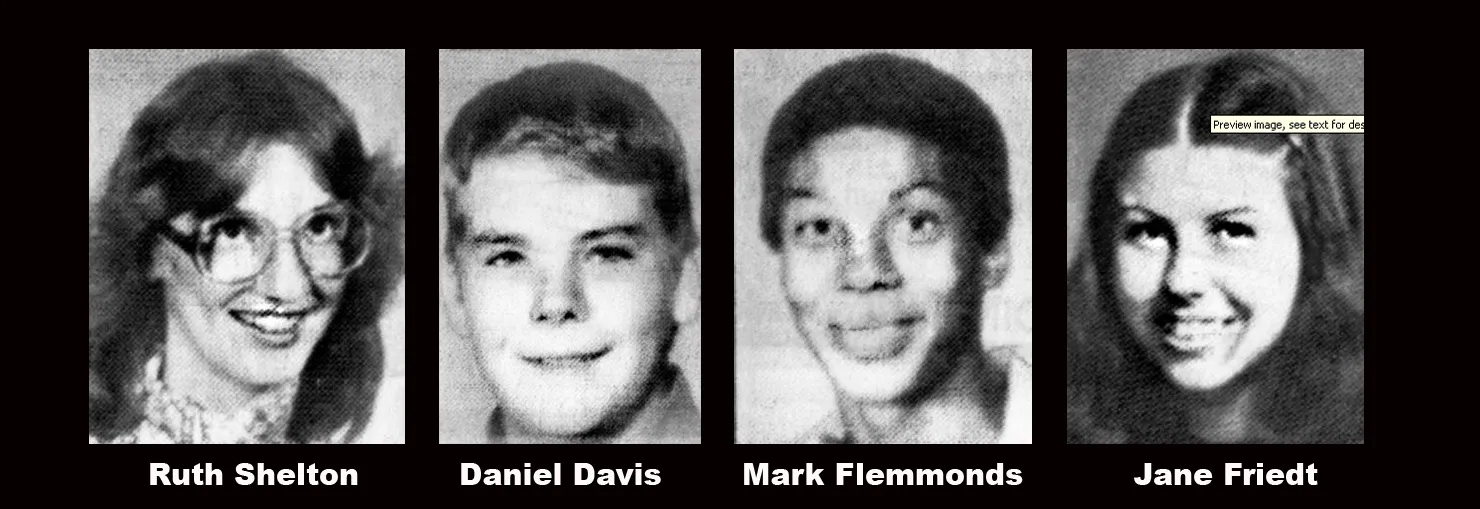
The Burger Chef murders remain one of Indiana’s most haunting unsolved crimes, a case that has lingered in public memory for decades because of its cruelty, its victims’ youth, and the many questions that still have not been answered. What began as a routine closing shift at a fast food restaurant in Speedway, Indiana, turned into a nightmare that ended with four young employees dead in Johnson County. The victims were Jayne Friedt, 20, Ruth Ellen Shelton, 17, Daniel Davis, 16, and Mark Flemmonds, 16. Their lives were cut short in a case that shocked the state and became one of the most infamous unsolved mass murders in Indiana history.
The story is especially disturbing because it started in such an ordinary setting. A restaurant closing at the end of the night is the sort of scene that is repeated thousands of times every day across the country. Young workers clean counters, count money, take out trash, and prepare to go home. There is a built in sense of normalcy in those final hours of a work shift. In the Burger Chef case, that normalcy was shattered in the most brutal way possible. Instead of going home after work, four teenagers and young adults vanished from the restaurant, and two days later their bodies were found in Johnson County, Indiana.
This case continues to grip the public because it carries all the elements of a true American tragedy. The victims were young and working ordinary jobs. The crime scene was mishandled in the early stages. Potential evidence was compromised. Suspects emerged over the years, but no one was ever convicted. Time has passed, but the emotional weight of the case has not lessened. The Burger Chef murders remain a symbol of stolen youth, investigative frustration, and the enduring pain of families who never received full justice.
The Four Young Victims
The human center of this case is found in the lives of the four victims. Jayne Friedt was 20 years old, the oldest of the group. Ruth Ellen Shelton was 17. Daniel Davis was 16, and Mark Flemmonds was also 16. Each of them was young, with a future that should have stretched far beyond that November weekend. They were not public figures or people who expected their names to live on in headlines and documentaries. They were working people, young employees doing a job, and that is part of what makes the case so heartbreaking.
When people think about major murder cases, they often focus on the mystery, the suspects, and the investigation. Those things matter, but they can overshadow the victims themselves. In the Burger Chef case, it is important to remember that these were four individuals with families, routines, personalities, and plans. They were part of the everyday life of their community. Their deaths were not only a public crime story. They were a private devastation for parents, siblings, relatives, friends, classmates, and coworkers.
The ages of the victims make the crime especially painful to reflect on. Three of the four were teenagers. They were at an age when life is usually filled with beginnings. There are school plans, friendships, first jobs, early independence, and the slow excitement of becoming an adult. Jayne, at 20, was also still very young, standing at the threshold of a life that should have been long and full. The fact that all four were killed together gives the case a collective sorrow that is difficult to put into words. It was not one family shattered by loss. It was multiple families, all struck at once.
The Closing Shift in Speedway
The events that led to the murders began at the Burger Chef restaurant in Speedway, Indiana. The restaurant sat on Crawfordsville Road, and on the night of November 17, 1978, the four young employees were working the closing shift. There was nothing outwardly extraordinary about that assignment. Restaurants close every night, and the tasks are often predictable. Money is counted. Equipment is cleaned. Doors are locked. Workers leave for home.
At some point during that night, something went terribly wrong. When others came to the restaurant, signs suggested that the expected closing routine had been interrupted. The back door was open. The safe had been emptied or exposed. A company car, a Chevy Vega, was later found abandoned. The four employees were gone. In the earliest moments, investigators reportedly considered the possibility that the young workers had taken money and left voluntarily. That assumption would become one of the most criticized aspects of the case, because it shaped the initial response during a crucial window of time.
The possibility that the victims had simply left on their own now seems tragically misguided in hindsight. What was actually unfolding was far more sinister. The four employees had not abandoned their duties for some impulsive escape. They had been taken from the restaurant and driven away from the place where they should have been safe enough to finish work and return home. The closing shift at Burger Chef became the starting point of a crime that would reverberate far beyond Speedway.
The Discovery in Johnson County
On November 19, 1978, two days after the abduction, the bodies of Jayne Friedt, Ruth Ellen Shelton, Daniel Davis, and Mark Flemmonds were found in Johnson County, Indiana. That discovery turned a missing persons crisis into a full scale murder investigation. Any lingering hope that the four might still be alive disappeared the moment their bodies were recovered.
The recovery site in Johnson County added another layer of dread to the case. The victims had not only been taken from their workplace, but transported away from Speedway to a more isolated location. That suggested planning, movement, and enough control by the offenders to relocate four young victims. The crime was no longer a mysterious disappearance from a restaurant. It was a coordinated, violent act that extended across county lines and ended in a rural area far from where the young workers had last been seen.
Reports over the years have described the victims as having been killed in different ways, which has only deepened the sense of brutality surrounding the case. The varying methods of death have often been cited as evidence of the chaotic and vicious nature of the murders. The crime scene in Johnson County became the final chapter of the victims’ last hours, but not the final chapter of the story itself. Instead, it became the center of a decades long mystery in which the full truth never emerged in court.
A Case Damaged in Its Earliest Hours
One of the most painful aspects of the Burger Chef murders is the widespread belief that the case was damaged almost from the beginning. Early investigative mistakes have been discussed for years and are often mentioned whenever the case is revisited. The first major problem was the initial assumption that the employees may have stolen money and gone off on their own. That belief appears to have delayed the urgency that should have accompanied the disappearance of four young workers from a restaurant closing shift.
Another major issue involved the handling of the restaurant itself. The Burger Chef was cleaned and reopened before a full forensic understanding of the scene had been secured. In any major violent crime, the original scene can contain priceless evidence. Fingerprints, footprints, fibers, blood traces, disturbed objects, and tiny details can all shape the direction of an investigation. Once a scene is altered, those clues may be lost forever. In the Burger Chef case, this point has haunted the investigation for decades because it raises the question of what might have been found if the site had been preserved more carefully.
The recovery site in Johnson County also suffered from problems. Reports have long indicated that the area was not protected in the way a modern major crime scene would be. Vehicles and other disturbances reportedly affected the site, creating yet another layer of loss in a case already struggling for answers. These errors do not mean the murders could certainly have been solved if everything had been handled perfectly, but they do mean the investigation faced steep disadvantages before it had even fully taken shape.
Theories, Suspects, and False Starts
Over the years, the Burger Chef murders generated numerous theories, suspects, and leads. Some ideas focused on robbery, suggesting the offenders targeted the restaurant and then escalated to abduction and murder. Others proposed that one or more of the victims may have been known to the killers. Because the crime involved four victims being removed from a public business and driven elsewhere, many observers have long believed the offenders were bold, experienced, or both.
At different points, names surfaced in connection with the case, and one of the most well known turns came years later when an inmate confessed. That confession drew attention because it seemed to include details that investigators took seriously enough to pursue. Yet it ultimately did not produce charges that held. Like so many moments in this case, it offered the appearance of possible progress without delivering a final resolution. The confession became another example of hope rising and then collapsing.
Retired investigators have also spoken publicly about their belief that they developed a strong idea of who was responsible, but belief and proof are not the same thing. In murder cases, especially ones this old, prosecutors need evidence that can stand up in court. Suspicion, even educated suspicion, does not automatically become justice. That gap between what may be privately believed and what can be publicly proven is one of the reasons the Burger Chef murders remain unsolved despite decades of attention.
The Fear This Crime Created
The murders of four young restaurant workers in one case created deep public fear. Crimes involving multiple victims often leave a wider emotional impact because they suggest a level of danger that feels unusually extreme. This was not a single isolated attack hidden from public view. It began at a familiar roadside restaurant, a place where customers came for food and teenagers came to work. That made the crime feel close to ordinary life in a way that terrified people.
Parents likely looked at their own teenagers differently after the news broke. A late shift at a restaurant, something that normally might have seemed like a harmless first job, suddenly looked far more dangerous. Communities often rely on a shared confidence that public spaces are reasonably safe and that work routines carry a certain predictability. The Burger Chef case shattered that confidence. It showed that even a well lit commercial setting could become the starting point for a horrifying crime.
The emotional aftershock lasted because there was no arrest to restore order. In some murder cases, a suspect is caught quickly, and while the grief remains, the public fear begins to settle into a narrative with a known culprit. That did not happen here. Instead, uncertainty lingered. People were left knowing that whoever committed the abductions and murders had not been conclusively brought to justice. That unresolved fact helped the case stay alive in public memory for years.
The Weight of an Unsolved Crime
There is a particular kind of pain that comes with an unsolved murder. Grief is mixed with uncertainty, and mourning becomes tangled with the constant question of who did it and why. For the families of Jayne Friedt, Ruth Ellen Shelton, Daniel Davis, and Mark Flemmonds, the years after November 19, 1978, could never have been ordinary. Every anniversary would return them to the same terrible facts. Their loved ones had been abducted from work, murdered, and left in Johnson County. No courtroom verdict came to close that wound.
Cases like this also take on a broader symbolic meaning. The Burger Chef murders came to represent not only the loss of four young lives, but also the consequences of investigative failure and the fragility of justice when early decisions go wrong. The case became a reminder that time can be both an ally and an enemy. It can bring fresh witnesses, changing loyalties, and renewed public attention, but it can also erode memory and make physical evidence harder to use.
Despite the passage of decades, the case remains compelling because it sits at the intersection of innocence and violence. The victims were doing something ordinary. The crime that overtook them was extraordinary in its ruthlessness. That contrast is one reason the story continues to resonate. It is not only about what happened in 1978. It is also about what never happened afterward. No full accountability. No clear public conclusion. No final answer that could match the enormity of the loss.
Why the Burger Chef Murders Still Endure
The abduction and murders of Jayne Friedt, Ruth Ellen Shelton, Daniel Davis, and Mark Flemmonds continue to endure in public memory because the case refuses to become just another old file. It remains vivid. The victims were young. The setting was ordinary. The crime was shocking. The investigation was troubled. Every one of those elements gives the story staying power.
There is also something deeply American about the image at the center of the case. A roadside fast food restaurant. Teen workers closing up for the night. Families expecting them home. A vehicle left behind. A quiet county where bodies are found. The details are so grounded in everyday life that they become even more disturbing. This was not a remote mystery detached from common experience. It unfolded in a world people recognized immediately.
As long as the case remains unsolved, it will continue to stand as one of Indiana’s darkest and most tragic criminal mysteries. The names Jayne Friedt, Ruth Ellen Shelton, Daniel Davis, and Mark Flemmonds still matter because they were not statistics. They were four young people whose lives ended in fear and violence, and whose families were left with grief that never received the full answer it deserved.
A Lasting Shadow Over Johnson County and Speedway
The final geography of the Burger Chef murders links two Indiana places forever. Speedway is where the victims worked, where the disappearance began, and where the first signs of catastrophe emerged. Johnson County is where the murders came into terrible focus, where the bodies were found, and where the case took on its lasting shape as an unsolved mass killing. Those two locations remain joined in memory by what happened in November 1978.
The story still carries weight because it is unfinished. A crime of this scale seems as though it should have produced a neat ending, a named killer, a trial, and a verdict. Instead, what remains is a haunting absence. The known facts are clear enough to horrify, but incomplete when it comes to justice. Four young Burger Chef employees vanished from work. Two days later they were found murdered in Johnson County. That truth is devastating, but it is not the whole answer.
Until a conclusive resolution is reached, the Burger Chef murders will remain a lasting shadow over Indiana history. They are remembered not only for the brutality of the crime, but for the lives cut short and the silence that followed. The passage of time has not erased that silence. It has only made it heavier.
Discover more from City Towner
Subscribe to get the latest posts sent to your email.