History of Peoria Arizona
The history of Peoria, Arizona begins long before the community received its name or appeared on a territorial map. The land that eventually became Peoria was part of the broad Salt River Valley, a desert region shaped by mountain ranges, seasonal waterways, extreme heat, and long periods of limited rainfall.
Indigenous peoples lived in central Arizona for thousands of years and developed sophisticated ways of surviving in the Sonoran Desert. Among the best known early cultures of the region were the Hohokam, whose communities constructed extensive canal systems that carried water from rivers to agricultural fields.
These canals made it possible to grow crops in an environment where dependable rainfall was rare. Corn, beans, squash, cotton, and other plants were cultivated through careful irrigation. Villages were established near water sources, while trade networks connected communities throughout what is now Arizona and neighboring regions.
The canal building traditions of the Hohokam demonstrated that the Salt River Valley could support permanent agriculture when water was properly managed. Centuries later, American settlers and developers followed many similar routes while building modern irrigation systems.
The land around present day Peoria was also connected to the history of the Yavapai, O’odham, and other Indigenous peoples whose lives were shaped by the desert, mountains, plants, animals, and waterways of central Arizona. Their presence forms the earliest and longest chapter in the history of the region.
Arizona Territory and the Search for Water
Arizona became a separate United States territory on February 24, 1863. During the following decades, military posts, mining camps, ranches, farms, and small settlements appeared across the territory.
Central Arizona attracted settlers because of its warm climate, open land, and agricultural potential. However, farming on a large scale was impossible without dependable irrigation. Water became the deciding factor in whether a community could survive.
The Salt River Valley contained fertile soil, but the desert climate created serious challenges. Summers were extremely hot, rainfall was limited, and natural streams could not always provide a steady supply of water. Investors and land developers understood that canals would be necessary to transform dry desert land into productive farms.
One of the most important figures in this effort was William John Murphy, a businessman and engineer who became involved in the construction of the Arizona Canal. Murphy believed that the canal could open thousands of acres north and west of Phoenix to agriculture and permanent settlement.
The Arizona Canal was completed in 1885. Its arrival changed the future of the region by carrying Salt River water across previously dry land. Areas that had appeared unsuitable for farming could now support crops, livestock, homes, and communities.
The canal became the foundation for the settlement that would eventually become Peoria.
The Founding of Peoria in 1886
After the Arizona Canal was completed, William John Murphy traveled east to encourage people to purchase and settle land in the Salt River Valley. His efforts attracted interest from residents of Peoria, Illinois.
In 1886, four farming families from Illinois relocated to Arizona and established homes in the newly irrigated district. The settlers named their community Peoria after the Illinois city they had left behind.
The move required courage and patience. Arizona was still a sparsely populated territory, transportation was limited, and the environment was dramatically different from the Midwest. The settlers faced intense heat, desert conditions, unfamiliar wildlife, and long distances between established communities.
They also saw opportunity. Irrigation water created the possibility of productive farmland, while the growing Phoenix area offered a market for crops and livestock. Families cleared land, built houses, planted fields, and created the beginnings of a permanent agricultural settlement.
Peoria did not immediately develop into a concentrated town. Many settlers lived on farms spread across the surrounding countryside. The community consisted of agricultural properties connected by rough roads, irrigation canals, family relationships, and shared institutions.
The year 1886 is generally recognized as the founding year of Peoria, even though the formal townsite was not established until later.
The First Roads, Wells, and Community Services
A permanent community needed more than farmland. Residents required roads, drinking water, mail service, schools, churches, stores, and transportation connections.
Grand Avenue became one of the most important roads through the area. Established during the late 1880s, it connected Peoria with Phoenix and other communities in the Salt River Valley. The road later developed into a major transportation corridor and remained central to Peoria’s commercial life.
A community well was established near the early town center. The well supplied water to residents and travelers at a time when modern water systems did not exist. It became an important gathering point and helped define the location of the settlement.
Postal service began in 1888, giving Peoria a clearer identity and connecting residents with distant family members, businesses, government offices, and newspapers. A post office was a meaningful sign that the community was becoming permanent.
Early settlers depended heavily on one another. Families shared labor, tools, transportation, information, and assistance during emergencies. Community cooperation was necessary because professional services were limited and established towns were often far away.
These early improvements helped Peoria grow from a loose collection of farms into a recognizable settlement.
The Arrival of the Railroad
Railroad development was another major turning point in Peoria’s history. During the 1890s, rail lines expanded through central and northern Arizona, connecting agricultural communities with larger markets.
A railroad route through Peoria provided farmers with a more efficient way to transport crops, livestock, and supplies. Before rail service, moving goods across long distances was slow and expensive. Trains made it possible to send agricultural products to Phoenix, Prescott, and other regional destinations.
The Peoria railroad depot was built in 1895. The depot became an important center of transportation and community activity. Passengers boarded trains, mail arrived, freight was unloaded, and farmers shipped products from the surrounding area.
The railroad encouraged commercial development near the tracks. Businesses benefited from access to travelers and freight, while residents gained better connections to other parts of Arizona.
Rail service also influenced the physical layout of Peoria. Grand Avenue and the railroad corridor became central features around which homes, stores, warehouses, and public buildings developed.
For decades, the sound of trains was a familiar part of daily life. The railroad represented connection, commerce, and access to the outside world.
The Establishment of the Original Townsite
The original Peoria townsite was officially platted in 1897. This process created an organized plan of streets, blocks, lots, and public areas.
The townsite developed near the intersection of Grand Avenue and Peoria Avenue. This location became the historic center of the community and is now commonly associated with Old Town Peoria.
The formal town plan allowed land to be divided and sold more systematically. Stores, homes, churches, schools, and other structures began appearing within a more concentrated area.
Although many residents continued living on farms outside the town center, the townsite became the location for commerce, education, worship, public meetings, and social activity.
The community remained small, but its identity became stronger. Peoria was no longer simply a farming district named by settlers from Illinois. It was becoming a town with streets, institutions, businesses, and a shared sense of place.
Agriculture Becomes the Economic Foundation
Agriculture dominated Peoria’s economy during its early history. Irrigation transformed desert soil into productive farmland, allowing farmers to grow crops and raise livestock.
Alfalfa became especially important because it could be used as animal feed and grown successfully in the warm climate. Farmers also produced wheat, barley, cotton, citrus fruit, vegetables, and other crops depending on market conditions and available water.
Dairy farming became a significant part of the local economy. Cattle could be supported by irrigated feed crops, and dairy products were in demand throughout the growing Phoenix region.
Cotton became particularly important during periods when prices and national demand were high. The crop required substantial labor and water, but it provided income for many landowners and workers.
Agricultural life was demanding. Farmers worked during intense summer heat, maintained canals and ditches, protected crops from pests, and depended on reliable access to water. Equipment was limited during the early years, requiring much of the work to be performed by hand or with horses and other animals.
The success of Peoria depended on the relationship between water, land, labor, and transportation. The Arizona Canal supplied irrigation, farms produced valuable goods, and the railroad carried those goods to market.
Churches and the Development of Community Life
Churches played an important role in early Peoria. They provided places for worship, education, social gatherings, weddings, funerals, charitable work, and community discussions.
The Peoria Presbyterian Church was built in 1899 and became one of the most important surviving structures from the original townsite. Its presence reflected the values and religious traditions of many early settlers.
Churches often performed functions that extended beyond religion. In small agricultural communities, they helped families form relationships and provided support during illness, financial hardship, crop failure, and personal loss.
Social events organized through churches gave residents opportunities to gather after long periods of farm work. Meals, holiday programs, musical performances, and community meetings strengthened local relationships.
As Peoria became more diverse, additional congregations and religious traditions appeared. Churches remained important institutions throughout the city’s transition from a rural settlement to a modern suburb.
The Growth of Education in Peoria
Education became a priority for Peoria’s early families. Children initially attended classes in small facilities with limited supplies and few teachers.
Peoria Central School was built in 1906 as a 2 room schoolhouse. The building represented the community’s commitment to creating a permanent educational system.
Teachers often instructed students of different ages and grade levels in the same room. Schools taught reading, writing, arithmetic, history, geography, and practical subjects. Attendance could be interrupted when children were needed to assist with farm work.
As the population increased, larger schools were required. Peoria High School opened during the early twentieth century and became an important institution for students across the area.
The Peoria Unified School District eventually grew far beyond its rural origins. As residential development spread across the northwest Valley, the district added elementary schools, middle schools, high schools, athletic programs, and specialized educational services.
Historic school buildings became physical reminders of how a small farming settlement developed into a large suburban community.
Arizona Statehood and a Changing Region
Arizona entered the Union as the forty eighth state on February 14, 1912. Statehood brought greater political representation, expanded government institutions, and increased national attention.
Peoria remained primarily agricultural during the early years of statehood. The town was surrounded by fields, irrigation canals, livestock, and open desert.
Phoenix continued to grow southeast of Peoria, creating larger markets for agricultural products. Improvements to roads and vehicles allowed residents to travel more easily between communities.
Electricity, telephones, motor vehicles, and modern farm machinery gradually changed daily life. These technologies reduced isolation and increased productivity, although they did not reach every family at the same time.
Peoria’s residents experienced the same national events that affected communities throughout the country, including World War I, the influenza pandemic, economic changes, and shifting agricultural prices.
Despite these changes, Peoria maintained its identity as a close agricultural community where families often knew one another through schools, churches, farms, and local businesses.
The Destructive Fire of 1917
Fire was a constant threat to early towns because many buildings were constructed of wood and firefighting resources were limited.
In July 1917, a major fire destroyed much of Peoria’s commercial district. The flames spread through businesses near the center of town, causing significant property loss.
The fire demonstrated the vulnerability of small communities without professional fire departments, modern water systems, and fire resistant construction. Once flames reached neighboring buildings, residents had few effective ways to stop them.
Although the destruction was serious, Peoria rebuilt. New businesses and structures appeared, and the town continued serving the surrounding agricultural region.
The rebuilding process showed the resilience of local residents. Fires, droughts, floods, crop failures, and economic downturns were all part of life in the desert Southwest, and survival often depended on cooperation.
Peoria During the Great Depression
The Great Depression created hardship throughout Arizona after 1929. Agricultural communities were affected by falling prices, reduced demand, debt, and unemployment.
Peoria families relied on farming, informal trade, family support, and community assistance. Some households grew food for their own use, repaired equipment rather than replacing it, and shared resources with neighbors.
Federal relief programs created jobs and funded public projects across Arizona. Roads, schools, parks, and other forms of infrastructure were improved during the period.
The Peoria Jail House was built in 1939. The small structure was used for law enforcement purposes and also served as a meeting place for community government.
The Depression years tested Peoria’s economy, but agriculture continued to provide a measure of stability. Families who controlled productive land and had access to water could still produce food, even when market prices were low.
World War II and the Transformation of Arizona
World War II accelerated economic and population growth throughout Arizona. Military bases, airfields, defense industries, and training facilities brought workers and service members to the state.
Peoria residents served in the armed forces, worked in agriculture, and supported wartime programs. Farmers were encouraged to increase production to supply food and materials for the national effort.
The greater Phoenix area expanded as military personnel, defense workers, and their families arrived. Many people discovered Arizona during the war and returned after military service ended.
Air conditioning technology also improved, making life in the desert more comfortable and allowing businesses and homes to operate more effectively during summer.
These changes prepared the Salt River Valley for the enormous growth that followed World War II. Peoria was still a farming community, but the expanding metropolitan region was moving steadily toward it.
Incorporation as a City in 1954
By the early 1950s, Peoria residents recognized the need for a formal municipal government. Growth created demand for improved roads, utilities, police protection, fire services, planning, and local decision making.
Peoria was incorporated on June 7, 1954. At the time, the new city covered a relatively small area and had fewer than 2,000 residents.
A 7 member city council was organized to guide municipal affairs. Incorporation gave Peoria the legal authority to provide services, collect revenue, regulate development, and plan for future expansion.
The decision proved important because suburban growth was beginning to reshape the western portion of the Phoenix metropolitan area. Without an organized city government, Peoria would have had less control over land use and public services.
The community that had begun with farming families from Illinois was now officially a city.
Peoria as the Rose Capital of the World
During the 1950s, Peoria became known for commercial rose production. The climate, irrigation system, and agricultural experience of local growers supported large fields of roses.
In 1956, Peoria was promoted as the Rose Capital of the World. Rose farms became an important part of the local landscape and economy.
The flowers were grown for commercial sale and shipped to customers beyond Arizona. Rows of colorful blooms created a striking contrast with the surrounding desert.
The rose industry represented a distinctive chapter in Peoria’s agricultural history. It demonstrated how irrigation and specialized knowledge could support crops that might seem unexpected in an arid environment.
As residential development increased and farmland became more valuable for construction, many rose fields disappeared. However, the Rose Capital identity remained part of local memory.
The Arrival of Modern City Services
Incorporation allowed Peoria to develop the services required by a growing population. Roads were paved, water systems expanded, and municipal departments became more professional.
A major sewer system was completed in 1969 after voters approved funding for the project. Reliable wastewater service was essential for larger residential subdivisions and commercial development.
Fire protection also changed. Early residents had depended on volunteers and limited equipment. Peoria began moving toward a paid professional firefighting staff during the 1970s.
Police services expanded as the city grew. New neighborhoods, businesses, schools, and roads created demands that could no longer be handled by the small systems of the farming era.
Parks, libraries, recreation programs, building inspections, and planning services also became more important. Peoria was slowly developing the administrative structure of a modern municipality.
Suburban Growth Replaces Agricultural Land
The growth of metropolitan Phoenix changed Peoria dramatically during the second half of the twentieth century.
Affordable land, warm winters, new highways, air conditioning, and employment opportunities attracted residents from other states. Developers purchased farms and desert acreage for housing subdivisions, shopping centers, schools, and office buildings.
Fields that had once produced cotton, alfalfa, citrus fruit, and roses were gradually replaced by streets and homes. Irrigation canals remained visible in some areas, but the landscape became increasingly suburban.
The expansion was not limited to the original townsite. Peoria annexed land northward, eventually creating a long and unusually shaped municipal boundary.
The older section near Grand Avenue remained connected to the city’s agricultural and railroad past, while newer communities featured planned subdivisions, shopping districts, parks, and wide roads.
Population growth changed Peoria’s identity. It was no longer a small farming town separated from Phoenix by open fields. It had become an important part of the metropolitan area.
Lake Pleasant and the Expansion to the North
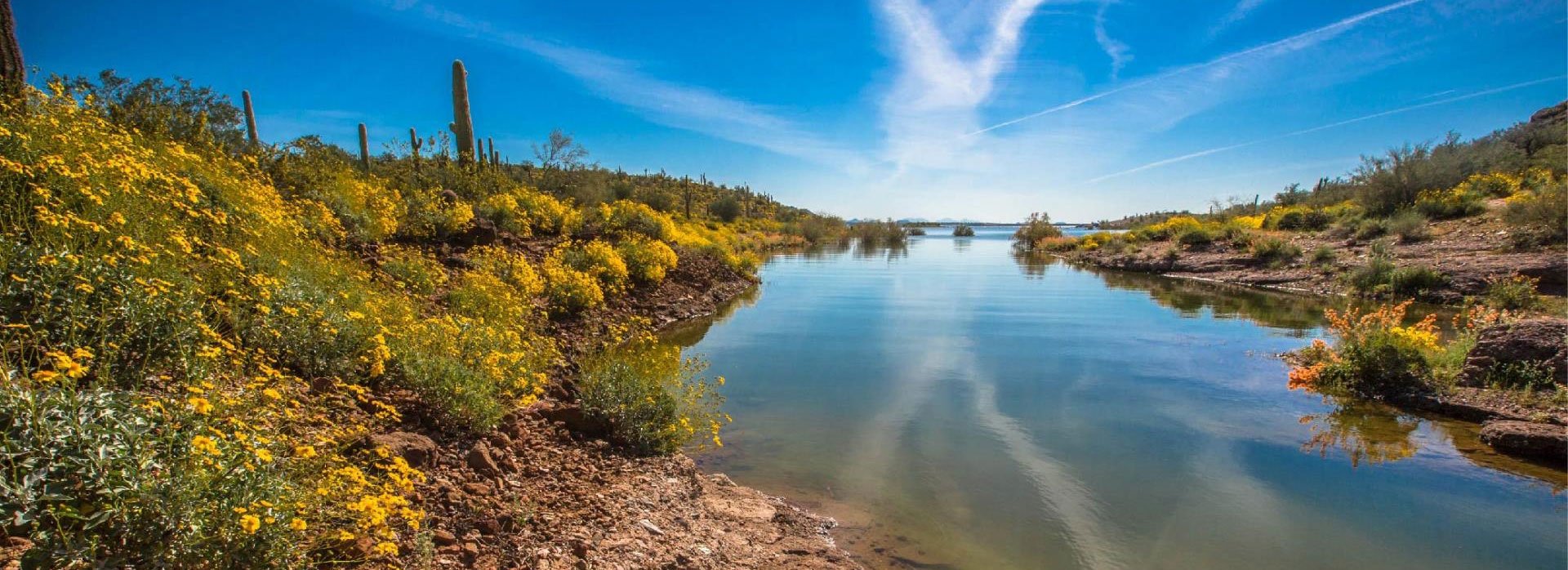
Northern Peoria includes large areas of desert, foothills, and land near Lake Pleasant. This region differs considerably from the historic town center.
Lake Pleasant began as a reservoir created by a dam on the Agua Fria River. Later expansion increased its size and importance as part of Arizona’s water system.
The lake also became a major recreation destination. Boating, fishing, camping, hiking, swimming, and wildlife viewing attracted residents and visitors.
As Peoria annexed territory toward Lake Pleasant, the city gained access to scenic desert landscapes and new development opportunities. Residential communities appeared near mountain views, open desert, and recreational areas.
The northward expansion created a city with multiple geographic identities. Southern Peoria reflected the older agricultural community and suburban growth, while northern Peoria contained newer neighborhoods, desert preserves, commercial development, and access to the lake.
Water remained central to Peoria’s story. The Arizona Canal made the original settlement possible, while Lake Pleasant became important to the modern city’s recreation and regional water planning.
The Peoria Sports Complex Changes the City’s Image
The Peoria Sports Complex opened in 1994 and became one of the city’s most recognizable attractions.
The facility was designed to serve as the shared spring training home of the Seattle Mariners and San Diego Padres. It was the first Major League Baseball spring training complex specifically designed for use by 2 teams.
Spring training brought fans, players, coaches, media representatives, and tourism revenue to Peoria. Hotels, restaurants, stores, and entertainment businesses benefited from the annual arrival of baseball visitors.
The complex also helped create a new commercial and entertainment district in northern Peoria. Retail centers, restaurants, theaters, and other businesses developed nearby.
Baseball gave Peoria a regional and national identity beyond agriculture and suburban housing. The city became known as a destination where fans could watch professional teams prepare for the regular season in a relaxed setting.
The Sports Complex continues to connect Peoria with Arizona’s long tradition of Cactus League baseball.
Historic Preservation in Old Town Peoria
Rapid growth created concern that Peoria’s oldest buildings and stories might disappear. Farms were sold, businesses changed, and historic structures faced demolition or neglect.
The Peoria Arizona Historical Society was formed in 1990 by residents committed to preserving local history. The organization collected documents, photographs, tools, furniture, clothing, agricultural equipment, and family records.
Historic buildings in Old Town Peoria became important reminders of the community’s early years. The former Peoria Central School was converted into a museum, allowing visitors to learn about education, agriculture, transportation, and daily life.
The old jail, historic churches, commercial buildings, and the original street pattern helped preserve the character of the early townsite.
Historic preservation is challenging in a fast growing city. Land values, redevelopment plans, maintenance costs, and safety concerns can place older structures at risk.
However, preserving selected buildings allows residents to see physical evidence of the city that existed before freeways, subdivisions, sports complexes, and large shopping centers.
Peoria in the New Millennium
During the early twenty first century, Peoria continued growing in population, land area, and economic importance.
New residential communities expanded across northern portions of the city. Some developments were designed around golf courses, parks, trails, schools, and community centers.
Commercial districts offered shopping, dining, entertainment, health care, and professional services. The city worked to attract employers and reduce dependence on jobs located elsewhere in the Phoenix metropolitan area.
Cultural programs also expanded. The Peoria Center for the Performing Arts provided space for theatrical productions, music, education, and community events.
Public art, parks, libraries, recreation facilities, and youth programs became increasingly important to the city’s identity.
Peoria faced many of the same challenges affecting other rapidly growing Arizona communities. These included traffic congestion, water supply, housing affordability, environmental protection, extreme heat, and the cost of providing services across a large geographic area.
The Importance of Water Throughout Peoria’s History
No subject is more important to Peoria’s history than water.
The region’s Indigenous inhabitants built canals to support agriculture centuries before American settlement. The completion of the Arizona Canal in 1885 allowed farming families to establish the modern community.
Irrigation supported crops, dairies, orchards, rose farms, and livestock. Water systems later made suburban housing and commercial development possible.
Lake Pleasant became part of the region’s larger water infrastructure while also serving as a major recreational resource.
As Peoria continues to grow, water conservation remains essential. Arizona faces long term concerns involving drought, river supplies, groundwater, climate conditions, and increasing demand.
Modern residents experience a city filled with homes, parks, businesses, pools, and landscaped areas, but this urban environment exists only because generations of people created systems to capture, transport, store, and manage water.
Peoria’s history is therefore a history of adapting to the desert through engineering, agriculture, planning, and conservation.
A City of Contrasting Landscapes
Peoria is unusual because its boundaries include several distinct environments.
Old Town preserves reminders of the original railroad and agricultural settlement. Southern neighborhoods reflect the suburban expansion of the twentieth century. Central commercial districts contain entertainment, retail, restaurants, and sports facilities.
Northern Peoria includes master planned communities, open desert, mountain views, trails, and access to Lake Pleasant.
These contrasting areas demonstrate how dramatically Peoria changed after its founding. A person traveling from the historic town center to the northern edge of the city passes through more than a century of development patterns.
The city’s shape also reveals the influence of annexation. Peoria expanded northward over many years, creating connections between the original farming community and distant desert land.
This geography gives Peoria a complex identity. It is simultaneously a historic agricultural town, a Phoenix suburb, a sports destination, a desert community, and a gateway to outdoor recreation.
Remembering the People Who Built Peoria
The history of Peoria is often described through canals, railroads, farms, buildings, and municipal expansion. However, the city was built by people.
Indigenous communities first learned how to cultivate crops and survive in the desert environment. Engineers and laborers constructed the canals that carried water across the valley.
Farming families cleared fields, planted crops, maintained irrigation ditches, and raised livestock. Railroad workers moved passengers and goods through the community.
Teachers educated children in small classrooms. Business owners served residents and travelers. Religious congregations provided spiritual guidance and social support.
Mexican and Mexican American laborers made major contributions to agriculture, construction, railroads, domestic work, and local commerce. Their labor helped sustain the economy, although their experiences were not always fully represented in traditional historical accounts.
Later generations built roads, operated city departments, developed neighborhoods, opened businesses, coached athletic teams, created cultural programs, and preserved local landmarks.
Peoria’s transformation was not the work of a single founder or government. It was the result of generations of labor, risk, cooperation, disagreement, and adaptation.
From Farming Settlement to Modern Arizona City
Peoria began in 1886 as a small agricultural settlement made possible by the Arizona Canal. Families from Peoria, Illinois gave the community its name, but the deeper history of the land extended back thousands of years.
The railroad helped farmers reach distant markets. Schools, churches, wells, roads, and businesses turned scattered farms into a town. Agriculture remained the foundation of the economy for decades.
Incorporation on June 7, 1954 gave residents greater control over public services and future development. The arrival of subdivisions, shopping centers, highways, and modern utilities transformed the rural landscape.
The opening of the Peoria Sports Complex in 1994 introduced a new identity based on baseball, entertainment, and tourism. Expansion toward Lake Pleasant connected the city with desert recreation and large planned communities.
Throughout every stage, water determined what was possible. Canals supported the first farms, municipal systems supported suburban growth, and regional reservoirs helped prepare for the future.
Modern Peoria is one of the major cities of the Phoenix metropolitan area, but signs of its earlier life remain. Old Town streets, historic school buildings, railroad memories, churches, canals, and preserved artifacts tell the story of a community that grew from irrigated farmland into a large and diverse desert city.
Peoria’s history is ultimately a story of transformation. It reveals how water, agriculture, transportation, migration, technology, and metropolitan growth reshaped a small Arizona settlement while leaving behind a heritage that continues to influence the city today.
Discover more from City Towner
Subscribe to get the latest posts sent to your email.