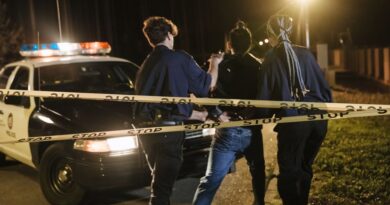

Theresa Rodger Strangled to Death on Rooftop in Brooklyn New York
On October 20, 1971, 17-year-old Theresa Rose Rodger left her home in Brooklyn, New York, expecting to spend part of the day shopping and looking for work. Within hours, she was dead. Her body would later be discovered on the rooftop of a public housing building less than a mile from where she lived, bound with pieces of her own clothing and showing evidence of a violent attack.
The murder of Theresa Rose Rodger became one of Brooklyn’s lesser known unsolved homicide cases from the early 1970s. Despite the brutal circumstances surrounding her death and the fact that investigators developed theories about what may have happened, no publicly identified suspect was ultimately convicted of killing her.
More than five decades later, the case remains notable not only because of Theresa’s young age and the violence inflicted upon her, but also because of how little publicly available information survives about the investigation.
Theresa Rose Rodger
Theresa Rose Rodger was born on February 05, 1954. By October 1971, she was 17 years old and living with her mother, Rosalie Rodger, and her brother at 235 Pacific Street in Brooklyn.
Theresa was described as a brown haired teenager who was beginning to make plans for her own independence. On the morning of October 20, 1971, she reportedly told her mother that she planned to buy a blouse and then travel toward the Bay Ridge section of Brooklyn to search for part-time employment as a waitress.
She left home at approximately 10:00 a.m.
Theresa reportedly carried about $4 with her. It was a small amount of money, but investigators would later consider the possibility that robbery played a role in what happened to her.
Nothing about Theresa’s plans suggested that she expected to be away for an extended period of time. She was supposed to return home.
She never did.
Theresa Leaves Home on October 20, 1971
The final known hours of Theresa’s life began like an ordinary day.
After leaving her Pacific Street home, Theresa apparently intended to shop before searching for work. Investigators later attempted to determine where she traveled and whom she may have encountered after leaving her neighborhood.
What remains unclear is whether Theresa ever reached Bay Ridge.
There is no widely available public record identifying a store where she purchased clothing, a restaurant where she applied for work, or a person who reported seeing her during the final hours of her life.
According to information connected to her death certificate, investigators estimated that Theresa died at approximately 1:45 p.m. on October 20, 1971.
If that estimate was accurate, fewer than four hours passed between the time Theresa left home and the time she was killed.
The short window became one of the most disturbing aspects of the case. Theresa had apparently remained relatively close to home during the period in which she disappeared.
A Body Is Found on a Brooklyn Rooftop
Theresa’s body was discovered on the roof of a building at 198 Bond Street in the Gowanus Houses, a public housing development in Brooklyn.
The location was approximately half a mile from her family’s residence on Pacific Street.
An elevator repairman reportedly discovered the body while working in or around the building.
There has been some conflicting information in later accounts regarding the exact time Theresa’s body was discovered. Some timelines indicate that the discovery occurred on October 20, 1971, while other accounts suggest that her body was found on October 21, 1971, more than 24 hours after she left home.
What is clear is that Theresa had been killed by the time she was found and that investigators encountered a disturbing crime scene on the rooftop.
The location immediately raised difficult questions.
How had Theresa reached the roof?
Had she entered the building voluntarily?
Did she know the person or people who accompanied her there?
Was she followed, forced into the building, or lured upstairs under false pretenses?
None of those questions appears to have received a publicly documented answer.
Evidence of a Violent Struggle
The condition of Theresa’s body reportedly showed that she had fought against whoever attacked her.
Her hands had apparently been tied using material torn from her brown blouse. Her knees were reportedly restrained with fabric from her corduroy slacks.
Her ankles had been tied using her shoelaces.
Her bra was reportedly used as a gag.
The use of Theresa’s own clothing to restrain her suggested that the attack may have developed suddenly and that her killer or killers used whatever materials were immediately available.
Investigators reportedly found evidence of a significant struggle.
The circumstances suggested that Theresa did not surrender quietly. She apparently resisted her attackers and fought for her life.
That struggle became important to investigators as they considered whether one person could have controlled her or whether several people may have participated in the assault.
Theresa’s Cause of Death
Early reports surrounding the murder apparently suggested that Theresa’s throat had been cut with a knife.
Later medical findings provided a more detailed picture.
Theresa had reportedly been strangled with wire. The wire caused a severe injury to her neck and reportedly cut her jugular vein.
She also suffered multiple stab wounds to her chest and abdomen.
The combination of strangulation and stabbing demonstrated the extreme violence of the attack.
There was reportedly no evidence that Theresa had been sexually assaulted.
That fact became an important part of one of the theories investigators considered during the early stages of the case.
The Theory of a Robbery
Police reportedly believed robbery may have been a possible motive for Theresa’s murder.
The theory was especially striking because Theresa reportedly left home with only approximately $4.
A newspaper story published shortly after her death used language suggesting that investigators believed she may have been killed over that small amount of money.
Whether the $4 was actually missing has never been clearly established in surviving public accounts.
It is also unclear whether investigators found evidence showing that someone had attempted to rob Theresa or whether the robbery theory developed largely because of the money she was known to have carried.
If robbery was the motive, the level of violence used against Theresa appeared dramatically disproportionate to the amount that could have been stolen.
That raises the possibility that robbery may have been only part of the encounter or that another motive existed.
The Theory That Several Girls Were Responsible
One of the most unusual aspects of the investigation was a reported theory that Theresa may have been attacked by several girls.
Investigators reportedly considered the possibility that a group of female attackers confronted Theresa and attempted to rob her.
According to later accounts, police may have believed that multiple attackers were involved because Theresa apparently fought fiercely and because there was no evidence of sexual assault.
The absence of sexual assault, however, does not establish the sex of an offender.
It is therefore difficult to know how much evidence investigators actually possessed to support the theory that girls were responsible.
The possibility that multiple people participated in the attack may have had more support because Theresa had been restrained in several ways and evidence reportedly indicated a substantial struggle.
Even then, no publicly available information appears to identify any specific girls as suspects.
No names emerged publicly.
No arrests connected to this theory are widely documented.
No prosecution followed.
Questions About the Gowanus Houses
The discovery of Theresa’s body at 198 Bond Street created another major investigative question.
If Theresa did not live in the Gowanus Houses, why was she there?
Apartment buildings often require familiarity with entrances, elevators, stairwells, roof access points, and the patterns of residents. Whoever brought Theresa to the rooftop may have known the building well.
That possibility raises the question of whether the killer lived there, visited someone there, worked nearby, or simply knew that the rooftop provided privacy.
Investigators almost certainly would have been interested in residents, visitors, maintenance workers, and anyone who might have seen Theresa entering the building.
Yet little public information survives describing witness interviews from the complex.
There is also no widely available description of whether police recovered fingerprints, fibers, blood evidence, a weapon, or other physical evidence from the rooftop.
Because the murder occurred in 1971, forensic techniques were far more limited than they are today.
DNA profiling did not exist.
Investigators depended heavily on witness statements, fingerprints, blood typing, physical evidence, informants, and traditional detective work.
If physical evidence from Theresa’s case was preserved, modern testing could theoretically provide information unavailable to investigators in 1971.
There is no public indication that such testing has occurred.
A Murder Committed During Daylight Hours
The estimated time of Theresa’s death makes the case especially unusual.
If she died at approximately 1:45 p.m., the attack took place during the middle of the day.
That raises another series of questions.
Were people moving through the building?
Did anyone hear a struggle?
Did residents notice unfamiliar visitors?
Did someone see Theresa entering the building with another person?
Could the attack have occurred somewhere else before her body was moved to the roof?
Publicly available accounts do not provide clear answers.
A daylight murder in a populated Brooklyn housing complex would seemingly have created a significant risk of discovery for the killer.
That could mean the attacker was familiar with the rooftop and believed it would remain isolated.
It could also suggest that the confrontation escalated unexpectedly and that the killer had not originally planned to murder Theresa.
The Investigation Fades From Public View
The newspaper coverage surrounding Theresa’s murder appears to have been brief.
A story published on October 22, 1971, identified the teenager and discussed the possibility that robbery was connected to her death.
After the initial coverage, however, the case largely disappeared from public attention.
There is little accessible information explaining which detectives worked the homicide, how long the investigation remained active, or whether serious suspects were ever developed.
There is no widely documented arrest.
There is no known criminal trial connected to Theresa’s death.
There is no publicly identified confession.
There is no publicly confirmed murder weapon linked to a suspect.
There is also no easily accessible record explaining whether investigators later changed their theory about the identity or number of attackers.
The lack of surviving information does not necessarily mean detectives stopped working the case immediately.
Police investigations from the early 1970s were not documented online, and many records remain difficult for the public to obtain decades later.
Still, the absence of a publicly known resolution means that Theresa’s killer or killers were never held accountable in any documented criminal proceeding.
An Underreported Brooklyn Cold Case
Theresa’s murder occurred during a period when New York City was experiencing high levels of violent crime.
Many killings competed for newspaper attention, and cases involving people without prominent families or significant media interest could quickly disappear from public view.
Theresa appears to have become one of those victims.
Her case received enough early attention to document the basic circumstances of her death, but not enough sustained attention to preserve a detailed public record of the investigation.
Decades later, researchers and true crime writers began bringing Theresa’s story back into public discussion.
Modern coverage has helped preserve her name and the known circumstances of her murder, but it has also highlighted how many parts of the case remain unknown.
Much of the surviving information appears to come from a small number of historical reports that have been repeated in later accounts.
That makes it important to separate confirmed facts from investigative theories.
What Is Known About Theresa’s Final Hours
The most reliable outline begins with Theresa leaving her home on October 20, 1971.
She was 17 years old.
She lived at 235 Pacific Street in Brooklyn.
She reportedly left at approximately 10:00 a.m.
She planned to buy a blouse and look for part-time waitress work in Bay Ridge.
She reportedly carried approximately $4.
By approximately 1:45 p.m., according to the estimated time of death, Theresa had been killed.
Her body was discovered on the rooftop of 198 Bond Street in the Gowanus Houses.
She had been bound using pieces of her clothing and shoelaces.
She had been strangled with wire and stabbed repeatedly.
Investigators reportedly found evidence that she fought with her attacker or attackers.
There was reportedly no evidence of sexual assault.
Police considered robbery and the possibility of multiple female attackers, but neither theory resulted in a publicly documented prosecution.
What Remains Unknown
The identity of Theresa’s killer remains the greatest unanswered question.
It is also unknown exactly where Theresa went after leaving her home.
No publicly identified witness has provided a complete account of her movements that morning.
It is unclear whether she reached Bay Ridge.
It is unclear whether she successfully purchased the blouse she planned to buy.
It is unknown when she entered the Gowanus Houses.
It is unknown whether she entered alone.
It is unknown whether she knew her attacker.
It is unknown whether the person responsible lived in the housing complex.
It is unclear whether robbery was truly the motive.
It is also unclear whether investigators developed evidence supporting their theory that several girls may have been responsible.
The answers may once have existed in police reports, witness statements, or detective files that are not readily available to the public.
Remembering Theresa Rose Rodger
Theresa Rose Rodger was more than the victim described in a brief newspaper story.
She was a 17-year-old girl who left home on an ordinary October morning expecting to shop and search for work.
Her life ended only hours later.
The brutality of her murder contrasts sharply with the ordinary plans she had made for that day.
A teenager carrying only a few dollars was bound, strangled, stabbed, and abandoned on a rooftop close to her own neighborhood.
Her family was left without her and apparently without the justice that should have followed such a violent crime.
The passage of time has made solving the murder increasingly difficult, but it has not made Theresa’s death less important.
Cold cases depend partly on records being preserved and partly on people continuing to remember that an unanswered crime represents an unanswered loss.
Theresa’s murder remains a disturbing Brooklyn mystery because the basic facts are known while the central question remains unresolved.
Someone knew what happened on that rooftop.
Someone may have witnessed Theresa during the final hours of her life.
Someone may have known who was responsible.
More than five decades after October 20, 1971, the murder of Theresa Rose Rodger remains an unresolved chapter in Brooklyn’s history and a reminder of how easily a victim’s story can disappear when a case receives little long term public attention.
Discover more from City Towner
Subscribe to get the latest posts sent to your email.