Mount Rainier in Tacoma Washington
Mount Rainier is not in Tacoma, yet it feels woven into Tacoma’s identity. From many streets, parks, and hilltop neighborhoods, the mountain appears as a massive white crowned presence rising beyond the horizon. Locals often talk about it as if it is part of the city’s everyday landscape, because it is. The most common Tacoma weather report is not about rain or temperature. It is a simple observation that the mountain is out, meaning the sky has cleared enough for Mount Rainier to reveal itself in full.
That visibility has a powerful effect on how Tacoma feels. When the mountain is hidden behind clouds, the city’s mood can feel softer and more inward. When the mountain suddenly appears, Tacoma seems brighter and more expansive, even if the temperature has not changed. It is a reminder of the region’s scale, the way nature can dominate human made places, and the fact that Tacoma sits in a corridor where water, forests, and volcano shaped peaks all exist within a short distance.
Understanding What You Are Seeing
Mount Rainier is a towering stratovolcano with a broad base and a glacier covered summit. From Tacoma, it can look deceptively close because it is so large and so visually clear on bright days. The mountain’s shape is smooth and symmetrical from some angles, while from others it shows ridges, shoulders, and the layered profile of a volcano built over time by repeated eruptions and flows.
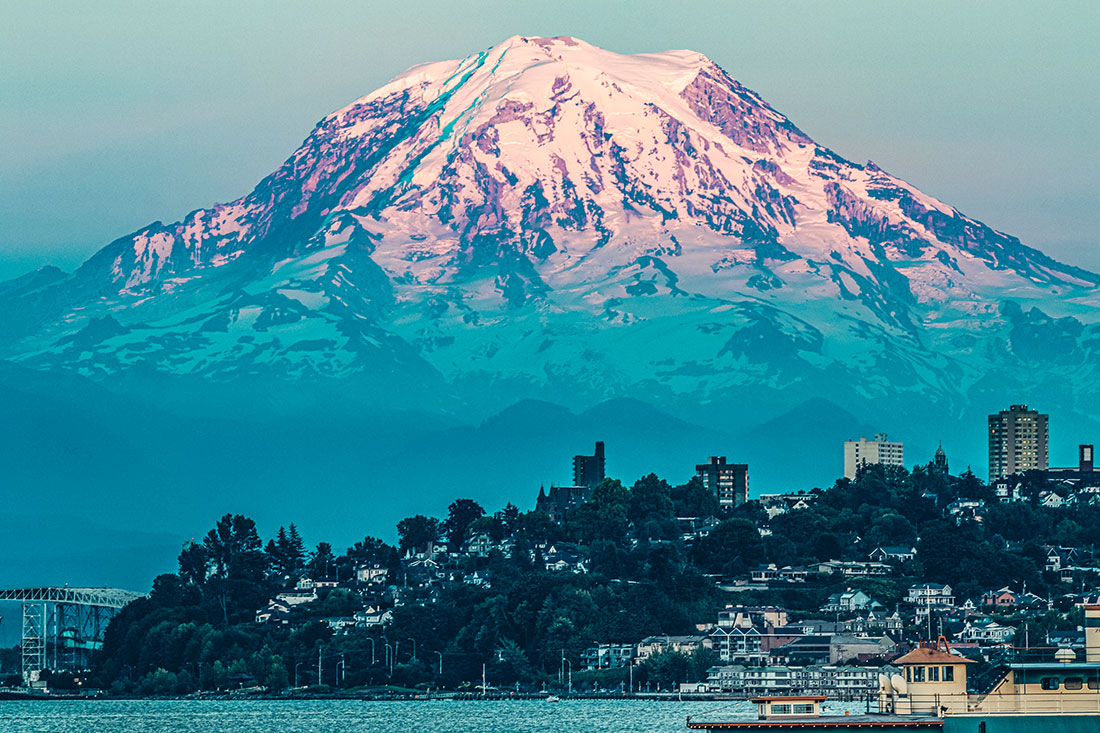
The white cap that makes Rainier so recognizable is not only snow. It is also glacial ice. The glaciers are part of what gives the mountain its brightness and its sense of permanence. Even during warmer months, the upper mountain stays icy, catching sunlight in a way that makes it stand out against blue sky. On certain evenings, the summit can glow pink or gold as the sun drops, creating a moment that makes people stop mid conversation just to stare.
Tacoma’s position on the south Puget Sound means the mountain often appears behind the city’s built environment. You might see it framed between houses, hovering above a line of trees, or rising behind downtown buildings. These accidental frames create some of Tacoma’s most memorable everyday views, and they explain why residents never seem to get tired of looking at it.
The Emotional Pull of the Mountain
Mount Rainier is more than scenery. For many in Tacoma, it functions like a compass and a symbol. It points you south and east. It anchors your sense of place. It also represents the broader Pacific Northwest identity, a blend of rugged landscape and quiet reverence for nature.
There is a reason people talk about Rainier with affection and even gratitude. In a world filled with screens, noise, and constant motion, the mountain offers something steady. Seeing it can change the tone of a day. It can turn a routine commute into a small moment of awe. It can remind people to get outside, to drive toward the parklands, or to take a walk somewhere with a view.
For newcomers, the mountain can be a surprise. They expect it to be impressive, but they do not expect it to feel personal. Over time it becomes part of Tacoma’s shared language. People send photos of it to friends. They measure seasons by how often it appears. They take visitors to parks or viewpoints and wait for the moment when the mountain reveals itself and the visitor finally understands why locals talk about it so much.
Where Tacoma Meets Rainier in the Landscape
Tacoma is built on elevations that create a natural stage for mountain views. Hilltop neighborhoods, certain stretches of major roads, and parks with open sightlines become informal viewing platforms. The experience is not only about a single lookout. It is about the way the mountain can appear unexpectedly, then disappear again as you turn a corner or drop into a valley.
Parks play a major role in this relationship. Open lawns, waterfront edges, and higher ridges create places where you can sit and watch the sky change over the mountain. Even when the city feels busy, these spaces let you reconnect with the sense that Tacoma is part of a larger natural system. On clear days, Rainier seems to stand guard over the region, visible across the sound and above the foothills.
The water adds another layer. When you see the mountain with the bay or the sound in the foreground, the view becomes even more dramatic. The contrast between bright ice, blue water, and darker evergreen ridges makes Rainier feel like the centerpiece of a vast panorama. It is one of those sights that makes Tacoma feel larger than its borders.
The Mountain’s Influence on Weather and Light
Rainier does not control Tacoma’s weather, but it shapes how weather is experienced. In the Pacific Northwest, clouds often cling to mountain slopes and shift quickly. A day that looks gray in one neighborhood can open into sun and mountain visibility in another. The mountain itself can be partially hidden, with the summit showing while the lower ridges disappear, or the reverse, creating the illusion that Rainier is floating above the landscape.
Light is part of the drama. Morning views can look crisp and sharp, with the mountain’s edges appearing clean against the sky. Midday can flatten the contrast, making Rainier look like a painted backdrop. Evening often produces the most emotional views, when the summit catches late light and turns warm while the city below cools into shadow.
These changes create a sense of unpredictability that keeps the mountain interesting. Tacoma residents can see Rainier hundreds of times and still feel like each view is a little different, shaped by the season, the cloud cover, and the angle of light.
A Reminder of Power and Risk
Mount Rainier’s beauty can make it easy to forget that it is a volcano. It is considered one of the more closely watched volcanoes in the United States because of its size, its ice, and its history. The mountain’s glaciers and steep slopes mean that hazards are not only about eruptions. Mudflows, known as lahars, are a major concern in the broader region because they can follow river valleys far from the mountain.
For Tacoma, this reality is part of the region’s safety planning and public education. Awareness does not usually dominate daily life, but it exists beneath the admiration. The mountain is loved, but it is also respected. That respect is woven into how people talk about the landscape. In the Pacific Northwest, nature is not treated as a decorative background. It is treated as something that can inspire and challenge you at the same time.
This dual identity makes Rainier even more important as a symbol. It represents beauty, but also scale and power. It reminds Tacoma that the region’s most iconic feature is also a dynamic natural system with a deep past and a future that is not fully predictable.
Culture, Art, and the Mountain as an Icon
Rainier appears in Tacoma’s creative life again and again. It shows up in photography, murals, posters, and local branding. It appears on postcards, coffee shop walls, and social media feeds, often framed with Tacoma’s streets or waterfront as a way of saying this is home. The mountain becomes a backdrop for celebrations, outdoor runs, and family outings, turning ordinary moments into something that feels bigger.
In a city that values art and public creativity, Rainier is a natural subject. It offers a clear shape that artists can interpret in countless ways. Some portray it realistically, emphasizing the glaciers and the sharpness of winter light. Others turn it abstract, using the mountain’s outline as a symbol of place rather than a literal portrait. Either way, the message is similar. Tacoma belongs to the mountain’s world.
The mountain also strengthens local pride. People who live here understand that not every city gets a landmark like this, visible from neighborhoods and streets, changing the atmosphere of a day without saying a word.
Experiencing Rainier Through Tacoma’s Everyday Life
You do not need to climb a trail to feel Mount Rainier’s presence in Tacoma. It is part of everyday rituals. People check the sky in the morning to see if it will appear. They choose routes that offer better views. They pause in parking lots or on sidewalks when the mountain suddenly emerges. They text friends when the summit looks unusually sharp, as if sharing a gift.
On weekends, the mountain becomes a motivator. It encourages day trips, outdoor adventures, and scenic drives. Even if you do not head toward the national park, the sight of Rainier can be enough to inspire a walk in a local park or a waterfront stroll. It nudges people toward the outdoors in a region where nature is always close.
This is why Rainier matters so much to Tacoma. It is not only a destination for hikers and climbers. It is a presence that shapes how the city feels, how people orient themselves, and how they connect to the bigger landscape around them.
The Tacoma Rainier Relationship in One Sentence
Tacoma and Mount Rainier are linked by visibility, emotion, and identity. The mountain may stand beyond the city limits, but it sits at the center of Tacoma’s sense of place, reminding residents every clear day that they live in a region defined by water, forests, and a towering peak that feels both distant and intimate at once.
Discover more from City Towner
Subscribe to get the latest posts sent to your email.