
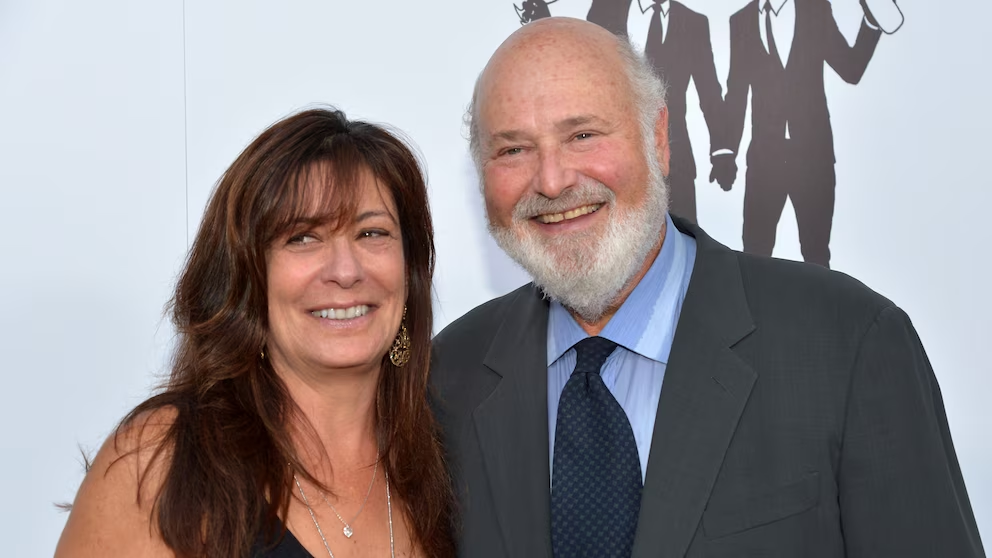
Actor Rob Reiner and Wife Michelle Reiner Murdered By His Son in Los Angeles California
On December 14, 2025, a quiet stretch of Brentwood in Los Angeles, California became the center of a fast moving homicide investigation that quickly drew national attention. By the end of the day, police had announced that filmmaker and actor Rob Reiner was dead, and that his wife, Michele Singer Reiner, was also found slain inside the same home. Within hours, the case turned into a family tragedy in the harshest possible way when authorities arrested the couple’s son, Nick Reiner, and prosecutors later filed murder charges.
The investigation is still a legal process, and the facts that matter most are those established by investigators, medical examiners, and the courts. What has been publicly described so far points to a brutal set of events inside a private residence, followed by an urgent response, an arrest later that night, and a courtroom fight that will likely hinge on forensic evidence, timelines, intent, and mental state.
Who Rob Reiner was to the public
Rob Reiner’s name carried decades of cultural weight. He was widely known as a director, producer, and performer whose work shaped modern American comedy and drama. Over the years, he became associated with a particular kind of storytelling, one that mixed sharp humor with emotional stakes, and he built a reputation as someone who could take familiar human conflicts and make them feel both intimate and cinematic.
He was also known for public political engagement, which made him a recognizable voice beyond film and television. That visibility meant the shock of his death traveled quickly, reaching far beyond the neighborhood where it occurred and into a broader public conversation about violence, family breakdown, and the pressures that sometimes surround fame.
The family at the center of the investigation
Michele Singer Reiner, Rob Reiner’s wife, was described as part of the couple’s shared personal and social world. Their family life was not simply a private matter, because public visibility has a way of drawing attention to relationships that would otherwise stay out of headlines. Still, even for families that live partly in public view, the inside of a home is assumed to be safe, routine, and ordinary.
Nick Reiner, their son, became the focus of the investigation almost immediately after police identified the victims and began tracing who had access, who was present, and what the timeline looked like in the hours leading up to the discovery. Investigators and prosecutors later publicly characterized the case as one in which the killings were committed by a family member, and they moved quickly to file charges that reflected the seriousness of the allegations.
December 14, 2025 in Brentwood
The day that changed everything began like any other winter Sunday in Los Angeles, at least from the outside. Brentwood is known for calm streets, well kept homes, and a sense of separation from the city’s louder edges. That sense of separation collapsed as law enforcement and first responders converged on the property after the couple was found.
Authorities have described the deaths as the result of a stabbing. Reports about the scene focused on the severity of the attack and the immediate decision to treat the event as a homicide investigation rather than an accident or medical emergency. In cases like this, the first questions investigators work through are methodical: who made the call, who arrived first, what condition were the victims in, and what evidence might reveal when and how the killings happened.
Emergency response and the first hours of the case
Once the call for help went out, the response followed the familiar rhythm of a major investigation. Paramedics and officers arrive, attempt lifesaving measures if there is any chance to do so, secure the location, and begin protecting the scene from contamination. Detectives then step into a space where the smallest detail can matter, from the position of a door to the placement of a phone, from signs of struggle to the presence of a weapon.
Even when the immediate facts appear clear, investigators avoid assuming the story is complete. They work to confirm identity, establish a timeline, and rule in or rule out alternate explanations. That means speaking to neighbors and potential witnesses, checking surveillance where available, reviewing phone activity when legally permitted, and mapping movements across the day and night that led to the discovery.
What authorities allege happened inside the home
Prosecutors later alleged that Nick Reiner stabbed his parents, resulting in their deaths. In the public telling of the case, the core allegation is straightforward, but what matters legally is how that allegation is supported: forensic findings, physical evidence, and a timeline that makes sense.
A homicide case involving a stabbing often turns on specific questions. Was the weapon recovered, and can it be tied to the suspect through fingerprints, DNA, or trace evidence. Do injuries indicate a sudden assault, a prolonged struggle, or multiple phases of violence. Are there defensive wounds. Is there evidence suggesting a dispute, and if so, what kind of dispute. These details can shape how prosecutors argue intent and premeditation, and how defense attorneys challenge the state’s interpretation.
The arrest of Nick Reiner and the filing of charges
Later on December 14, 2025, police arrested Nick Reiner. Prosecutors charged him with two counts of first-degree murder, a charge that generally reflects an allegation of deliberate intent rather than an impulsive act without planning. Prosecutors also cited the nature of the allegations and the fact that there were two victims, signaling that the case would be treated as among the most serious crimes the justice system handles.
A first-degree murder filing does not settle the truth of what happened. It sets the legal battlefield. From that point forward, everything revolves around how each side interprets the evidence and whether the state can prove its case beyond a reasonable doubt.
What the prosecution will likely focus on
In a high profile double homicide, prosecutors typically aim to build a clean narrative that a jury can follow without confusion. That narrative usually includes a precise timeline, a clear explanation of how the suspect had the opportunity to commit the crime, and physical evidence that connects the suspect to the act, the weapon, and the scene.
Prosecutors also tend to emphasize behavior before and after the event. They may highlight any indication of conflict, threats, planning, or attempts to conceal. They may point to injuries and forensic findings to argue the attack was intentional and sustained. They may also attempt to show why the suspect, rather than any alternative person, is the only plausible perpetrator.
What the defense will likely challenge
A defense team in a case like this often concentrates on weaknesses in the chain of proof. They may question timelines, argue that the interpretation of forensic evidence is not as definitive as it sounds, and scrutinize the investigative steps taken in the first hours when scenes are chaotic and decisions are made quickly.
Depending on what facts emerge, the defense may also raise issues connected to mental state, substance use, or the presence of a crisis. Those issues can become central when the law requires jurors to decide not only what happened, but what level of intent can be proven. The difference between deliberate planning and a chaotic event can be the difference between legal categories, sentencing outcomes, and how the case is remembered.
A community reaction shaped by fame and grief
When violence touches a public figure, reactions often split into two overlapping stories. One story is intensely personal: a family destroyed, private pain broadcast through headlines, and loved ones facing a grief that cannot be separated from public scrutiny. The other story is cultural: people revisiting decades of work, remembering characters and scenes, and feeling as if a familiar presence in American life has been abruptly removed.
In Brentwood, neighbors and local residents faced the immediate reality that a double homicide can happen even in places assumed to be insulated from such danger. More broadly, the public confronted the grim truth that family violence can take forms that seem unthinkable until they are suddenly real.
The road ahead in court
The legal process after an arrest moves in stages. There are early hearings focused on arraignment, custody status, and the initial presentation of charges. After that, there are often months of evidence exchange, motions, and expert analysis. In a homicide case, that can include autopsy findings, DNA analysis, digital forensics, and testimony from specialists who interpret injuries, timelines, and behavioral evidence.
Because the case involves a well known figure and an allegation against an immediate family member, the court process may also involve heightened attention to jury selection, courtroom security, and media rules. The goal of the court, at least in principle, remains the same: separate emotion from proof and decide the case based on admissible evidence.
Remembering Rob Reiner amid the allegations
Rob Reiner’s death is being examined through the lens of a criminal allegation against his son, but his life will also be remembered for what it meant to audiences, collaborators, and the craft of filmmaking. Even in a story defined by violence, people often reach for the fuller picture: a long career, a public voice, a family life that, until that day, existed beyond the reach of a homicide investigation.
For many, the lasting memory will be the sudden contradiction between a familiar name associated with entertainment and a grim set of headlines associated with loss. For investigators and the court system, the task is narrower but crucial: determine what happened inside that home on December 14, 2025, and apply the law to the facts that can be proven.
Discover more from City Towner
Subscribe to get the latest posts sent to your email.