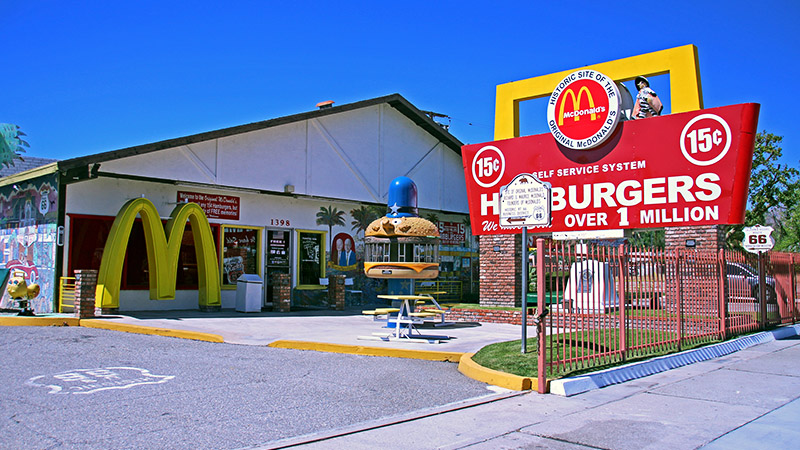
The Original McDonald’s in San Bernardino California
San Bernardino has a unique place in American food history because a modest local restaurant helped spark a global transformation in fast food. Long before the golden arches became a symbol recognized almost everywhere, the story began with two brothers focused on a simple goal: serve a small menu quickly, consistently, and at a price ordinary families could afford. The original McDonald’s in San Bernardino was not initially built as a worldwide concept. It was a local business responding to local demand in a car centered Southern California where families wanted convenience and teenagers wanted a hangout.
The early success came from understanding the moment. Southern California in the mid twentieth century was growing fast. New neighborhoods stretched outward, driving became part of daily life, and eating outside the home became more common. Restaurants that could serve people quickly without sacrificing familiarity had an advantage. The McDonald brothers noticed that many drive ins had large menus, slow service, and complex kitchen operations. They believed the future belonged to speed, focus, and repetition. That belief became the foundation of the restaurant’s influence.
The McDonald Brothers and the San Bernardino Setting
Richard and Maurice McDonald, often called Dick and Mac, were entrepreneurs who learned by doing. They had experience in food and hospitality, and they understood that a restaurant could be both a business and a system. Their San Bernardino location was positioned in a region shaped by movement. People were traveling through the Inland Empire, commuting, and building new routines in a rapidly expanding part of California. A restaurant that fit the pace of that lifestyle could thrive.
The brothers originally operated a drive in style restaurant like many others of the era, offering a broad menu and carhop service. But over time they studied what actually sold, what created delays, and what made customers happy. They realized that a small portion of the menu generated most of the revenue. They also realized that the kitchen, not the parking lot, was the real engine of the business. The big change came when they decided to stop trying to be everything at once and instead build a restaurant around a tight set of items executed with discipline.
The Speedee Service System and the Birth of Modern Fast Food
The McDonald brothers are remembered for developing a new approach to restaurant operations that emphasized efficiency, consistency, and speed. Their idea was not only to cook faster but to create a repeatable method that any trained crew could follow. They designed a workflow where each station had a clear role, ingredients were prepared in advance, and assembly was standardized. That meant fewer mistakes, fewer delays, and a predictable customer experience.
This approach became known as the Speedee Service System. It was more than a catchy phrase. It was a philosophy of operations that treated food preparation like a carefully organized production line, but one still rooted in basic cooking and cleanliness. The brothers created a kitchen layout to minimize wasted movement. They used precise portions and straightforward cooking steps. They limited customization so orders could move quickly. They emphasized packaging that made food portable for people eating in their cars or taking meals home.
At a time when many restaurants were built around entertainment and atmosphere, this system treated the restaurant as a machine designed to deliver food. That idea was revolutionary. It is difficult today to imagine how unusual it felt to order a burger and receive it almost immediately, wrapped neatly, tasting the same every time, and costing little enough that families could return frequently.
The Menu That Made the Model Work
The original San Bernardino McDonald’s focused on a narrow menu, which was part of its genius. Instead of trying to satisfy every possible craving, the restaurant centered on burgers, fries, and drinks, built for speed and mass appeal. The goal was not to impress diners with variety. The goal was to impress them with reliability.
The hamburger became the anchor because it was easy to produce consistently. Fries paired naturally with burgers and could be cooked in batches. Drinks were fast to serve and profitable. The simplicity of the menu allowed the kitchen to run smoothly and reduced training time for employees. It also made the restaurant predictable in a way that encouraged repeat business. Customers knew exactly what they were getting, and that predictability became a form of comfort.
This also shaped a new kind of consumer relationship with restaurants. Instead of seeing eating out as an occasional event, people began to see it as a routine. That change helped fast food become part of everyday American life, especially as suburban growth and highway travel expanded.
A Restaurant Built for the Automobile Age
The original McDonald’s story cannot be separated from Southern California car culture. San Bernardino was part of a broader region where driving was essential and where roadside businesses catered to people on the move. The McDonald brothers designed their restaurant for that environment. Quick ordering, quick service, and easy take away fit perfectly with a society increasingly built around automobiles, commuting, and leisure travel.
The restaurant also served teenagers, who were becoming a powerful consumer group in the postwar era. A place that offered affordable food quickly created a natural gathering spot. Families appreciated the value and speed. Workers appreciated the convenience. Travelers appreciated the consistency. The restaurant hit multiple audiences at once without needing a complicated menu or a fancy dining room.
In many ways, the San Bernardino restaurant became a template for how businesses could adapt to suburban growth. It was not only about food. It was about designing an experience that matched the pace and geography of modern life.
Enter Ray Kroc and the Path to a Global Brand
The San Bernardino restaurant’s success attracted attention. The system worked, and it could be replicated. Ray Kroc, a salesman who saw potential in the operation, became involved and helped push the concept toward franchising on a massive scale. Kroc recognized that the Speedee Service System was valuable not only as a local business model but as a national, and eventually international, blueprint.
The expansion story is complex because it involves different visions and business priorities. The McDonald brothers cared deeply about the system they created and the quality standards they believed in. Kroc focused on scaling, branding, and building a network that could dominate a growing market. Together, their combined impact changed the restaurant industry permanently. The idea that a standardized menu and a standardized operating system could produce consistent food across many locations became a defining feature of modern fast food.
From that point forward, McDonald’s became a story of franchising, real estate strategy, supply chain control, and marketing power. But the foundation of all of it was the San Bernardino origin, the proof that the system worked in real life and that customers wanted what it offered.
The San Bernardino Legacy Today
San Bernardino’s role in this story remains a point of local pride and historical curiosity. The original site is remembered as the birthplace of a new era in dining. People visit to connect with the origin story and to see how a local restaurant became the starting point for something that reshaped global eating habits.
The legacy is also visible in how the city’s identity connects to roadside history and Route 66 culture. San Bernardino sits in a region where American mobility, highways, and suburban life took on major cultural meaning. The original McDonald’s story fits into that landscape. It is a chapter in the broader narrative of Southern California shaping trends that later spread across the country and the world.
For residents, the story can feel personal because it began as a neighborhood business, not a corporate giant. It is a reminder that big changes often start in ordinary places, with people paying attention to details others overlook. A simple decision to simplify a menu and redesign a kitchen can ripple outward in ways no one expects.
What the Original McDonald’s Represents
The original San Bernardino restaurant represents several American themes at once. It reflects innovation born from practicality, not luxury. It reflects a culture shifting toward speed and convenience. It reflects the rise of franchising and standardized business systems. It also reflects how regional lifestyles, especially car culture and suburban growth, can shape business models that later become global.
The story is not only celebratory. It also raises questions about the broader impact of fast food, including nutrition, labor practices, and the cultural shift toward quick meals. But even those debates underline the same point: what began in San Bernardino became influential enough to reshape daily life. Few local businesses can claim that level of impact.
When you think about the original McDonald’s in San Bernardino, you are not just thinking about burgers and fries. You are looking at a moment when operations, design, and consumer habits aligned perfectly. That alignment created a new kind of restaurant, and from that moment forward, the world of food service was never the same.
Discover more from City Towner
Subscribe to get the latest posts sent to your email.