
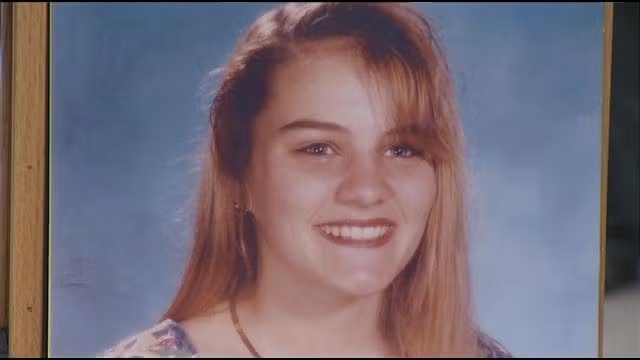
Deanna Cremin Murdered Less Than a Mile From Home in Somerville Massachusetts
The case of Deanna Cremin has remained one of the most painful and haunting unsolved crimes in Somerville, Massachusetts for decades. Although people sometimes loosely refer to it as a disappearance because she vanished during the walk home, the known facts point to something even more tragic. Deanna did not simply go missing on March 29, 1995. She was attacked while walking home that night, and her body was found the next morning on March 30, 1995, near where she lived. That distinction matters because it shapes the way the case is remembered and the kind of grief it has carried for her family and community ever since.
She was only 17 years old, a teenager with her life still in front of her, when an ordinary trip home turned into one of the area’s most enduring cold cases. More than anything else, the case has stayed alive in public memory because of how close she was to safety. She was not found far away in some distant or unfamiliar place. She was found within a short distance of home, which makes the crime feel even more intimate, more cruel, and more disturbing. The idea that she came so close to making it back and still lost her life is one of the reasons the case has continued to weigh so heavily on Somerville.
The years have not erased the heartbreak attached to her name. If anything, time has only sharpened the sadness. Each anniversary serves as another reminder that her family has been forced to live with not only loss, but also the added burden of not knowing who killed her and why no one has been held accountable. In that sense, the story of Deanna Cremin is not just about one terrible night in March 1995. It is also about the long shadow that unresolved violence casts over a family, a neighborhood, and an entire city.
The Night of March 29, 1995
On March 29, 1995, Deanna followed what sounded like a fairly normal routine for a teenager. She spent time with friends and with her boyfriend, moving through the familiar patterns of a young life that likely felt ordinary at the time. There was nothing publicly known about that evening that would have signaled to anyone around her that it would end in tragedy. That is part of what makes the case so painful. The night did not begin with obvious warning signs. It began like countless other nights in a teenager’s life.
At some point that evening, she began the walk home. It was supposed to be a short trip, the kind of routine movement through a neighborhood that most people would not think twice about. But somewhere along that path, something went terribly wrong. Deanna never made it inside her home. Instead, sometime during the night, she was attacked, sexually assaulted, and strangled.
The next morning, March 30, 1995, her body was discovered behind a housing complex near Jaques Street, not far from her house. That detail has remained one of the most haunting elements of the case. She was so close to home that the crime has always felt deeply personal to the people who know the area. The distance between safety and tragedy was terrifyingly small.
A Teenager at the Center of a Lasting Tragedy
Before Deanna became the subject of news coverage and investigative files, she was a young woman known to the people around her as a daughter, a family member, a friend, and a teenager with the ordinary hopes and concerns that come with that stage of life. One of the saddest aspects of crimes like this is how quickly a full human life can become reduced to the circumstances of death. But Deanna was more than the violence that ended her life. She was a person whose future was taken from her before it had the chance to unfold.
That is why cases involving teenagers strike such a deep emotional chord. There is a particular cruelty in the loss of someone so young because the mind cannot help measuring not only what was taken in the moment, but also all the years that should have followed. Her death did not simply end a life. It ended every possibility that would have come after. Graduation, work, adulthood, family, growth, change, and all the quiet milestones that make up a lifetime were stolen as well.
For the people who loved her, that loss was not something that could be confined to one awful day. It became part of the structure of their lives. Unsolved murders create a special kind of pain because grief is forced to coexist with uncertainty. There is sorrow, but also anger. There is memory, but also a constant unfinished question. That is the emotional condition Deanna’s loved ones have had to carry since 1995.
Somerville as the Setting of the Crime
The city of Somerville is an important part of how this case is understood. This was not a remote highway, an isolated field, or an anonymous far off location. It was a neighborhood setting, a place where people lived close together, walked familiar streets, and moved through everyday routines. Crimes that happen in residential areas often leave a distinct kind of scar because they violate the sense of normalcy that communities depend on. When a young person is killed near home, the whole area can begin to feel altered by the memory of what happened there.
In Deanna’s case, the proximity to home has always amplified the emotional force of the crime. It suggests that safety was almost within reach. It also raises the haunting possibility that someone may have seen or heard something and not realized its significance until much later. A neighborhood murder does not just affect immediate family. It becomes woven into local memory. People remember where they were, what they heard, and how the city felt afterward.
That is one reason the case has continued to hold such a strong place in Somerville’s public consciousness. It was not just another crime on a map. It happened in a lived community, in a place people knew, involving a teenager whose daily life was tied to the city in ordinary ways. The familiarity of the setting has made the case feel deeply personal for many who followed it.
The Shock of the Discovery
There is something especially devastating about the moment a missing loved one is no longer missing, but found in the worst possible way. For families, that discovery marks a permanent division between the life that existed before and the life that follows after. In Deanna’s case, the fact that she was discovered the next morning so near to home only deepened the horror. The crime did not unfold in some distant unknown world. It unfolded within the orbit of her normal life.
The emotional shock of that kind of discovery is difficult to fully describe. It forces loved ones to confront not just death, but violence. It replaces hope with devastation almost instantly. One moment there may still be questions, uncertainty, or even the possibility that she is simply delayed. The next, those possibilities collapse into a brutal reality. From that point forward, every memory of the previous evening becomes charged with unbearable meaning.
For the broader community, the discovery also changed the emotional texture of the case. What began as concern over a teenager who had not made it home became an unsolved homicide involving sexual violence and strangulation. That shift transformed the case into something far darker and more difficult to process. The city was no longer dealing with absence alone. It was dealing with the fact that a teenage girl had been murdered within walking distance of where she lived.
The Investigation and the Frustration of No Charges
Over the years, investigators examined the case from multiple angles. Persons of interest were publicly discussed at different points, and attention focused on men who might have had some connection to the circumstances surrounding her final hours. Yet despite the passage of time, no one has ever been charged with Deanna Cremin’s murder. That fact has become one of the most painful features of the case.
To the public, an unsolved murder can feel like a mystery. To the family, it often feels like an open wound. Every year without charges is not simply another year on the calendar. It is another year without justice, another year without a courtroom, another year without answers. The question of who killed Deanna has remained unresolved for so long that the case now stands as both a specific tragedy and a symbol of how cold cases continue to hurt people long after the headlines fade.
The lack of charges can also create lingering frustration around what might have been missed, delayed, or left incomplete. In older unsolved cases, people often wonder whether better technology, stronger evidence collection, or faster action might have changed the outcome. Those kinds of questions are hard to avoid, especially when the victim was young and the case has remained so emotionally present for so long.
The Family’s Long Fight for Justice
One reason Deanna’s name has never disappeared from public discussion is because her family has continued to push for answers. Families often become the enduring public conscience of an unsolved case. Long after the first round of coverage fades, they remain. They remember every date, every detail, every anniversary, and every moment the system failed to deliver closure. Their grief does not become less real just because time passes.
In many cold cases, the family’s persistence is what keeps a victim from being lost to history. The same is true here. The continuing effort to speak her name, revisit the case, and call for justice is a refusal to let the crime fade into silence. It is a way of insisting that Deanna mattered, that her life cannot be reduced to an old file, and that the unanswered questions surrounding her death still deserve attention.
That kind of persistence comes at a cost. It means reliving the pain repeatedly. It means watching years pass without the resolution that should have come long ago. But it also reflects love. Families continue because memory and love do not end when a case goes cold. In that sense, every public remembrance of Deanna is also an act of devotion.
Why the Case Still Resonates
The murder of Deanna Cremin still resonates because it contains so many of the elements that make a case linger in the public imagination. The victim was young. The crime was brutal. The location was close to home. The case remained unsolved. Together, those facts create a story that feels at once deeply specific and universally disturbing. It is specific because it happened to one teenager in one Massachusetts city on one March night. It is universal because it touches on fears shared by nearly everyone who has ever loved a child, walked a familiar route, or believed home was only a few steps away.
It also resonates because it exposes the fragility of ordinary life. An evening that began in routine ended in irrevocable violence. There was no dramatic trip into danger, no far flung disappearance across state lines, no elaborate sequence of strange events. There was simply a walk home that should have ended safely and did not. That stark simplicity is part of what makes the case so haunting.
The emotional power of the case has only deepened with time. Each passing year makes the lack of justice more glaring. The city changes, neighborhoods evolve, and new generations grow up, but the question remains. Who killed Deanna Cremin? The fact that the question can still be asked so many years later is itself a measure of how profoundly unresolved the case remains.
A Story Marked by Loss and Unfinished Time
There is a particular kind of sadness attached to unsolved murders because they leave time feeling unfinished. The death itself is final, but the story around it remains suspended. There is no completed arc, no clear answer, no decisive end. In Deanna’s case, that unfinished quality has shaped how the crime is remembered. It is not just the story of a teenager murdered in Somerville in March 1995. It is also the story of everything that never followed, justice, accountability, explanation, or peace.
That unfinished time affects more than a case file. It affects the people who continue to live in the shadow of the crime. For loved ones, the past never fully settles into the past. It remains emotionally active, returning through anniversaries, media coverage, and everyday reminders. Cold cases do not simply sit still. They continue to move through the lives of the people left behind.
In that sense, Deanna Cremin’s story remains tragically open. The known facts are devastating enough on their own. A 17 year old girl was attacked while walking home on March 29, 1995, in Somerville, Massachusetts, and her body was found the next morning near where she lived. But beyond those facts lies the larger tragedy of an answer that has not yet come. Until it does, the story remains suspended between grief and justice, memory and silence.
Remembering Deanna Cremin
To remember Deanna Cremin properly is to remember both the young life that was lost and the long burden placed on those who survived her. She should not be remembered only as the victim of an unsolved crime. She should also be remembered as a teenager whose life mattered before that crime ever occurred. Her name continues to endure because the people who cared about her never allowed her to become invisible.
That remembrance carries moral force. It says that a young woman killed near home on a March night should not be forgotten just because time has passed. It says that unsolved does not mean unimportant. And it says that the absence of charges does not erase the need for truth. In many ways, that is what keeps the case alive. Not only the unanswered question of who did it, but the continuing insistence that Deanna’s life and death still matter.
Her story remains one of Somerville’s most painful unfinished chapters. It is a story of youth, violence, loss, and the long ache of unresolved grief. Until there is justice, it will remain a case that haunts the city and the people who have never stopped waiting for answers.
Discover more from City Towner
Subscribe to get the latest posts sent to your email.