History of Vancouver Washington
Vancouver, Washington, has a history shaped by Indigenous communities, exploration, international trade, military development, transportation, industry, and steady urban growth. Located along the north bank of the Columbia River directly across from Portland, Oregon, Vancouver occupies one of the most historically important locations in the Pacific Northwest.
Long before the city was established, the area was home to Indigenous peoples who depended on the Columbia River for transportation, fishing, trade, and cultural life. During the nineteenth century, Vancouver became a major center of the fur trade and later an important military and transportation hub. Its location along the Columbia River helped connect inland communities with coastal ports and played a major role in the settlement and economic development of the region.
Today, Vancouver is a growing city within the Portland metropolitan area, but traces of its long history remain visible in its historic districts, military sites, waterfront, museums, parks, and architecture.
Indigenous Life Along the Columbia River
The history of Vancouver begins thousands of years before European and American explorers entered the Pacific Northwest. Indigenous peoples lived throughout the Columbia River region, building communities that relied heavily on the river and surrounding forests.
The Columbia River was one of the most important transportation and trade corridors in western North America. Indigenous communities traveled by canoe between settlements and gathering places, while extensive trading networks connected people throughout the Pacific Northwest.
Salmon was especially important to the people living along the Columbia. Seasonal salmon runs provided a dependable food source and supported large communities. Fishing techniques were carefully developed over generations, and salmon became deeply connected to cultural traditions, ceremonies, and social life.
The forests and wetlands surrounding present day Vancouver also supplied berries, roots, game, medicinal plants, building materials, and other resources.
Indigenous communities maintained complex political and economic relationships long before outsiders arrived. Trade routes extended far beyond the immediate Columbia River region, allowing goods, knowledge, and cultural traditions to move between communities.
The arrival of Europeans and Americans dramatically changed this way of life. Disease, displacement, settlement, military expansion, and changes to the river environment reduced Indigenous populations and transformed access to traditional lands.
Despite those disruptions, Indigenous communities continue to maintain cultural and historical connections to the Vancouver area and the Columbia River.
Early European Exploration
European and American interest in the Pacific Northwest increased during the late eighteenth and early nineteenth centuries as explorers, traders, and governments competed for influence in the region.
The Columbia River became particularly important because it offered access to the interior of the Pacific Northwest. Traders recognized that control of the river could provide economic and strategic advantages.
American explorers Meriwether Lewis and William Clark traveled through the region during their famous expedition across the continent. Their journey helped increase American knowledge of the Columbia River and contributed to growing interest in settlement and commerce in the Pacific Northwest.
The area that would eventually become Vancouver occupied a favorable position along the river. The surrounding land provided access to timber, fertile agricultural areas, waterways, and transportation routes.
As the fur trade expanded, European commercial interests began establishing more permanent facilities throughout the region.
The Establishment of Fort Vancouver
One of the most important moments in Vancouver’s history came with the establishment of Fort Vancouver in 1825.
The Hudson’s Bay Company created the fort as the headquarters for its Columbia Department, making it one of the most important centers of the fur trade in the Pacific Northwest.
The fort was named in honor of British naval officer and explorer George Vancouver, who had explored portions of the Pacific Northwest coast during the eighteenth century.
Fort Vancouver quickly became much more than a simple trading post. It developed into a large commercial and administrative center overseeing operations across an enormous territory.
Furs collected throughout the region were transported to the fort, processed, stored, and eventually shipped to international markets. Beaver pelts were especially valuable because of demand for felt hats in Europe and North America.
The Hudson’s Bay Company operated a sophisticated network of forts, trading posts, farms, transportation routes, and supply systems throughout the Pacific Northwest.
Fort Vancouver became the center of that network west of the Rocky Mountains.
Life at Fort Vancouver
Life at Fort Vancouver reflected the international nature of the fur trade.
Employees and residents came from many different cultural backgrounds. British officers, French Canadian workers, Indigenous people, Hawaiians, Métis families, and people from other regions lived and worked around the fort.
This created one of the most culturally diverse settlements in the Pacific Northwest during the early nineteenth century.
The fort itself contained warehouses, workshops, residences, administrative offices, and defensive structures. Skilled workers produced or repaired tools, barrels, clothing, furniture, equipment, and other materials necessary for maintaining distant trading posts.
Agriculture was also an important part of the operation.
Large farms surrounding Fort Vancouver produced crops and livestock that supported company employees and supplied other Hudson’s Bay Company outposts.
Wheat, vegetables, fruit, and other agricultural products were grown in the area. Cattle, pigs, and other livestock were also raised.
This agricultural activity demonstrated that the region had significant potential for permanent settlement, something that later attracted increasing numbers of American migrants.
Dr. John McLoughlin and Fort Vancouver
Dr. John McLoughlin became one of the most important individuals associated with Fort Vancouver.
As chief factor of the Hudson’s Bay Company in the Columbia District, McLoughlin directed operations from the fort and played a major role in the economic and political development of the region.
He supervised trade, agriculture, transportation, and relations with Indigenous communities and incoming settlers.
McLoughlin also became known for assisting American pioneers arriving in the Oregon Country, even though increasing American settlement threatened British commercial influence.
Many travelers arriving after difficult journeys over the Oregon Trail depended on supplies, food, tools, or other assistance available through Fort Vancouver.
The fort therefore became both a British commercial center and an important destination for American settlers.
Competition Between Britain and the United States
During the early nineteenth century, both Britain and the United States claimed influence over the Oregon Country.
For years, the two countries maintained a complicated arrangement that allowed citizens and companies from both nations to operate in the region.
Fort Vancouver represented British economic power, while increasing numbers of American settlers began traveling westward.
By the 1840s, migration along the Oregon Trail significantly increased the American population in the region.
Political pressure grew in the United States to establish clear control over the Pacific Northwest.
The dispute was eventually resolved through the Oregon Treaty of 1846, which established the international boundary largely along the 49th parallel.
The land surrounding Fort Vancouver became part of the United States.
Although the Hudson’s Bay Company continued operating for a period afterward, the political environment had changed dramatically.
The Arrival of the United States Army
As American control increased, the United States Army established a military presence near Fort Vancouver.
Vancouver Barracks was created in 1849 and became one of the oldest continuously operating military posts in the Pacific Northwest.
The post played a major role in military operations throughout the western territories.
Soldiers stationed at Vancouver traveled throughout the region to protect transportation routes, establish additional military posts, respond to conflicts, and support expanding American settlement.
The military installation helped transform Vancouver from a fur trading community into a permanent American settlement.
Officers, enlisted soldiers, merchants, families, and workers created a growing population around the military post.
The barracks would remain important for generations and eventually become associated with numerous well known military figures.
Ulysses S. Grant in Vancouver
One of the most famous individuals connected to Vancouver’s military history was Ulysses S. Grant.
Before becoming a Civil War general and later President of the United States, Grant served in the Pacific Northwest as a young Army officer.
He spent time stationed at Vancouver Barracks during the 1850s.
Grant’s experience in the region came during a period when the Army was strengthening its presence throughout the western territories.
Although his time in Vancouver represented only a small part of his long military and political career, his association with the city remains an interesting connection between Vancouver and national history.
Other prominent military officers also passed through Vancouver during the nineteenth century, giving the post significance well beyond the immediate region.
Vancouver Becomes a City
As the military presence expanded and American settlement increased, a civilian community developed around Fort Vancouver and Vancouver Barracks.
The settlement was initially known by different names, but Vancouver eventually became the established name.
Vancouver was incorporated as a city in 1857.
Its location along the Columbia River provided important economic advantages.
Riverboats carried passengers, agricultural products, timber, manufactured goods, and other cargo throughout the Columbia River system.
The city’s waterfront became a center of commercial activity.
Warehouses, mills, docks, and businesses developed near the river, while residential neighborhoods expanded farther inland.
Vancouver’s growth was closely connected to regional transportation and trade.
Agriculture and Early Economic Growth
Agriculture played an important role in Vancouver’s early economy.
The fertile land surrounding the city supported farms producing grains, vegetables, fruit, and livestock.
Farmers could transport their products along the Columbia River to markets throughout the Pacific Northwest.
Vancouver also became an important center for processing agricultural goods.
Mills, warehouses, and commercial businesses developed to serve farmers and traders.
The surrounding forests contributed another major resource.
Timber became one of the most important industries in Washington and Oregon, and Vancouver benefited from its location near extensive forests and river transportation.
Logging operations supplied sawmills, construction companies, and export markets.
The combination of farming, timber, transportation, and military activity created a relatively diverse local economy.
Transportation Shapes Vancouver
Transportation has always been central to Vancouver’s development.
The Columbia River served as the city’s first major transportation corridor.
Steamboats connected Vancouver with communities throughout Washington and Oregon, making it possible to move large quantities of goods much faster than overland transportation allowed.
Railroads later transformed regional commerce.
As rail connections expanded during the nineteenth and early twentieth centuries, Vancouver gained improved access to inland markets and national transportation networks.
Bridges across the Columbia River eventually strengthened Vancouver’s connection with Portland.
The Interstate Bridge became especially important because it provided a direct road connection between Washington and Oregon.
As automobile ownership increased, the bridge helped integrate Vancouver more closely with the expanding Portland metropolitan region.
Vancouver During the Early Twentieth Century
By the early twentieth century, Vancouver was evolving from a relatively small river and military town into a more diversified city.
New neighborhoods developed, businesses expanded, and modern infrastructure improved daily life.
Electricity, telephone service, paved roads, public transportation, and municipal utilities gradually transformed the city.
Downtown Vancouver became an important commercial center for residents of Clark County.
Banks, stores, hotels, restaurants, theaters, and professional offices served the growing population.
The city’s location near Portland provided both opportunities and challenges.
Residents could access the much larger economy across the river, but Vancouver also had to compete with Portland businesses.
Over time, the relationship between the two cities became increasingly interconnected.
The Spruce Production Division During World War I
World War I brought significant changes to Vancouver.
The United States military required enormous quantities of high quality spruce wood for aircraft production.
The Pacific Northwest contained extensive stands of suitable spruce, making the region strategically important.
Vancouver became involved in military logging and lumber production efforts.
The Army’s Spruce Production Division organized logging, transportation, and manufacturing operations throughout the Northwest.
Military activity brought workers and investment into the region.
Although World War I ended before many long term production plans were fully realized, the infrastructure and industrial development created during the period contributed to later economic growth.
Pearson Field and Aviation History
Vancouver also became important in the early history of aviation.
Pearson Field developed near Vancouver Barracks and became one of the historically significant airfields in the Pacific Northwest.
During the early twentieth century, military and civilian aviators used the field for training, demonstrations, transportation, and experimental flights.
The location became associated with important developments in aviation during a time when airplanes were still relatively new technology.
One notable event occurred in 1937 when Soviet aviator Valery Chkalov and his crew completed a historic nonstop transpolar flight from Moscow to Vancouver.
The aircraft traveled across the Arctic before landing at Pearson Field.
The achievement brought international attention to Vancouver and remains one of the city’s most famous aviation events.
Vancouver During World War II
World War II dramatically transformed Vancouver.
The city’s location along the Columbia River and its access to transportation networks made it an ideal location for large scale shipbuilding.
The Kaiser Shipyards became one of the most important wartime industrial operations in the area.
Thousands of workers arrived in Vancouver to build ships for the American war effort.
The workforce included women and people from many regions of the country who had previously worked in different industries.
Housing had to be constructed rapidly to accommodate the enormous increase in population.
Temporary communities and housing developments expanded around Vancouver and nearby areas.
Shipbuilding provided high paying industrial employment and permanently changed the city’s population and economy.
The Kaiser Shipyards and Wartime Production
Industrialist Henry J. Kaiser operated major shipbuilding facilities throughout the West Coast during World War II.
Vancouver’s shipyards became part of this enormous production system.
Workers constructed cargo ships and other vessels needed to transport troops, equipment, and supplies.
Modern production techniques allowed ships to be built with remarkable speed.
Large numbers of workers were trained quickly to perform specialized jobs.
Women entered industrial employment in unprecedented numbers as men joined the military.
The wartime shipyards helped challenge traditional ideas about who could perform industrial work.
African American workers and other migrants also arrived in the region searching for employment.
Although discrimination remained a serious problem, wartime migration contributed to increasing cultural diversity in Vancouver and the greater Portland area.
Postwar Growth and Suburban Development
After World War II, Vancouver continued growing as returning veterans, workers, and families settled permanently in the region.
Housing construction expanded rapidly.
New suburban neighborhoods appeared outside the traditional downtown area, reflecting national trends toward automobile oriented development.
Shopping centers, schools, churches, parks, and other community facilities followed residential growth.
Highways became increasingly important as more residents owned automobiles.
Vancouver’s relationship with Portland also strengthened.
Many Vancouver residents traveled across the Columbia River for employment, entertainment, education, and shopping.
At the same time, businesses and industries continued expanding on the Washington side of the river.
The Changing Vancouver Economy
During the second half of the twentieth century, Vancouver’s economy gradually shifted away from its earlier dependence on timber, military operations, river commerce, and heavy industry.
Manufacturing remained important, but service industries, healthcare, education, technology, retail, and professional services became increasingly significant.
Population growth throughout Clark County created demand for construction, transportation, schools, healthcare facilities, and commercial development.
Vancouver also benefited from businesses seeking locations near Portland while operating in Washington.
The city’s strategic position near Interstate 5 and Interstate 205 provided excellent highway access throughout the Pacific Northwest.
These transportation advantages helped attract warehouses, distribution centers, manufacturers, and other employers.
Preserving Historic Vancouver
As Vancouver modernized, efforts increased to preserve important historic sites.
Fort Vancouver became one of the central symbols of the city’s history.
Reconstructed buildings and archaeological research have helped visitors understand how the Hudson’s Bay Company operated during the nineteenth century.
The Fort Vancouver National Historic Site preserves portions of the former trading post, military grounds, aviation history, and surrounding cultural landscape.
Vancouver Barracks has also been preserved as part of the broader historic district.
Historic homes, officers’ residences, and military buildings provide reminders of the city’s long connection with the United States Army.
Preservation efforts allow modern residents to experience physical connections to events that shaped the Pacific Northwest.
Downtown Vancouver Through the Years
Downtown Vancouver has experienced repeated periods of growth, decline, and redevelopment.
During the city’s early history, downtown served as the commercial heart of the community.
As suburban shopping centers and automobile oriented development expanded after World War II, traditional downtown businesses faced increasing competition.
Like many American cities, Vancouver eventually began investing in downtown revitalization.
Historic buildings were restored, new residential projects were constructed, and restaurants, shops, offices, and entertainment businesses returned to the urban core.
Public improvements helped make downtown more attractive for pedestrians and residents.
The redevelopment of downtown has strengthened Vancouver’s identity as a city rather than simply a suburb of Portland.
The Transformation of the Waterfront
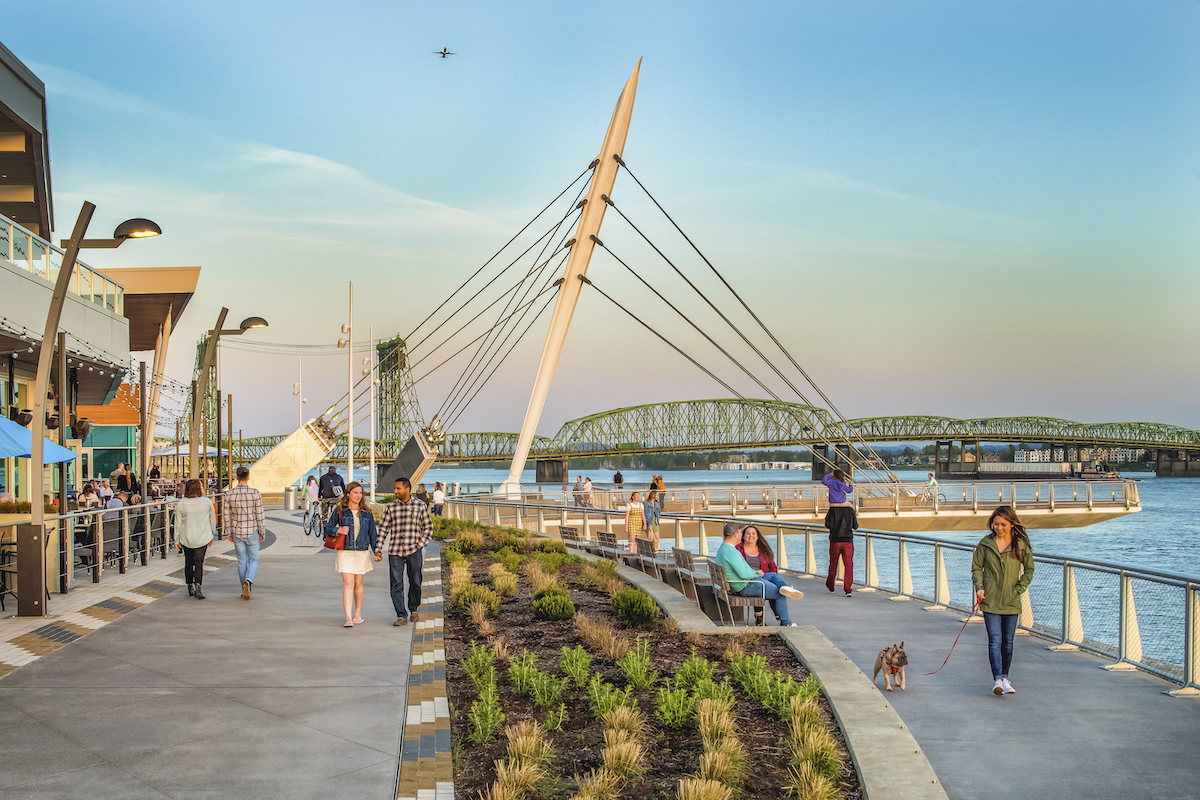
One of the most dramatic modern changes in Vancouver has occurred along the Columbia River waterfront.
For generations, much of the waterfront was dominated by industrial and transportation uses.
Modern redevelopment transformed portions of the riverfront into a mixture of public spaces, residential buildings, restaurants, offices, hotels, and recreational areas.
The Vancouver Waterfront has created a stronger physical connection between downtown and the Columbia River.
Walking paths, parks, and gathering spaces allow residents and visitors to enjoy the river that originally made Vancouver an important settlement.
The development represents an interesting connection between the city’s past and present.
The same river that supported Indigenous communities, fur traders, steamboats, soldiers, timber companies, and shipbuilders now serves as a major recreational and civic destination.
Vancouver’s Relationship With Portland
Vancouver’s history cannot be completely separated from Portland.
The two cities developed on opposite sides of the Columbia River and have become increasingly connected economically and socially.
Thousands of people travel between Washington and Oregon each day for employment, education, shopping, healthcare, and entertainment.
Despite this connection, Vancouver has maintained its own identity.
Washington’s tax structure, local government, schools, neighborhoods, parks, and business environment distinguish Vancouver from communities across the river.
Population growth has also allowed Vancouver to develop a larger collection of restaurants, businesses, cultural attractions, and entertainment options.
Rather than simply functioning as a residential extension of Portland, Vancouver has increasingly emerged as an important regional center in its own right.
Population Growth in Modern Vancouver
Vancouver experienced substantial population growth during the late twentieth and early twenty first centuries.
People moved to the region from California, Oregon, other parts of Washington, and states throughout the country.
Some newcomers were attracted by employment opportunities, while others appreciated the area’s scenery, climate, access to outdoor recreation, and proximity to Portland.
Residential development expanded east and north of the historic city center.
Formerly rural portions of Clark County gradually became suburban communities.
Schools, shopping centers, medical facilities, parks, and transportation infrastructure expanded to accommodate the larger population.
Growth created economic opportunities but also raised concerns about traffic, housing affordability, environmental protection, and preservation of open space.
These challenges continue influencing discussions about Vancouver’s future.
The Columbia River’s Continuing Importance
Throughout every period of Vancouver’s history, the Columbia River has remained central to the city’s identity.
The river supported Indigenous communities long before the city existed.
It attracted fur traders who established Fort Vancouver.
It carried steamboats transporting settlers and agricultural products.
It supported timber operations and industrial development.
During World War II, the river provided access for massive shipbuilding operations.
Today, commercial vessels still travel the Columbia while recreational boats, kayaks, and fishing vessels share the water.
Residents walk and bicycle along waterfront paths while restaurants and public spaces overlook the river.
Few features demonstrate Vancouver’s historical continuity as clearly as the Columbia River.
Historic Sites That Tell Vancouver’s Story
Visitors interested in Vancouver’s history can discover many locations connected to different periods of the city’s development.
Fort Vancouver represents the fur trade era and the international competition that shaped the Pacific Northwest.
Vancouver Barracks reflects the city’s military history.
Pearson Field preserves connections to early aviation.
Historic downtown buildings reveal the development of Vancouver as a commercial center.
The Columbia River waterfront demonstrates the city’s transition from industrial riverfront uses to modern public and residential development.
Historic neighborhoods contain houses representing different architectural periods and generations of Vancouver residents.
Together, these places create a physical record of more than a century of urban development layered over a much older Indigenous landscape.
Vancouver Today
Modern Vancouver is one of the largest cities in Washington and an important part of the Portland metropolitan region.
Its economy includes healthcare, manufacturing, technology, education, government, retail, construction, logistics, and professional services.
The city continues attracting residents who want access to both urban amenities and outdoor recreation.
Mountains, forests, rivers, lakes, and the Columbia River Gorge are all accessible from Vancouver.
At the same time, downtown redevelopment and waterfront growth have expanded dining, entertainment, and cultural opportunities within the city itself.
Modern Vancouver looks very different from the fur trading settlement established along the Columbia River in 1825, yet its location continues to shape its prosperity.
Transportation, commerce, migration, and the river remain central themes.
Why Vancouver’s History Matters
Vancouver’s history provides an unusually broad view of the forces that shaped the Pacific Northwest.
The city was influenced by Indigenous civilizations, international competition, the fur trade, westward migration, military expansion, agriculture, timber production, transportation, aviation, shipbuilding, suburbanization, and modern metropolitan growth.
Few cities in the region contain such a concentration of historically significant places.
Fort Vancouver illustrates the period when Britain and the United States competed for influence over the Northwest.
Vancouver Barracks reflects American military expansion.
Pearson Field connects the city to aviation history.
The Kaiser Shipyards demonstrate the enormous industrial transformation created by World War II.
Modern waterfront redevelopment shows how Vancouver continues adapting its historic landscape to new generations.
The history of Vancouver is ultimately the story of a community repeatedly transformed by its location along one of North America’s great rivers. From Indigenous settlements and fur traders to soldiers, shipbuilders, commuters, entrepreneurs, and modern families, generations of people have been drawn to the north bank of the Columbia River.
That long relationship between people, transportation, commerce, and the river continues defining Vancouver today.
Discover more from City Towner
Subscribe to get the latest posts sent to your email.