History of Oxnard California
The history of Oxnard, California, is deeply connected to the fertile coastal plain of Ventura County and the people who lived in the region long before a modern city appeared. Located along the Southern California coast between Los Angeles and Santa Barbara, the area that eventually became Oxnard benefited from rich soil, a mild Mediterranean climate, access to the Pacific Ocean, and an agricultural environment capable of producing crops throughout much of the year.
For thousands of years before European settlement, the broader Ventura County region was inhabited by the Chumash people. Chumash communities developed sophisticated societies throughout the coastal areas and nearby Channel Islands. They relied on fishing, hunting, gathering, trade, and the natural resources of the coastline. Villages were connected through extensive trade networks, and Chumash craftspeople became known for producing items such as baskets, tools, ornaments, and plank canoes used for coastal transportation.
The arrival of Spanish explorers and missionaries during the eighteenth century dramatically changed the region. Spanish settlement expanded through the California mission system, and Mission San Buenaventura was established in what is now Ventura in 1782. The mission became an important religious, agricultural, and economic center for the surrounding territory.
Land surrounding the modern Oxnard area eventually became associated with large Mexican land grants following Mexico’s independence from Spain. Ranching became a major economic activity throughout coastal California during the Mexican period, particularly cattle ranching. Large ranchos dominated much of the region before American settlement, agriculture, transportation infrastructure, and land development gradually changed the landscape.
California became part of the United States following the Mexican American War, and the discovery of gold elsewhere in the state accelerated migration and economic development. Although the Oxnard Plain was far removed from California’s major mining districts, population growth throughout the state created new markets for agricultural products. Over time, ranching land was increasingly divided and converted into farms.
The Agricultural Foundation of Oxnard
Agriculture played the central role in the creation of modern Oxnard. By the late nineteenth century, farmers had discovered that the Oxnard Plain possessed exceptionally productive soil. The combination of fertile land, moderate temperatures, irrigation possibilities, and access to transportation made the region ideal for commercial farming.
Early farmers grew a variety of crops, including beans, barley, corn, vegetables, and fruit. One crop, however, would become especially important in transforming the area from scattered farms into an organized community: sugar beets.
The growth of the sugar beet industry was part of a broader effort to develop a domestic sugar industry in the United States. Southern California’s agricultural conditions made certain parts of the region particularly suitable for sugar beet cultivation.
The development of a large sugar processing operation required substantial capital and industrial organization. That opportunity attracted the Oxnard brothers, Henry, James, Robert, and Benjamin Oxnard, members of a family already involved in the American sugar industry.
Their involvement would eventually give the city its name.
The Oxnard Brothers and the Sugar Beet Industry
The Oxnard brothers were associated with the American Beet Sugar Company, which became an important force in the local economy. The construction of a major sugar beet processing factory near the end of the nineteenth century helped create the economic foundation around which the city developed.
The factory opened in 1899 and quickly became one of the most important industrial operations in the region. Farmers throughout the Oxnard Plain supplied sugar beets to the plant, where they were processed into refined sugar.
The factory created jobs not only inside the processing plant but throughout the agricultural economy. Workers were needed to plant, maintain, and harvest crops. Transportation companies moved agricultural products. Warehouses stored goods. Merchants supplied farmers and laborers. New residents arrived seeking employment and economic opportunity.
Although the surrounding area had existed long before the factory, the sugar operation accelerated the creation of a concentrated town center.
The community that developed around the factory adopted the name Oxnard. Interestingly, members of the Oxnard family were reportedly not originally enthusiastic about having the settlement named after them, but the name remained.
The emergence of the sugar industry illustrates how industrial agriculture shaped many communities in California. Oxnard was not simply founded because people chose a convenient location for a town. Its development was closely tied to an agricultural industry that created both the economic demand and population necessary for urban growth.
The Railroad and the Growth of the City
Transportation was another major factor in Oxnard’s development. Agricultural communities depended heavily on reliable transportation because crops needed to reach processors, wholesalers, and consumers quickly.
Railroad service connected Oxnard with larger markets throughout California and beyond. The Southern Pacific Railroad became particularly important to the development of the community. Rail connections allowed farmers to transport crops more efficiently while bringing manufactured goods, building materials, equipment, and new residents into the area.
The railroad also influenced the physical layout of the developing city. Businesses, warehouses, and commercial activity tended to cluster around transportation corridors and areas where agricultural goods could be loaded and unloaded.
As the community grew, stores, hotels, restaurants, banks, offices, schools, churches, and residential neighborhoods began appearing.
Oxnard increasingly functioned not merely as an agricultural settlement but as a commercial center serving the surrounding farming region.
Oxnard Becomes an Incorporated City
Oxnard officially incorporated as a city on June 30, 1903.
At the time, the city was still relatively small compared with the major metropolitan areas that would eventually dominate Southern California. Nevertheless, incorporation represented an important transition. Oxnard now had a formal municipal government capable of managing streets, public services, development, utilities, law enforcement, and other community needs.
The early twentieth century brought continued agricultural growth. Sugar beets remained important, but farmers also expanded into other crops.
Beans became one of the region’s most famous agricultural products. For many years, the Oxnard Plain developed a strong reputation for producing lima beans. Other crops included vegetables, citrus fruit, and eventually strawberries, which became one of Ventura County’s most recognizable agricultural products.
The city’s location near the Pacific Ocean helped moderate temperatures, reducing some of the extreme heat experienced farther inland. This agricultural advantage allowed the region to produce high value crops that could be shipped to markets across the country.
A Diverse Community Begins to Form
Agricultural labor contributed greatly to Oxnard’s cultural diversity.
Workers arrived from different parts of the United States and from countries around the world. Mexican and Mexican American laborers became especially important to Ventura County agriculture, contributing generations of work to the farms and agricultural industries surrounding Oxnard.
Japanese immigrants also played a significant role in early twentieth century agriculture throughout parts of California, including Ventura County. Other immigrant groups participated in farming, business ownership, transportation, and industrial employment.
The need for seasonal agricultural workers produced complex patterns of migration. Some laborers remained temporarily during harvest periods, while others established permanent families and neighborhoods.
Over several generations, Oxnard developed into one of the most culturally diverse cities in Ventura County.
Mexican American culture became particularly influential in the city’s food, religious traditions, celebrations, businesses, politics, and community organizations.
Labor Struggles and the 1903 Oxnard Strike
One of the most important events in Oxnard’s early labor history occurred in 1903.
Agricultural workers, including Mexican and Japanese laborers, organized against labor contracting practices and poor working conditions. The resulting Oxnard Strike became notable because workers from different ethnic backgrounds cooperated in a period when racial discrimination and segregation were common throughout California and the United States.
The workers formed the Japanese Mexican Labor Association and challenged contractors who controlled employment opportunities and wages.
Tensions escalated during the dispute, and violence occurred during confrontations connected with the strike. Despite those difficulties, the workers succeeded in obtaining important concessions.
The Oxnard labor struggle became a notable chapter in American labor history because it demonstrated the potential power of multiracial worker organization. It also reflected the broader economic tensions created by California’s rapidly expanding agricultural economy, which depended heavily on low paid manual labor.
Downtown Oxnard and Early Commercial Development
As Oxnard expanded during the early twentieth century, downtown became the commercial and civic heart of the community.
Businesses lined streets near the railroad and surrounding neighborhoods. Banks, department stores, restaurants, theaters, professional offices, and specialty shops served residents from both the city and nearby farming communities.
Historic buildings from Oxnard’s early development reflected architectural styles popular during the first decades of the twentieth century. Some structures featured elaborate facades and decorative details that distinguished the downtown area from the surrounding agricultural landscape.
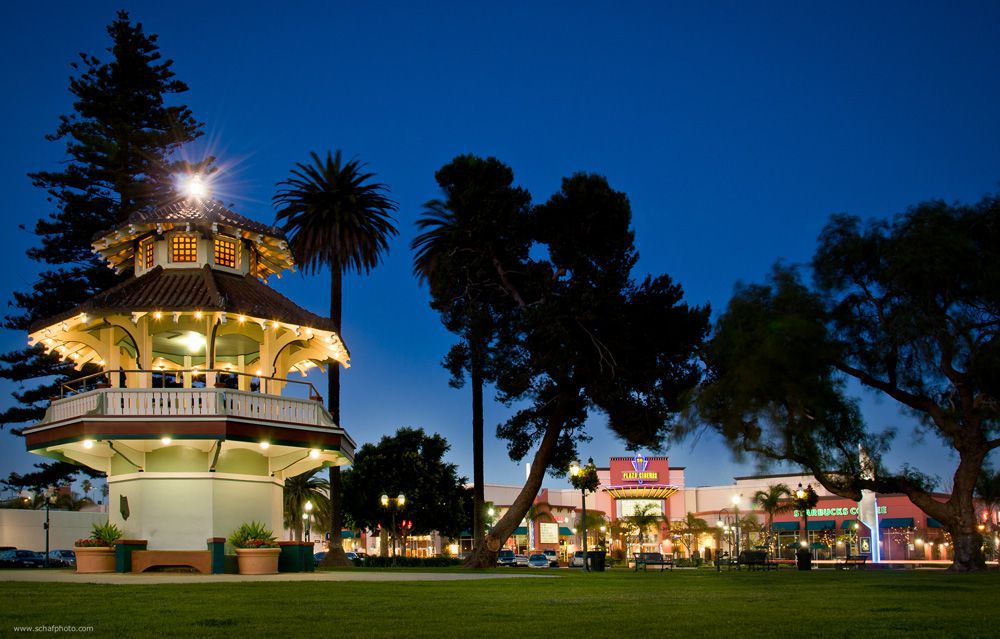
Plaza Park became an important community gathering area. Parks, churches, civic buildings, and commercial establishments helped transform Oxnard from an industrial agricultural settlement into a more complete city.
Automobiles gradually changed transportation patterns as well. Roads became increasingly important, and Oxnard became connected with neighboring communities such as Ventura, Camarillo, Port Hueneme, and Santa Paula.
The Importance of Port Hueneme
Oxnard’s economic development became closely connected with nearby Port Hueneme.
For decades, Ventura County farmers and business leaders wanted improved access to ocean shipping. Transporting agricultural products through ports farther away increased costs and complicated distribution.
The development of a deep water harbor at Port Hueneme significantly strengthened the regional economy. The harbor eventually became the Port of Hueneme, which grew into an important commercial shipping facility.
The port allowed agricultural products and other goods to move through Ventura County more efficiently. In later decades, automobiles became an especially important category of cargo moving through the port.
The relationship between Oxnard and Port Hueneme remains economically significant. Although they are separate cities, their geographic proximity has resulted in interconnected transportation, employment, military, industrial, and commercial activity.
World War II Changes the Region
World War II transformed Oxnard and the surrounding area.
The strategic importance of the California coastline led to the expansion of military installations throughout Southern California. The United States Navy established major facilities near Port Hueneme and Point Mugu.
Naval Base Ventura County traces its history to these wartime facilities, which became major employers and brought thousands of military personnel and civilian workers into the region.
Construction activity increased dramatically. Housing demand grew as workers arrived to support military operations and defense industries.
The war also produced one of the darkest episodes in California history with the forced removal and incarceration of Japanese Americans. Families of Japanese ancestry living throughout California were removed from their homes and communities under federal government policies implemented after the attack on Pearl Harbor.
Japanese American farmers and business owners in Ventura County were among those affected. Many lost access to property, businesses, farms, and community networks that had taken years to build.
After the war, some families returned and attempted to rebuild their lives, while others settled elsewhere.
Postwar Population Growth
The decades following World War II brought major population growth to Southern California.
Oxnard participated in that expansion as new housing developments replaced portions of the agricultural landscape. Returning veterans, military families, industrial workers, and people attracted by Southern California’s economy increased demand for homes.
New neighborhoods spread outward from the historic center of Oxnard.
Schools, shopping centers, roads, parks, hospitals, and municipal services expanded to serve the growing population.
Automobile ownership changed the way residents moved throughout Ventura County. Instead of concentrating development primarily around downtown and railroad corridors, suburban neighborhoods could extend farther from the city’s traditional commercial center.
Highway development also strengthened Oxnard’s connections with Los Angeles, Santa Barbara, and other parts of Southern California.
Despite urban growth, agriculture remained a major part of the local economy and identity.
This created an unusual landscape where residential neighborhoods, commercial developments, industrial districts, and productive farmland existed close together.
The Transformation of Local Agriculture
Oxnard’s agricultural economy changed substantially during the twentieth century.
Sugar beets, which had helped create the city, gradually lost their central role. The local sugar beet factory eventually closed, marking the end of an industry that had once been essential to Oxnard’s economy.
Other crops became increasingly valuable.
Strawberries emerged as one of the most important crops grown around Oxnard. Ventura County’s coastal climate provided favorable growing conditions, and strawberry fields became a familiar sight surrounding the city.
Celery, lettuce, peppers, tomatoes, lemons, avocados, raspberries, and other fruits and vegetables also contributed to the regional economy.
Agriculture became increasingly sophisticated. Irrigation technology, refrigeration, transportation networks, packing facilities, and modern farming techniques allowed local products to reach national and international markets.
Farm labor continued to be essential, particularly among Latino and immigrant communities.
Agriculture therefore remained both an economic industry and a major influence on Oxnard’s demographic and cultural development.
Civil Rights and Community Change
As Oxnard grew, residents confronted many of the same social and political issues experienced across California.
Latino residents increasingly organized around educational opportunities, labor rights, housing, political representation, and civil rights. Community organizations worked to increase representation in local government and improve conditions in neighborhoods that had historically received fewer resources.
The broader Chicano movement of the 1960s and 1970s influenced activism throughout Southern California, including communities in Ventura County.
Oxnard’s growing Latino population gradually gained greater influence in business, education, politics, religion, and civic life.
Other communities also contributed to the city’s diversity, including African American families, Filipino residents, Asian American communities, and immigrants from Central America and other regions.
By the late twentieth century, Oxnard had developed a cultural identity that reflected generations of migration and agricultural labor.
The Development of the Coast and Channel Islands Harbor
Oxnard’s Pacific coastline became increasingly important to the city’s residential and recreational development.
Channel Islands Harbor was developed during the twentieth century and became one of the area’s major boating and waterfront destinations.
The harbor created opportunities for marinas, restaurants, recreational businesses, residential communities, fishing, sailing, and tourism.
Nearby beaches including Oxnard Beach, Hollywood Beach, and Silver Strand became popular locations for residents and visitors.
The coastline also provided access to the Channel Islands, particularly through boating and excursions departing from the Ventura County area.
The development of coastal neighborhoods gave Oxnard a different identity from many inland agricultural cities. Visitors could travel only a short distance between productive farmland and Pacific Ocean beaches.
This combination of agriculture and coastline remains one of Oxnard’s defining geographical characteristics.
Historic Preservation and Heritage Square
As development accelerated, interest grew in preserving parts of Oxnard’s early architectural heritage.
Heritage Square became one of the city’s most visible historic preservation projects. Several Victorian and early twentieth century buildings were relocated and restored in a concentrated area near downtown.
These homes and structures provide examples of the architecture associated with some of Oxnard’s early residents.
Rather than allowing all of these buildings to disappear during redevelopment, preservation efforts created a location where residents and visitors could experience elements of the city’s early urban history.
Heritage Square also became a setting for businesses, events, weddings, community gatherings, and cultural programs.
The preservation project reflects a broader effort to maintain connections with Oxnard’s origins while accommodating continued growth.
Modern Economic Development
Modern Oxnard has an economy far more diverse than the agricultural economy that created the original city.
Agriculture remains important, but manufacturing, international trade, retail, health care, education, government, tourism, logistics, construction, military activity, and professional services now provide significant employment.
The nearby Port of Hueneme contributes to international commerce and transportation. Automobile imports and exports have become particularly important to port operations.
Naval Base Ventura County continues to influence the regional economy through military and civilian employment.
Retail development expanded considerably during the late twentieth and early twenty first centuries. Shopping districts and commercial centers serve Oxnard residents as well as people from neighboring Ventura County communities.
At the same time, farmland surrounding the city remains extremely valuable, creating continuing debates about development, housing, agricultural preservation, water supplies, and land use.
Downtown Revitalization and Urban Challenges
Like many California cities, Oxnard has experienced periods when older commercial districts struggled as shopping and residential development moved toward suburban areas.
Downtown Oxnard has undergone repeated revitalization efforts intended to attract businesses, restaurants, entertainment, housing, cultural activities, and investment.
Historic architecture and community institutions remain important elements of the downtown identity.
The city has also faced challenges related to housing affordability, homelessness, transportation, infrastructure, environmental protection, and the cost of living.
California’s housing shortage has placed particular pressure on coastal communities, where land values are often high and development opportunities can be limited by geography, agricultural preservation, zoning, and environmental considerations.
Oxnard therefore continues to balance growth with efforts to protect farmland and coastal resources.
Oxnard’s Cultural Identity
Modern Oxnard’s identity cannot be understood solely through buildings or economic statistics.
The city’s culture developed through generations of farmworkers, immigrants, military families, business owners, fishermen, teachers, labor organizers, religious communities, artists, and civic leaders.
Mexican and Mexican American culture remains especially visible throughout the city.
Traditional foods, bakeries, markets, restaurants, festivals, murals, music, churches, family businesses, and community celebrations reflect the city’s strong Latino heritage.
Oxnard has also developed an arts community that includes galleries, performance spaces, murals, museums, and cultural organizations.
The Carnegie Art Museum building, originally constructed as a public library, became one of the city’s most recognizable historic structures and reflected Oxnard’s long standing interest in public culture and education.
Local celebrations have frequently emphasized agriculture and community identity. The California Strawberry Festival, associated with the Oxnard area for many years, became one of the region’s most recognizable events and celebrated the strawberry industry’s importance to Ventura County.
The Legacy of Sugar Beets
Although sugar beet processing is no longer the foundation of Oxnard’s economy, the crop occupies a unique place in the city’s history.
Without the rapid expansion of the sugar beet industry during the late nineteenth century, Oxnard might have developed very differently.
The sugar factory attracted workers, encouraged railroad development, supported local businesses, and helped establish the population concentration necessary for incorporation.
The Oxnard family name survived even after the industry that brought the family to the region disappeared.
This connection between a single agricultural industry and an entire city’s identity illustrates the dramatic economic transformation of California during the late nineteenth and early twentieth centuries.
Many California communities developed around mines, railroads, ports, timber operations, citrus groves, cattle ranches, or manufacturing centers. Oxnard developed largely around commercial agriculture and sugar production.
Oxnard in the Twenty First Century
Today, Oxnard is the largest city in Ventura County by population and remains one of Southern California’s most significant agricultural and coastal communities.
Its location provides residents with access to beaches, fertile farmland, transportation corridors, military installations, and major metropolitan markets.
The city’s modern landscape demonstrates the different eras of its development.
Historic downtown buildings represent early twentieth century commercial growth. Agricultural fields recall the farming economy that created the city. Suburban neighborhoods reflect postwar expansion. Harbor communities represent coastal development. Industrial districts demonstrate the importance of manufacturing and transportation. Nearby military facilities reflect the transformation that began during World War II.
Oxnard continues to evolve as population growth and economic change reshape Ventura County.
Housing development remains one of the city’s most complicated issues because the demand for additional housing must be balanced against the desire to preserve agricultural land and protect environmentally sensitive coastal areas.
Water resources are another important issue. Agriculture, residential development, drought conditions, groundwater management, and environmental regulations all influence the region’s future.
Climate change and rising sea levels have also increased attention on the long term protection of coastal neighborhoods, beaches, wetlands, infrastructure, and ecosystems.
A City Shaped by Agriculture, Migration, and the Pacific
Oxnard’s history is ultimately the story of several forces coming together.
The rich Oxnard Plain made large scale agriculture possible. Sugar beets created the industrial foundation for the early city. Railroads connected local farms with distant markets. Immigrant workers supplied much of the labor that made agricultural expansion possible. The Port of Hueneme opened Ventura County to international shipping. World War II brought military development and rapid population growth. Postwar suburbanization transformed farmland into neighborhoods, while modern industries diversified the economy.
Yet Oxnard has never completely separated itself from its agricultural origins.
Fields remain visible near major roads and residential neighborhoods. Strawberries and other crops continue to grow on land that has been cultivated for generations. Farmworkers remain essential to the regional economy. The city’s cultural identity continues to reflect the families who came to the region seeking work and opportunity.
At the same time, the Pacific Ocean gives Oxnard another defining character. Beaches, harbors, wetlands, fishing, boating, and coastal recreation distinguish the community from inland agricultural centers.
The result is a city shaped equally by the land and the sea.
From Chumash communities and Spanish missions to ranchos, sugar beet farms, railroads, military installations, suburban neighborhoods, harbors, and international commerce, Oxnard has undergone extraordinary changes.
Its history provides a window into the larger story of Southern California, where agriculture, immigration, transportation, military expansion, suburban development, and coastal geography combined to create some of the most diverse and rapidly changing communities in the United States.
Discover more from City Towner
Subscribe to get the latest posts sent to your email.