Jody LeCornu Shot and Killed Execution Style in Baltimore Maryland
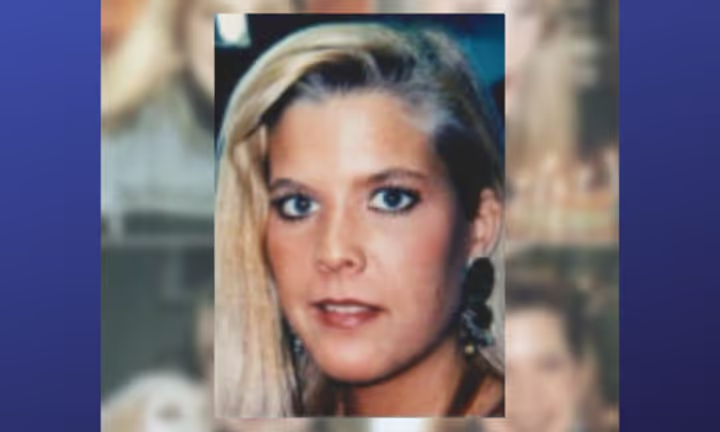
Joann “Jody” Elizabeth LeCornu was 23 years old when her life was taken in the early morning hours of March 2, 1996, in Baltimore County, Maryland. She was a Towson State University student, a young woman with deep roots in the community, and someone whose future seemed wide open before violence brought everything to an abrupt stop. More than 30 years later, her murder remains unsolved, and her name still carries weight in Baltimore area cold case discussions because of both the circumstances of her death and the determined search for answers that followed.
The case has stayed in public memory because it combines heartbreak, mystery, and lingering questions that have never been fully resolved. Jody was not a distant figure whose story faded with time. She was remembered by family, friends, investigators, and local media as a real person with plans, routines, and relationships. The years have passed, but the pain attached to her loss has not disappeared. Each anniversary has served as another reminder that the person responsible for her death has not been brought to justice.
The Night of March 2, 1996
According to police and later reporting, Jody spent part of the evening before her death out in the area, including time at the Mount Washington Tavern. Local reports also say she had been at the Curb Shoppe Bar and Grill before the final and fatal sequence of events unfolded near York Road. That timeline matters because investigators have long tried to understand where she went, who might have seen her, and whether she crossed paths with the person who killed her earlier in the night.
In the early morning hours, the case reached its tragic turning point. Police say Jody was in her white Honda when she was shot in the parking lot area around 6400 York Road. Officers later responded to a reported shooting in the 6300 block of York Road just before 4:00 a.m. She was found inside her vehicle, fatally wounded by a gunshot. Some reporting states she was discovered at a shopping center along York Road after the shooting, which has become one of the defining details in the case because it suggests movement in the final moments after she was attacked.
One of the most haunting aspects of the case is that Jody did not simply die where she was first shot. Investigators say she drove across York Road after being wounded, and her vehicle came to a stop in another nearby lot. That detail has always given the case an especially tragic dimension. It suggests she was trying to survive, trying to get away, or trying to make it to some point of safety after the gunfire erupted. Even after all these years, that sequence remains one of the clearest and saddest images attached to the case.
The Scene Along York Road
York Road in that stretch of Baltimore County was a commercial corridor, not some remote hidden area far from people and traffic. That has always made the murder more frustrating to investigators and more unsettling to the public. The shooting happened in a place where someone may have seen something important, even if they did not understand its importance at the time. Shopping center parking lots, roads, and late night businesses all create the possibility of witnesses, passing drivers, and scattered observations. That reality has fueled the belief that the answer may still rest with someone who noticed a face, a car, a motion, or a moment that never seemed significant until later.
The official and media accounts describe a suspect linked to a white BMW. Witness descriptions also repeatedly mention a Black male with a stocky build wearing an olive green or camouflage style jacket. Those details have circulated for years because they remain among the most recognizable public clues in the case. Even so, a broad description and a vehicle reference were never enough on their own to close the investigation. This is one of the reasons the case has endured as such a painful mystery. There were pieces to work with, but not enough to complete the puzzle.
A Case Marked by Unanswered Questions
A major question has always been whether Jody was targeted by someone she knew, lured into some kind of meeting, or encountered her killer by chance. Reporting in recent years has made clear that investigators have not publicly settled on a single definitive explanation. That uncertainty has left multiple possibilities on the table and has contributed to the case’s long life as an open homicide investigation. When a case begins with an unclear motive and incomplete identification of the suspect, every missing piece becomes more important.
Another troubling detail is the report that after Jody’s car stopped, the suspect allegedly reached inside and removed something. That detail has led to speculation about robbery or the taking of a specific item, but publicly available reporting stops short of resolving exactly what was taken or why. What remains clear is that investigators viewed that action as significant. It was not just a shooting and flight. There appeared to be an additional act at the car that may speak to motive, panic, or some connection between the victim and the killer that has never been fully explained in public.
Cases like this often become difficult not because there are no clues, but because there are too many partial clues and too few decisive ones. A witness may remember a jacket but not a face. A vehicle may stand out but never be tied conclusively to a suspect. Someone may hear something years later but refuse to come forward. Over time, those fragments can pile up into a thick file without yielding the one break that changes everything. Jody LeCornu’s murder appears to fit that painful pattern.
The Investigation Over the Years
The investigation did not vanish after the initial headlines. Baltimore County Police have continued to classify the case as an unsolved homicide and have kept it active through their Cold Case Squad. Recent reporting has emphasized that detectives still seek information and still believe the case can be solved. That continued official attention matters. It means the case is not simply a historical tragedy remembered by family alone. It remains an open matter for law enforcement.
WMAR reported that the case is among the larger unsolved files held by the Baltimore County Police Cold Case Unit and that seven binders of interviews and notes have accumulated over the years. That image says a great deal about the scale of the investigation. It suggests not a lack of effort, but an abundance of effort that still has not produced closure. Every interview, note, and lead reflects time spent trying to reconstruct one terrible night and identify the person who ended a young woman’s life.
The same reporting has noted that evidence over the years included witness statements, fingerprints, and video that was reportedly sent to the FBI for enhancement. Even with those efforts, the case remained unresolved. That is one of the cruel realities of cold cases. Evidence may exist, investigators may work it from multiple angles, and yet the final step toward prosecution never comes. The endurance of this case shows how even a well known murder can resist resolution for decades when the evidence does not align cleanly enough to produce a charge.
The Family’s Fight for Justice
No long article about Jody LeCornu can ignore the role of her family, especially her twin sister, Jennifer Carrieri. Public reporting has repeatedly pointed to Carrieri’s persistence in keeping the case alive. She has pushed for public attention, spoken to media, and refused to allow the case to disappear into silence. That effort has been central to the continued public awareness surrounding Jody’s murder.
Families of homicide victims often become unofficial keepers of the case. They remember dates, faces, old conversations, and unresolved suspicions with an intensity that few others can match. In Jody’s case, that emotional labor has stretched across decades. It has meant reliving the same loss over and over while also trying to move the case forward. It is difficult enough to lose someone to murder. It is even harder when the investigation remains open for years without a final answer.
Public remembrance can be exhausting for families, but it also becomes a way to resist erasure. The fact that Jody’s name still appears in news reports, police appeals, and cold case discussions is partly the result of sustained advocacy. Her story never fully disappeared, and that alone says something powerful about the devotion of those who loved her. While the legal case remains incomplete, the moral case for remembering her has never weakened.
Why the Case Still Resonates
The murder of Jody LeCornu continues to resonate because it feels at once specific and universal. It is specific in its details, a young student, a commercial stretch of road, a white Honda, a white BMW, a gunshot in the night, an unsolved file that never closed. But it is universal in the emotions it stirs. Fear, grief, frustration, and the longing for justice are all present in the story. That combination keeps the case alive in public memory.
There is also something deeply unsettling about violence occurring in a familiar everyday setting. Parking lots, shopping centers, and roadside commercial areas are supposed to feel ordinary. When a murder occurs there, especially one never solved, the ordinary setting becomes part of the unease. It reminds people how quickly normal life can turn into tragedy and how thin the line can be between routine movement through a city and irreversible catastrophe.
The passage of time has only deepened the emotional force of the case. Every anniversary adds another layer to the story. It marks not only the date of Jody’s death, but also the growing span of years in which her family has waited, investigators have searched, and the public has wondered who killed her. In unsolved murders, time does not close the wound. It simply measures how long it has remained open.
The Meaning of an Unsolved Murder
An unsolved murder leaves behind more than grief. It leaves behind a broken timeline. There is the life that was lived before the killing, and then there is the long suspended state that follows, where answers never fully arrive. That is the space in which Jody LeCornu’s story has remained for three decades. Her death on March 2, 1996, is not just a past event. It is an ongoing absence in the lives of the people who knew her and in the record of a community that still does not know who carried out the crime.
The continued attention to the case suggests that hope has not entirely disappeared. Cold cases can break years after the fact because of a renewed witness statement, a newly cooperative source, improved technology, or a detail that finally fits into place. Jody’s case remains one of those investigations where the belief in a future answer still survives. That hope is part of why the story continues to be told.
At its core, the murder of Jody LeCornu is the story of a young woman whose life ended violently and far too soon, a family forced to live with permanent loss, and an investigation that has refused to close even as the years have passed. It is a Baltimore County case, but it also stands as a larger symbol of what unresolved violence does to memory, community, and time itself. Until the person responsible is identified and held accountable, the story remains unfinished.
Discover more from City Towner
Subscribe to get the latest posts sent to your email.