History of Port St. Lucie Florida
Port St. Lucie sits on Florida’s Atlantic “Treasure Coast,” framed by the St. Lucie River system, low coastal ridges, pine flatwoods, and wetlands that once flowed seasonally toward the Indian River Lagoon. Before pavement and canals, this landscape was a mosaic of saw palmetto, longleaf pine, and hammocks cut by tannin-stained creeks. The climate—humid subtropical with a pronounced wet season—favored citrus, cattle grazing, and later suburban lawns. Geography matters to Port St. Lucie’s story: water and sand dictated where pioneers settled, how developers platted streets, and which neighborhoods boomed when new bridges, highways, and utility lines arrived.
Indigenous presence and early names
Archaeology and local tradition point to long Indigenous use of the middle St. Lucie basin, especially near resource-rich bluffs and shell middens along the river. Peoples associated with the Ais culture left earthworks and burial mounds; later, Seminole groups traversed the area during the eighteenth and nineteenth centuries as they adapted to pressures from colonial expansion. The “St. Lucie” toponym dates back to Spanish navigation and mission names from the sixteenth and seventeenth centuries (Santa Lucía), a label that migrated across maps and, over centuries, attached to river, inlet, and county. Well before a city existed, the name had regional currency.
Pioneer outposts: Spruce Bluff and river country
Nineteenth-century pioneer life clustered at reachable high ground. One of the earliest documented settlements within today’s city footprint was Spruce Bluff, established in the 1890s on a rise along the South Fork of the St. Lucie River. A small farming community with a modest cemetery and wharf, it supplied produce and lumber via the river to markets farther north and south. The settlement never exploded into a town—mosquitoes, storms, and limited overland access checked its growth—but it proved the river corridor could support permanent families. The pattern was typical of the Florida frontier: small river hamlets linked by boats, hunting trails, and later sand tracks.
From scattered homesteads to a planned city
Port St. Lucie’s transformation from woodland and ranchland to master-planned suburb came abruptly in the mid-twentieth century. In 1958, large tracts along the North Fork of the St. Lucie River changed hands to developers who specialized in “new town” subdivisions. Within a year, plats, model homes, and a sales machine were in motion. Roads were cut in a recognizable grid, drainage canals and retention lakes were engineered to dry out flatwoods during the wet season, and a riverfront focus anchored early neighborhoods. The sales strategy—common across Florida at the time—marketed affordable lots to retirees and middle-class families from the Northeast and Midwest, promising sunshine, boating, golf, and paved convenience at a fraction of big-city costs.
Incorporation and early civic identity
The pace of lot sales outstripped the ad-hoc governance structures of the county, leading residents to seek city status. Port St. Lucie incorporated in 1961, establishing the legal framework to levy taxes, plan land use, expand utilities, and professionalize public services. Early city leaders prioritized reliable water and sewer, stabilized roadway construction, and coordinated public safety across far-flung subdivisions. Even in these formative years, the city’s identity coalesced around three pillars: attainable single-family housing, river-and-park access, and a family-friendly brand distinct from the tourist economies of beach towns to the east.
Transportation: the quiet engine of growth
If cheap land and sunshine set the table, highways served dinner. The Florida Turnpike’s progressive build-out and, later, the arrival of Interstate 95 to the city’s west multiplied access. Each interchange became a lure for commercial strips, warehouses, and new residential pods. Bridges across the North Fork reconnected neighborhoods to services and schools. The result was a settlement pattern that pushed westward from the river, infilling cul-de-sacs and creating a checkerboard of micro-communities linked by arterials such as Port St. Lucie Boulevard and Prima Vista Boulevard. Transit remained largely auto-centric, but the road network gave the city control over where growth would land.
Parks, preserves, and the river
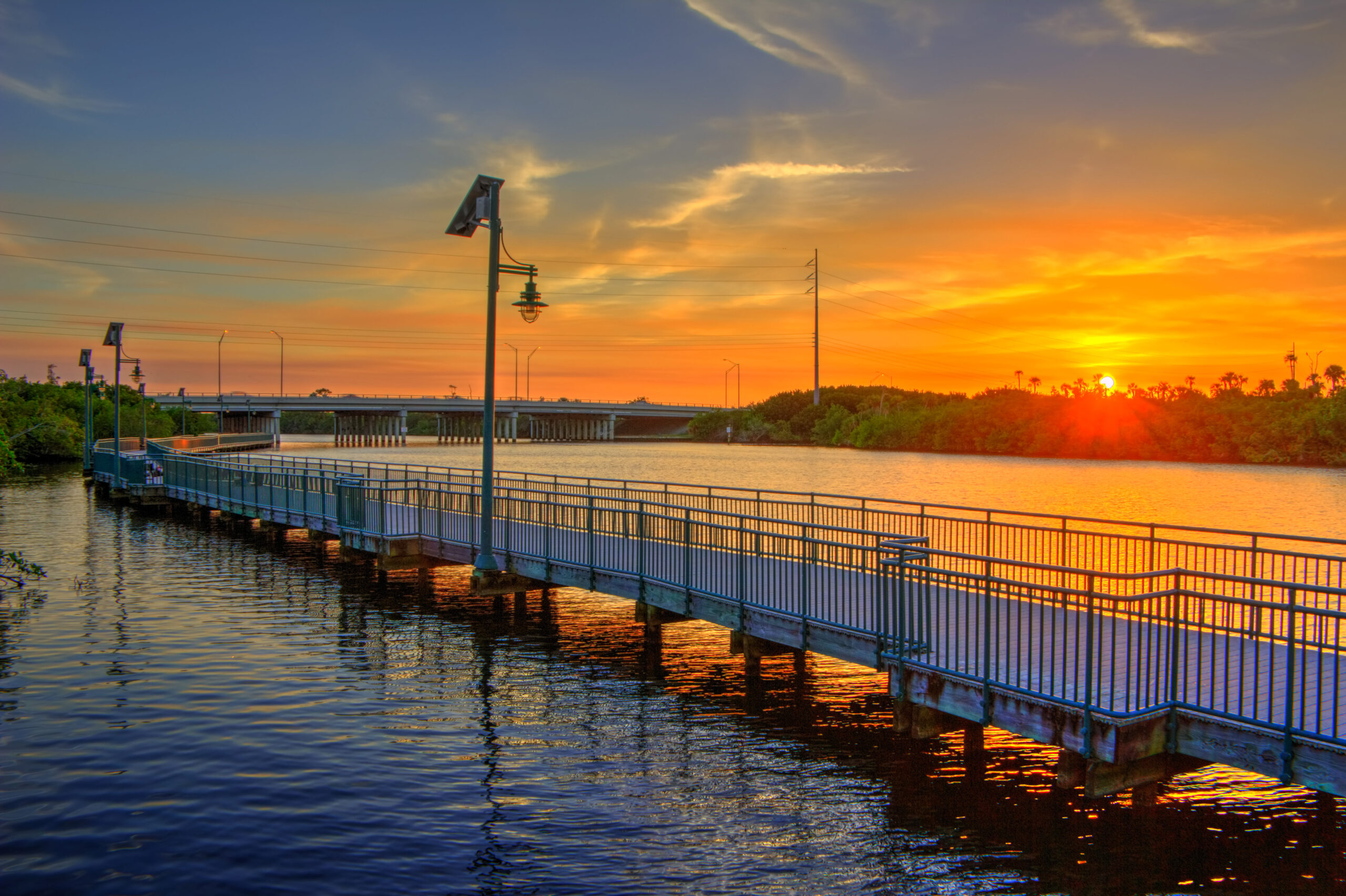
A deliberate park and preserve strategy kept Port St. Lucie’s “green bones” intact. Alongside neighborhood parks, the city and partners protected stretches of the North Fork’s floodplain as passive preserves with boardwalks and canoe launches. This threading of greenspace through residential areas did double duty: flood storage during storm events and daily recreation for walkers, paddlers, anglers, and birders. The city’s conservation stance—paired with routine canal maintenance—helped reconcile a built environment of tens of thousands of lots with the ecological realities of a river estuary.
Hurricanes, building codes, and resilience
Like all Atlantic-side Florida cities, Port St. Lucie is shaped by storm memory. Successive hurricane seasons, notably in the early 2000s, stress-tested roofs, drainage, and utility redundancy. Each event tightened codes: stronger tie-downs, impact windows, better elevation practices on new construction, pump station hardening, and power line upgrades. Road crews learned where sheet flow pooled; engineers re-optimized canal weirs and outfalls. The city’s rapid rebuilds after major storms signaled to residents and prospective movers that resilience investments paid off in quicker recoveries and stable insurance profiles relative to peers.
Economic evolution: from bedroom community to regional hub
For decades, Port St. Lucie’s economy was defined by construction, services, healthcare, education, and retail meeting the needs of a growing population. Two shifts broadened that base. First, destination recreation—the arrival of spring training baseball and year-round sports tourism—anchored hospitality, restaurants, and seasonal employment. Second, master-planned districts in the western reaches recruited medical offices, light industrial, and research-adjacent employers. While the city never tried to be a high-rise financial center, it matured into a regional hub: logistics on the interstate side, professional services in office parks, and a constellation of small businesses servicing a large homeowner base.
Housing stock and neighborhood character
The iconic Port St. Lucie home is a single-story ranch on a quarter-acre lot with block construction, a garage, and a screened lanai. Early subdivisions emphasized uniformity for speed and cost control; later phases diversified with gated communities, townhome clusters, and age-restricted enclaves. Architectural guidelines evolved to reflect wind standards and buyer taste, but affordability remained a civic priority. HOA and non-HOA areas live side by side, giving residents choices on assessments, amenities, and rules. The cumulative effect is a city of neighborhoods—some leafy and older near the river, others newer and master-planned toward the west.
Demography and culture: where new Floridians land
Port St. Lucie’s population story is one of continuous net in-migration. Retirees still arrive for climate and cost, but families with school-aged children and working adults priced out of South Florida metros also stream in. The city’s schools, youth sports, houses of worship, and civic clubs reflect that mix. Community festivals, farmers’ markets, and river clean-ups—more resident-focused than tourist-driven—fill the calendar. The cultural mood is practical and neighborhood-centric: mow the lawn early, coach on weekends, paddle the river when the weather cooperates, and keep an eye out during hurricane season.
Government, planning, and utilities at scale
Running a fast-growing city required professional planning. Port St. Lucie refined its comprehensive plan repeatedly: concurrency rules to ensure roads and schools kept pace with permits; utility expansions sequenced to avoid leapfrog development; and capital plans that bundled sidewalks, traffic signals, and park amenities. Because so much of the city was platted early, infill policies mattered—redeveloping aging commercial strips, incentivizing façade improvements, and retrofitting corridors for turn lanes and safer crossings. Utility departments scaled treatment plants and reuse water networks, while solid waste, stormwater, and fleet services modernized to serve a dispersed footprint efficiently.
Education and healthcare build-out
As rooftops multiplied, so did classrooms and clinics. The public school system added elementary, middle, and high schools in step with westward expansion. Charter and private options filled niche demand. On the healthcare side, outpatient centers, specialty practices, and hospital expansions followed demographics—cardiology and oncology for retirees, pediatrics and urgent care for families, sports medicine for the athletically active population. Workforce pipelines grew through partnerships with regional colleges and technical programs that trained nurses, medical techs, HVAC installers, and construction trades.
Environmental stewardship and the next chapter
Balancing growth with water quality remains a defining challenge. The city’s stormwater program, fertilizer ordinances, canal maintenance, and septic-to-sewer conversions aim to protect the North Fork and downstream lagoon. Tree canopy initiatives and habitat restoration projects seek to reconnect fragmented green spaces. On energy and mobility, incremental shifts—LED streetlights, EV charging at civic sites, and sidewalk gap programs—signal a pragmatic approach: many small actions, repeated over time, to bend the trajectory toward sustainability without upending the city’s single-family DNA.
Identity and through-lines
Across a relatively short municipal lifespan, several through-lines persist. Port St. Lucie is a place built quickly yet not haphazardly, where master-planning and homeowner scale coexist. It is a river city that keeps its wild edges visible. It is more “live here” than “visit here,” with amenities tuned to residents. And it is a city that treats infrastructure not as background noise but as the backbone of daily life—roads, pipes, culverts, parks, and schools knit together into the quiet machinery that makes a dispersed suburb function.
Timeline snapshot
- Pre-1800s: Indigenous use of the St. Lucie basin; archaeological sites on high ground near waterways.
- Late 1800s–early 1900s: Pioneer agriculture and lumber at Spruce Bluff and scattered homesteads; river transport dominates.
- 1958–1959: Large-scale land acquisition and subdivision launch; roads and canals cut; model homes built.
- 1961: Incorporation of Port St. Lucie; city governance begins formal planning and utility expansion.
- 1970s–1990s: Highway interchanges catalyze growth; steady infill of platted lots; parks and preserves designated.
- 2000s–present: Rapid population gains; resilience upgrades after hurricanes; diversified economy with healthcare, logistics, and services; continued westward build-out with conservation corridors along the river.
Why Port St. Lucie matters in Florida’s urban story
Port St. Lucie exemplifies the twentieth-century Florida city: conceived at scale, sold on lifestyle, and matured into a self-sustaining municipality. Unlike beach-centric resort towns, it shows how inland-adjacent river corridors can anchor large resident communities without relying on heavy tourism. Its planning lessons—sequencing utilities, preserving greenways, hardening against storms, and keeping housing attainable—have relevance across the Sun Belt as fast-growing metros wrestle with the trade-offs of space, water, and speed.
Discover more from City Towner
Subscribe to get the latest posts sent to your email.