
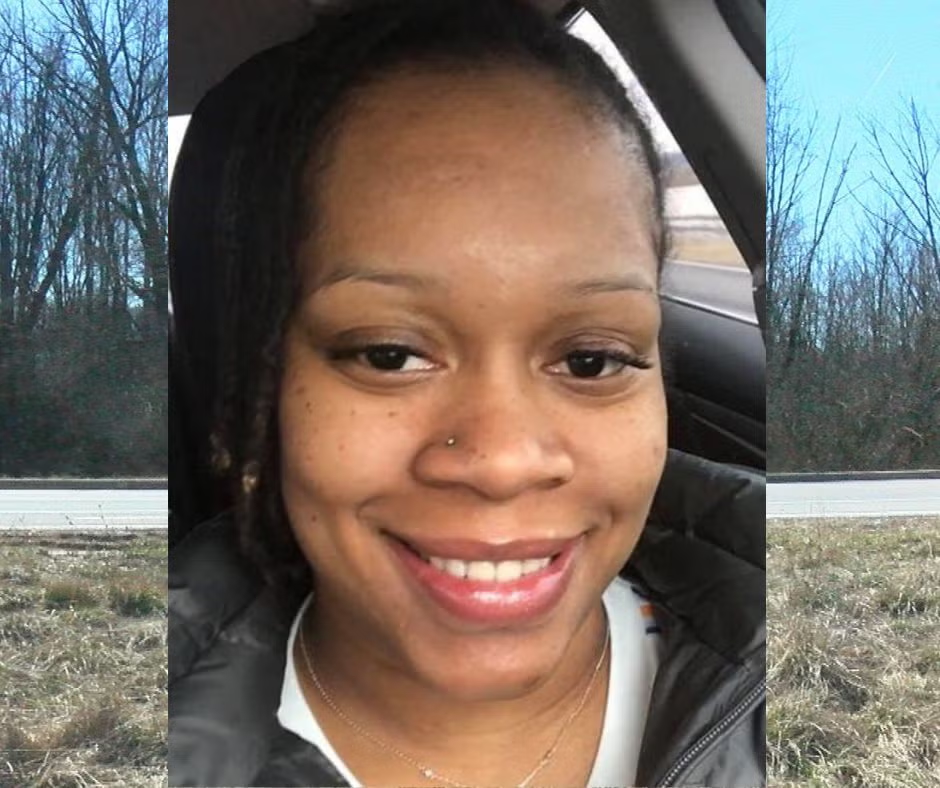
Najah Alesa Ferrell Murdered in Avon Indiana
The murder of Najah Alesa Ferrell remains one of the most disturbing and heartbreaking cases tied to Avon, Indiana. What began on March 15, 2019, as an ordinary workday morning for a young mother became the start of a tragedy filled with fear, unanswered questions, and a level of pain that would linger far beyond the first headlines. Najah left home expecting to begin a new opportunity, but she never made it to her destination. From that moment forward, her disappearance became a crisis for her family and, later, a devastating death investigation that left the public struggling to understand how such a violent loss could happen.
Some murder cases shake people because of the brutality involved. Others stay with the public because of the victim’s age, innocence, or the strange path the investigation takes. Najah’s case carried all of those emotional elements in a different way. She was a 30 year old mother whose life was still active, full, and connected to the people who depended on her. Her disappearance did not begin with some known dangerous encounter or a dramatic public scene. It began with something simple and relatable. She was leaving for work. That ordinary detail is one of the reasons the case continues to carry such emotional force. It reminds people how quickly normal life can be interrupted by violence.
The fact that her case later involved the discovery of only partial remains made the tragedy even more painful and unsettling. It transformed what was already a frightening missing person case into a homicide story marked by deep uncertainty and unbearable grief. For Najah’s loved ones, the horror was not limited to the fact that she was gone. It was amplified by the way the truth emerged in fragments, each development bringing more pain instead of peace.
Najah Alesa Ferrell and the Life She Was Living
Before her name became linked to a major investigation, Najah Alesa Ferrell was known to the people around her as a mother, a loved one, and a woman with responsibilities, relationships, and a life in motion. She was not someone living at the margins of society. She was part of a family structure, part of a community, and part of the daily rhythm that defines so many adults trying to build stability for themselves and their children.
That matters because murder cases are often discussed in ways that reduce victims to what happened to them. But Najah’s story is about more than the terrible end of her life. It is also about the fact that she was a real person with a future that should have continued. She had children who needed her. She had plans for that day. She had the normal concerns and hopes of somebody trying to move forward. That human reality makes the case especially painful. She was not simply the subject of an investigation. She was someone whose absence would have been felt immediately and deeply by the people who loved her.
The loss of a mother always carries a particular kind of emotional devastation. It reaches beyond the victim and into the lives of children who must grow up carrying that absence. In Najah’s case, that reality makes the story even more tragic. Her death did not only end her life. It reshaped the lives of those closest to her and left behind a grief that would not be limited to one moment or one season. It would continue through birthdays, family gatherings, milestones, and all the ordinary moments when her presence should still have been there.
The Morning of March 15, 2019
March 15, 2019, should have been just another day on the calendar. Instead, it became the date that would define one of Indiana’s most haunting unsolved homicide cases. Najah reportedly left her home in Avon, Indiana, that morning for a new job orientation. It was the kind of detail that makes the case feel even more grounded in ordinary life. She was not heading into chaos. She was stepping into a new opportunity.
That fact made her disappearance especially alarming. When someone vanishes on the way to a normal obligation, the contrast between the routine plan and the violent outcome becomes hard to process. A job orientation suggests structure, purpose, and a next step in life. It does not suggest danger. It does not suggest that a person will disappear and never arrive. That gap between expectation and reality is one of the darkest features of the case.
In the earliest hours after she did not show up, there was likely confusion before fear fully took hold. People often hope there is an innocent explanation. Maybe there was a misunderstanding. Maybe a phone battery died. Maybe plans changed. But as time passed and Najah remained out of contact, the situation became more serious. Loved ones were left trying to understand how a simple departure from home could turn into complete silence.
Cases like this are especially painful because the beginning is so relatable. Most people leave home for work, errands, or routine commitments without a second thought. Najah did the same. That familiarity makes what happened next feel even more disturbing because it reveals how fragile everyday safety can be.
From Missing Person to Homicide Investigation
At first, the public knew Najah’s case as a disappearance. That alone was frightening enough. A mother had left home and never reached her destination. Her absence created immediate concern, and the search for answers began with the same kinds of questions that define so many missing person cases. When was she last seen. Who spoke to her last. What route did she take. Did anyone notice anything unusual.
But the case took a darker turn as physical evidence began to surface. Her abandoned vehicle was found in Indianapolis, and some of her belongings were discovered nearby. That development immediately changed the emotional tone of the case. An abandoned car often signals that something is badly wrong. It suggests disruption. It suggests violence or coercion. It suggests that whatever happened was not part of a normal voluntary departure.
The discovery of belongings only deepened that fear. Objects connected to a missing person often become painfully symbolic. A purse, clothing, or other personal items can say more emotionally than words ever could. They show evidence of interruption. They show that a person did not simply walk away from one life into another. Something happened. Something severed the ordinary path of that day.
The most horrifying development came when a severed foot found in Crown Point, Indiana, was identified as belonging to Najah. At that point, any lingering hope of a simple disappearance was gone. The case was no longer a mystery about where she might be. It had become a homicide story marked by brutality and loss. The discovery of partial remains gave the family one kind of answer, but it was the kind no one ever wants. It confirmed that Najah had been killed, while still leaving the broader truth of what happened incomplete.
The Emotional Weight of Partial Remains
There is something especially devastating about murder cases in which a family receives only fragments of what was lost. It is one thing to face the confirmed death of a loved one. That alone is unbearable. It is another thing to face a death investigation in which the body is not fully recovered and answers arrive in pieces. That kind of case creates a special kind of anguish because the violence feels even more dehumanizing.
For Najah’s loved ones, the identification of her severed foot must have been emotionally shattering. It confirmed the worst possible outcome while also emphasizing the brutality of what had been done. Instead of bringing clean closure, it brought a grim and incomplete truth. She was gone, and the way that fact became known only made the suffering more intense.
Partial remains also deepen public fascination with a case because they raise so many unanswered questions. How did she die. Where did the killing take place. How did remains end up so far from where she disappeared. Who was involved. Was the body moved. Did anyone help cover up the crime. Those questions do not just serve public curiosity. They speak to the unfinished nature of justice in cases like this. A terrible act has clearly occurred, but the full story remains hidden.
That hidden story is part of what continues to make Najah’s murder so haunting. The public knows enough to understand the horror, but not enough to understand the complete truth. That combination can keep a case alive in memory for years.
Avon, Indianapolis, and Crown Point
One of the reasons this case has remained so troubling is the geography involved. Najah disappeared after leaving Avon, Indiana. Her vehicle and some belongings were later found in Indianapolis. Then a severed foot identified as hers was found in Crown Point, far from where the day had begun. That movement across locations makes the case feel broader, darker, and more deliberate.
A murder case that stretches across multiple places often leaves a stronger sense of mystery because it suggests planning, concealment, or at least a sequence of events more complicated than a sudden act of violence in one isolated setting. It also expands the emotional footprint of the case. Avon becomes the place where the disappearance began. Indianapolis becomes the place where physical clues reinforced fear. Crown Point becomes the place where the investigation crossed into confirmed horror.
For the public, that kind of map creates a disturbing chain of images. A woman leaves home for work. A vehicle is found abandoned. Belongings appear. Then remains are recovered far away. Each step adds another layer of dread. Each location becomes attached to a different stage of grief and realization.
For a family, those places become even heavier. They are not simply points on a map. They are markers in a nightmare. One is where life looked normal. Another is where fear sharpened. Another is where the loss became undeniable. That is part of why the case still feels so painful years later. It is not attached to one moment of tragedy alone. It is attached to a sequence of discoveries, each one cruel in its own way.
A Community Left With Fear and Questions
When a murder case remains unresolved, the grief felt by the family is often joined by a wider anxiety in the community. People do not only mourn the victim. They also begin to fear the unknown person or people responsible. In Najah’s case, that fear was intensified by how ordinary her day had appeared at first. If someone can leave home for work and disappear into a violent death, then the public is forced to confront how vulnerable ordinary routines really are.
Communities respond to cases like this in different ways. Some become loud and active, organizing awareness campaigns and keeping the victim’s name in public conversation. Others hold the grief more quietly, but the fear still lingers underneath. Parents become more cautious. Friends check on one another more often. People begin to think differently about roads, parking lots, and the spaces between home and destination. Violence changes not only a life but the sense of normalcy around it.
Najah’s murder also stayed present because of the unanswered nature of the case. When there is no public arrest and no full explanation, the story remains open in the minds of those following it. The absence of resolution becomes part of the pain. People are not simply mourning a woman whose life was taken. They are also struggling with the fact that the full truth remains obscured.
That unresolved status creates a second wound beyond the murder itself. The first wound is the loss. The second is the lack of public accountability. Families often live for years with the knowledge that someone knows more than has been said. That suspicion can be unbearable. It means justice feels possible, but still out of reach.
The Pain of a Mother Taken Too Soon
Najah Alesa Ferrell’s murder carries an especially heavy emotional force because she was a mother. That truth changes the way the case is felt. Her death was not an isolated personal tragedy. It was a family rupture. The person lost was also a parent, a source of care, structure, and love for children whose lives would now be permanently marked by absence.
Whenever a mother is taken violently, the grief expands outward in ways that cannot be measured by headlines alone. The children left behind do not simply lose someone from the family. They lose a presence that shapes identity, security, and emotional grounding. That pain unfolds over years, not only in the immediate aftermath. It appears in all the moments when a mother should be there but is not.
That is one reason Najah’s case continues to stir such strong sympathy. People do not only see a victim. They see a woman who was trying to move through ordinary life, perhaps build something better, and care for the people who depended on her. Her story feels like an especially cruel interruption of responsibility and love.
There is also a wider social weight to cases like this. They remind the public that violence against women often destroys entire family structures, not just individual lives. The murder of a mother sends shockwaves through generations. It leaves children with grief, relatives with questions, and communities with a sense of injustice that does not fade quickly.
The Long Shadow of an Unsolved Case
Years after March 15, 2019, Najah’s murder still cast a long shadow because the case remained publicly unsolved. That matters deeply. Time does not erase a violent death. In many ways, it intensifies the sorrow because the years that should have been filled with ordinary living instead become years of waiting, wondering, and remembering.
An unsolved homicide traps loved ones in a difficult emotional place. They know the person they love was taken from them, but they do not know everything about how it happened or who should be held accountable. That unfinished state keeps grief restless. It prevents the case from settling into the past. Each anniversary brings the pain back into focus. Each new year without answers feels like an additional injury.
For the public, unresolved murder cases often become stories of mystery. For the family, they remain stories of trauma. That distinction matters. It is easy to focus on theories, timelines, or possibilities, but the real human center of the case is a family living with the consequences of violence and uncertainty at the same time.
Najah’s case continues to resonate because it reflects one of the hardest truths about justice. Sometimes the reality of a crime becomes known before accountability arrives. Sometimes a death is obvious, but the full explanation remains hidden. That gap can torment families and frustrate communities for years.
Why Najah Ferrell’s Story Still Matters
The murder of Najah Alesa Ferrell still matters because it is a story about far more than a single crime. It is about vulnerability, motherhood, ordinary life interrupted, and the cruelty of a case in which truth emerged through fragments. It is about a woman who left home expecting a normal day and instead became the center of a tragedy that remains deeply unsettling.
Her story also matters because it reminds people how easily victims can be reduced to the worst thing that happened to them. That must be resisted. Najah should not be remembered only for the horror attached to her case. She should be remembered as a woman with relationships, responsibilities, and a life that had meaning long before violence entered the picture.
There is also value in continuing to speak about cases like hers because memory itself becomes a form of respect. An unsolved murder can slip from national attention, but for the family the loss never becomes old. Remembering the victim helps resist the silence that unresolved violence can create.
Najah Ferrell’s story stays with people because it contains so many painful elements that are hard to shake. A new job orientation. A mother leaving home. An abandoned vehicle. Personal belongings left behind. Remains discovered far away. No public resolution. Those details do not fade easily because together they form a picture of a life violently broken apart.
Remembering Najah Alesa Ferrell
To write about the murder of Najah Alesa Ferrell is to write about a life interrupted by violence in a way that still feels deeply unresolved. On March 15, 2019, in Avon, Indiana, she stepped into what should have been a normal day. Instead, that morning became the starting point of a case marked by disappearance, fear, and the grim confirmation that she had been killed.
Her story remains heartbreaking because it combines so much ordinary humanity with such terrible loss. She was not living in some distant world of danger separate from everyday experience. She was living the kind of life many people recognize. She was leaving home, moving through routine, and trying to take care of what mattered. That familiarity is what makes the violence feel so shocking.
Najah deserves to be remembered not only as a victim of homicide but as a mother and woman whose life had value beyond the case that now bears her name. The true tragedy is not simply that she died. It is that everything she should have continued to be and do was stolen.
That is why her murder still carries such emotional weight. It is a story of loss without full closure, grief without complete answers, and a family forced to live with both love and uncertainty. Even after the passage of time, the core truth remains devastating. A woman left home on March 15, 2019, and never came back. What followed became one of the most painful homicide mysteries connected to Avon, Indiana.
Discover more from City Towner
Subscribe to get the latest posts sent to your email.