
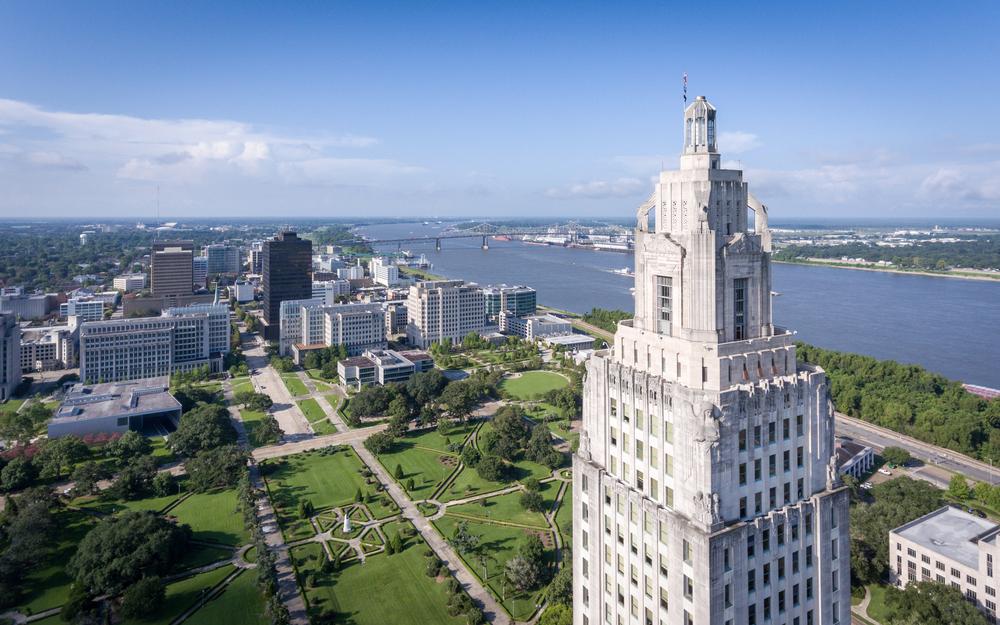
History of Baton Rogue
The history of Baton Rouge begins long before European settlement, in a region shaped by Indigenous peoples whose communities, trade, and territorial boundaries gave the area its earliest identity. The name Baton Rouge is widely traced to a “red stick,” a boundary marker reportedly observed by French explorer Pierre Le Moyne d’Iberville in 1699. Accounts describe this pole as marking a division between the hunting grounds of the Bayou Goula and Houma peoples. That image of a red marker on the landscape would become one of the most enduring origin stories in Louisiana history and eventually gave the city its name.
The land itself played a major role in the area’s early significance. Baton Rouge sits along the Mississippi River on bluffs higher than much of the surrounding low country. That geography mattered enormously. It made the site easier to defend, more practical for settlement, and less vulnerable to flooding than many nearby places. Long before the city developed into the capital of Louisiana, the location already held strategic value because of its position between interior lands and the river system that would shape so much of the region’s destiny.
The story of Baton Rouge is therefore not only a colonial or American story. It begins with Indigenous presence, Indigenous geography, and Indigenous influence over the cultural landscape. Even the city’s name, now repeated casually in maps and headlines, still carries that early encounter between Native space and European interpretation. That makes Baton Rouge different from places whose identities began only after European settlement. Here, the very first layer of history is still preserved in the name itself.
French Settlement and a Growing Frontier Outpost
The French formally established Baton Rouge in 1719, and from the start the settlement was shaped by its river position and its status as a frontier community. Baton Rouge was never simply an isolated village. It was part of the wider French colonial world in Louisiana, connected to trade, military interests, and the expansion of European power into lands already occupied by Native peoples. The French presence gave the area its earliest colonial structure, but like much of Louisiana, Baton Rouge would soon become a place of shifting empires rather than stable rule.
Life in the settlement was shaped by uncertainty as much as opportunity. Baton Rouge existed on a contested edge of empire, where military concerns, fear of attack, and broader colonial rivalries were always near the surface. The settlement’s location made it attractive, but it also made it vulnerable. It sat within a region where Native resistance, European competition, and the violent systems of colonial expansion all affected daily life. These tensions helped define Baton Rouge from the beginning and made it less a quiet town than a strategically important place where larger powers repeatedly tested one another.
Even in these early years, the seeds of Baton Rouge’s later importance were already there. The river gave it economic value. The bluffs gave it defensive strength. The frontier setting gave it political importance. What looked at first like a small colonial settlement contained the ingredients of a city that would later matter far beyond its size.
Shifting Flags and Changing Empires
One of the defining features of Baton Rouge history is how many times control of the area changed hands. After French rule, the British gained control of the region in 1763 following the Seven Years’ War. Then, in 1779, the Spanish took Baton Rouge during the American Revolutionary era. French control was restored briefly in 1800, only for the Louisiana Purchase in 1803 to transfer the territory to the United States. Few American cities can point to such a compressed sequence of imperial changes in such a relatively short period.
These transfers of power were not abstract political shifts. They shaped law, trade, military planning, and the cultural makeup of the region. Baton Rouge developed in an environment where French, British, Spanish, and then American influences all left marks on local identity. That helps explain why the city’s culture has always carried a layered quality. Even when Baton Rouge later became closely associated with Louisiana’s American and Southern identity, it still carried the traces of its earlier colonial chapters.
The repeated handoffs also made Baton Rouge a city accustomed to adaptation. Its history was never one of a single uninterrupted tradition. Instead, it grew through change, absorbing new political realities while preserving older cultural layers beneath them. That long habit of adjustment would continue into the nineteenth and twentieth centuries as the city shifted again through statehood, war, industrialization, and modern growth.
Incorporation and Early American Growth
Baton Rouge was incorporated in 1817, and by the early nineteenth century it had begun taking on a more formal civic shape under American rule. The transition from colonial outpost to incorporated town marked an important phase in its development. Incorporation meant that Baton Rouge was no longer only a strategic river settlement or a prize of empires. It was becoming a civic community with local institutions, organized government, and growing ambitions.
The town’s position on the Mississippi helped support this growth. Baton Rouge stood at the head of deepwater navigation on the river, giving it an advantage as a port and transport center. In a state where waterways shaped commerce and movement, that location made the city important far beyond its immediate surroundings. Baton Rouge was not New Orleans, but its place in the river network meant it had lasting strategic and economic significance.
The early American period also brought increased Anglo-American settlement into Louisiana. The Louisiana Purchase accelerated demographic and political change, especially in areas outside New Orleans. Baton Rouge’s development during this period reflected that larger shift. It was part of a Louisiana becoming more tightly connected to American expansion while still remaining culturally distinct from much of the rest of the United States.
Becoming the Capital of Louisiana
One of the most important turning points in Baton Rouge history came when it was selected as the capital of Louisiana in the mid nineteenth century. The state legislature designated Baton Rouge as the new capital in 1846, replacing New Orleans, and the new seat of government began taking shape soon after. This decision transformed the city’s identity. Baton Rouge was no longer only a river town and regional port. It became the political center of the state.
The choice reflected both practical and symbolic considerations. New Orleans was powerful, wealthy, and culturally dominant, but it was also seen by some lawmakers as too unruly, too distant from the rest of the state, and too tied to a coastal urban character. Baton Rouge, by contrast, offered a more central and controlled setting. Its elevated site along the river gave it dignity and visual prominence, and its smaller scale made it attractive as a purpose-built capital.
The construction of the Old Louisiana State Capitol helped cement that transformation. Designed in a dramatic neo-Gothic style, it gave Baton Rouge one of the most distinctive capitol buildings in the country. The building itself became a symbol of the city’s new status, a declaration that Baton Rouge was no longer secondary in Louisiana’s story. It now stood at the center of state politics and would remain there even as war and instability soon tested that role.
Civil War, Occupation, and Reconstruction
The Civil War brought upheaval to Baton Rouge, as it did to nearly every important Southern city. Because Baton Rouge was the state capital and held strategic river value, it became a significant target during the conflict. The city fell to Union forces in 1862, and the state government relocated for a time. This period disrupted political life, unsettled local society, and placed Baton Rouge within the larger military struggle over control of the Mississippi River and the Gulf South.
War altered Baton Rouge both physically and politically. Military installations grew in importance, and the city experienced the instability that comes when government, transportation, and civilian life are all shaped by conflict. As in much of Louisiana, the Civil War also exposed and intensified the brutal realities of slavery, race, and power that had long structured society. Baton Rouge’s wartime history cannot be separated from those deeper systems. The city was not only a battlefield of armies. It was also part of a broader social order being shattered and violently remade.
Reconstruction brought another difficult transition. Baton Rouge remained politically important, but like many Southern cities it had to navigate the aftermath of war, the redefinition of citizenship, and the contested future of the South. The capital eventually returned to Baton Rouge in 1882, reaffirming the city’s central role in Louisiana’s public life. That return mattered symbolically. It signaled that despite war and displacement, Baton Rouge’s role as the state capital had endured.
Education, Identity, and Institutional Growth
The later nineteenth and early twentieth centuries added another crucial layer to Baton Rouge’s history through the growth of major educational institutions. Louisiana State University made Baton Rouge its home in 1869, and Southern University arrived in 1914. Together, those institutions would become two of the most defining forces in the city’s culture, economy, and identity. Baton Rouge did not become merely a capital city. It also became a university city, shaped by students, faculty, athletics, research, and the social energy that colleges bring.
LSU in particular transformed the city’s image. Over time it became one of the state’s most visible institutions and a major force in Baton Rouge life, not just educationally but culturally. Southern University added another powerful dimension as one of the nation’s most important historically Black institutions. The presence of both schools in the same city helped make Baton Rouge a place where politics, education, race, and culture intersected in especially visible ways.
This educational development also helped Baton Rouge grow beyond its government role. A capital city can sometimes become overly defined by state politics alone. Baton Rouge avoided that by also becoming a place of student life, intellectual production, and cultural movement. The universities helped shape the city’s rhythms and gave it a complexity that extended well beyond legislative sessions and government buildings.
Industry, River Trade, and Modern Expansion
The Mississippi River always mattered to Baton Rouge, but the twentieth century brought a new scale of economic importance through port activity and industrial growth. Baton Rouge became the farthest inland port on the Mississippi capable of handling ocean-going vessels, and this helped make it a major center of trade and transport. River access gave the city long term economic leverage, connecting it to domestic commerce and global markets alike.
The petrochemical boom of the twentieth century transformed Baton Rouge even more dramatically. Industrial expansion reshaped the city’s economy, skyline, and geography, helping produce suburban growth beyond the older urban core. This industrial era created jobs, increased wealth, and strengthened Baton Rouge’s importance in Louisiana and the wider Gulf South. At the same time, it also tied the city’s identity more closely to refinery and chemical infrastructure, with all the social and environmental complications that such growth can bring.
As the city expanded, it changed in character. The historic riverfront and old governmental center were no longer the whole story. New neighborhoods, roads, commercial areas, and industrial corridors pushed Baton Rouge outward. Like many American cities in the mid and late twentieth century, it experienced the tensions of suburbanization, downtown change, and uneven development. The city that had once grown from a bluff-top settlement became a sprawling modern capital shaped by both state institutions and industrial power.
Consolidation and Civic Change
Another major milestone came in 1949, when Baton Rouge’s city government was combined with that of East Baton Rouge Parish. This consolidated city-parish structure was one of the earliest such arrangements in the country and changed the way Baton Rouge was governed. Rather than remaining only a city within a separate parish framework, Baton Rouge became part of a broader unified political system that shaped local administration for generations.
This change mattered because it reflected Baton Rouge’s growth beyond its older boundaries and acknowledged the reality that urban and parish life had become deeply interconnected. Consolidation was both practical and symbolic. It suggested that Baton Rouge had outgrown simpler local models and now required a broader structure to manage its expanding population, infrastructure, and services.
The city-parish system also reinforced Baton Rouge’s unusual identity. It was already the state capital, a river port, a university center, and an industrial city. Consolidated government added another layer, making Baton Rouge a place whose administrative structure stood apart from many other Southern cities. This helped shape civic life in lasting ways, influencing everything from planning to public services to political identity.
Culture, Memory, and the Baton Rouge of Today
Modern Baton Rouge carries all of these historical layers at once. It is the capital of Louisiana, but it is also a river city, a university city, an industrial city, and a cultural center with a distinct sense of place. The city’s museums, capitol buildings, riverfront spaces, arts institutions, and historic districts all reflect parts of that larger story. Baton Rouge does not tell a single clean narrative. It tells many at once.
Its architecture and landmarks preserve that layered history visibly. The Old State Capitol recalls the city’s nineteenth century political rise. The later New State Capitol reflects twentieth century ambition and modernity. Plantation houses, university buildings, military sites, and downtown institutions all speak to different eras in the city’s growth. Baton Rouge’s physical landscape functions almost like a map of its own evolution, showing how colonial settlement, American statehood, war, education, and industry all left traces.
The city also continues to be shaped by the tension between old and new. It carries the memory of Indigenous land, colonial rivalry, Civil War struggle, segregation and racial history, industrial transformation, and cultural reinvention. At the same time, it remains a living city, not a museum piece. Its universities, government institutions, neighborhoods, and businesses keep changing, which means Baton Rouge history is not something finished. It is still unfolding.
Why Baton Rouge History Matters
The history of Baton Rouge matters because it reveals so much about Louisiana and the American South in one place. Few cities combine Indigenous origins, repeated colonial transfers, capital city politics, Civil War significance, university influence, and industrial expansion as clearly as Baton Rouge does. It is a city where geography and power have always been tied together, where the river shaped destiny, and where every era left visible marks on the next.
It also matters because Baton Rouge has never been merely a backdrop for larger events. It has actively shaped them. As a capital, it influenced state policy. As a port, it shaped commerce. As a university center, it shaped culture and education. As an industrial city, it helped drive economic change across Louisiana. Baton Rouge’s history is therefore not only local history. It is part of the history of the entire state.
And perhaps most importantly, Baton Rouge history matters because it reminds us that cities are built layer by layer. A red stick on the landscape became a name. A colonial outpost became a town. A town became a capital. A capital became a modern city with universities, refineries, neighborhoods, and institutions that continue to shape life in Louisiana today. Baton Rouge is not important only because of where it is. It is important because of everything it has survived, absorbed, and become.
Discover more from City Towner
Subscribe to get the latest posts sent to your email.