History of Des Moines Iowa
Des Moines, Iowa has a history shaped by rivers, Native communities, military presence, agriculture, politics, industry, immigration, and the steady rise of the Midwest. As the capital of Iowa and one of the most important cities in the state, Des Moines has grown from a frontier river settlement into a center of government, insurance, finance, culture, education, and regional leadership.
The city sits where the Des Moines River and the Raccoon River meet. That location was important long before modern streets, bridges, offices, and neighborhoods were built. Rivers were natural travel routes, food sources, gathering places, and boundaries. For Native peoples, the river valleys of central Iowa were part of a broader landscape of movement, hunting, trade, and seasonal life.
Before European American settlement, the region was connected to Native nations including the Sauk, Meskwaki, Dakota, and other Indigenous peoples whose histories are tied to Iowa and the Upper Midwest. The land that later became Des Moines was not empty frontier. It was part of a living Native landscape with deep cultural meaning, changing alliances, and long established patterns of life.
The name Des Moines is believed to come from the French “Rivière des Moines,” often translated as “River of the Monks.” The exact origin of the name has been debated, with some explanations connecting it to French explorers, Indigenous language, or early European interpretations of the area. Whatever its precise origin, the name became attached to the river and eventually to the city that grew along it.
Fort Des Moines and the Frontier Era
The modern history of Des Moines is closely connected to Fort Des Moines. In 1843, the United States Army established Fort Des Moines at the meeting of the Des Moines and Raccoon rivers. The fort was created during a period when the federal government was expanding settlement into Native lands and reshaping the political geography of the Midwest.
The military post was originally part of a larger process of removal, control, and settlement. Soldiers were stationed there as the region transitioned from Indigenous homeland to land opened for Euro American settlement. The fort helped mark a turning point in the area’s history, because once the military presence was established, settlers, traders, and land speculators followed.
Fort Des Moines was not a large permanent military installation for long, but it gave the settlement a foundation. After the fort was abandoned, the area remained important because of its river location and central position in Iowa. The old fort site became the nucleus for the growing town.
In 1846, Iowa became a state. That same year, the settlement around the former fort began to take on greater civic importance. The community was first known as Fort Des Moines before later shortening its name to Des Moines. The early town was rough, practical, and shaped by frontier conditions. Streets were muddy, buildings were modest, and life depended on trade, farming, river travel, and local government.
From River Settlement to State Capital
Des Moines’ rise accelerated when it became Iowa’s state capital. Iowa’s original capital was Iowa City, but as settlement moved westward, many leaders believed the capital should be closer to the geographic center of the state. Des Moines was selected as the new capital in the 1850s, and the state government officially moved there in 1857.
This decision changed the city’s future. Becoming the capital gave Des Moines political importance, steady employment, public buildings, legal institutions, and long term influence. Government became one of the anchors of the local economy and identity.
The move also encouraged population growth. Lawyers, merchants, printers, builders, hotel operators, public officials, and workers came to the city. A capital city needed offices, homes, roads, schools, churches, and commercial services. Des Moines grew because government created demand.
The Iowa State Capitol later became one of the city’s most iconic landmarks. Its golden dome, grand architecture, and hilltop position gave Des Moines a powerful symbol of state government. The Capitol helped establish the city not only as a place of administration, but as the political heart of Iowa.
Railroads Changed the City’s Future
Like many American cities, Des Moines was transformed by railroads. During the 19th century, rail lines connected the city to markets, people, goods, and ideas. Railroads allowed agricultural products to move more efficiently, brought manufactured goods into the region, and made travel faster than older river and wagon routes.
The arrival of rail service helped Des Moines grow beyond its early frontier role. It became a transportation and trade center for central Iowa. Farmers from surrounding counties could connect to larger markets, while businesses in the city could receive supplies and ship products outward.
Railroads also helped shape neighborhoods and industry. Warehouses, mills, factories, depots, and worker housing developed near transportation corridors. The city became more urban, more connected, and more economically diverse.
The railroad era helped Des Moines become a bridge between rural Iowa and national commerce. It was not just a capital city. It was also a place where grain, livestock, machinery, manufactured goods, and people moved through the heart of the state.
Agriculture Built the Regional Economy
Des Moines has always been closely connected to agriculture. While the city itself became a center of government and business, the surrounding region was defined by farms, livestock, grain, and rural communities. Central Iowa’s agricultural strength helped support the city’s growth.
Farmers needed banks, insurance companies, newspapers, equipment suppliers, legal services, warehouses, and transportation. Des Moines provided many of those services. The city grew as a commercial hub for Iowa’s agricultural economy.
Agriculture also shaped the culture of Des Moines. The Iowa State Fair, held in Des Moines, became one of the most famous state fairs in the country. It reflects the deep relationship between the city and Iowa’s rural identity. Livestock shows, agricultural exhibits, food stands, competitions, concerts, and family traditions made the fair a major annual event.
The fair also helped Des Moines serve as a meeting place for the whole state. Rural and urban Iowa came together there, creating a tradition that continues to define the city’s public life.
Industry, Coal and Working Class Growth
In the late 19th and early 20th centuries, Des Moines became more industrial. Coal mining played an important role in the region’s development. Central Iowa had coal deposits, and mining communities developed in and around Des Moines. Coal helped power homes, businesses, railroads, and factories.
The city also had industries tied to printing, publishing, food processing, brick making, machinery, and manufacturing. These industries attracted workers and helped create a growing working class. Immigrants and migrants came to Des Moines looking for opportunity, bringing new cultural traditions and helping build the city’s neighborhoods.
Industrial growth brought both progress and hardship. Workers faced difficult conditions, long hours, and economic uncertainty. Like other American cities, Des Moines experienced labor tensions, class divisions, and debates over wages, safety, and public services.
Even so, the industrial era helped Des Moines mature. It became a city of factories, neighborhoods, churches, schools, unions, newspapers, and civic institutions. The city’s identity expanded beyond government and agriculture into a broader urban economy.
Immigration and Neighborhood Life
Des Moines’ history includes many immigrant communities that contributed to the city’s culture and workforce. European immigrants, including people of German, Irish, Italian, Scandinavian, Eastern European, and other backgrounds, helped shape the city’s neighborhoods, churches, businesses, and civic life.
Immigrant families often settled near places of work, religious institutions, and community networks. Neighborhoods developed their own identities, with local shops, schools, churches, taverns, social clubs, and traditions. These communities gave Des Moines a richer cultural life and helped turn the city into a more complex urban place.
African American residents also played an important role in Des Moines history. Black communities in the city built churches, businesses, civic organizations, newspapers, and social networks despite discrimination and segregation. Des Moines had important Black leaders, educators, activists, and professionals who helped shape the city and challenge inequality.
The city’s diversity continued to grow over time. In later decades, Des Moines became home to Latino, Asian, African, and refugee communities, adding new languages, foods, businesses, churches, festivals, and cultural traditions. This diversity helped reshape the modern city.
Des Moines and the Civil War Era
During the Civil War, Iowa strongly supported the Union, and Des Moines played a role as the state capital and organizing center. Iowa soldiers served in Union regiments, and the state contributed significantly to the war effort. The city’s newspapers, political leaders, and public institutions reflected the intense national debates of the era.
The Civil War period strengthened Des Moines’ role in state politics. Questions about slavery, Union loyalty, military service, citizenship, and national identity were discussed in the capital city. The war also affected families across Iowa as soldiers left home and communities supported the Union cause.
After the war, Des Moines continued to grow during the Reconstruction era and beyond. Veterans returned, railroads expanded, and the state’s economy became more connected to national markets. The city became more established, more politically influential, and more urban.
The Growth of Insurance and Finance
One of the most important chapters in Des Moines history is the rise of insurance and finance. Over time, the city became a major insurance center, earning a reputation as one of the leading insurance hubs in the United States.
Insurance companies grew in Des Moines because the city offered a stable business environment, central location, educated workforce, and strong ties to agriculture, property, banking, and commerce. As the industry expanded, it brought office jobs, professional careers, corporate headquarters, and downtown development.
This shift changed the city’s economy. Des Moines was no longer only a government and agricultural service center. It became a white collar business city with national influence. Insurance and financial services helped stabilize the economy and support the growth of office towers, banks, legal firms, accounting companies, and related businesses.
The industry also shaped the city’s image. Des Moines became known as a practical, professional, business friendly city. That reputation continues to influence how people view the city today.
Downtown Des Moines and Civic Development
Downtown Des Moines has changed many times throughout the city’s history. In the early years, downtown was the center of trade, government, hotels, shops, banks, theaters, newspapers, and transportation. As the city grew, downtown became more built up, with larger commercial buildings and public institutions.
During the 20th century, downtown faced challenges common to many American cities. Suburban growth, highway construction, shopping malls, and changing business patterns pulled some activity away from the urban core. Older buildings were demolished, parking lots expanded, and some parts of downtown struggled.
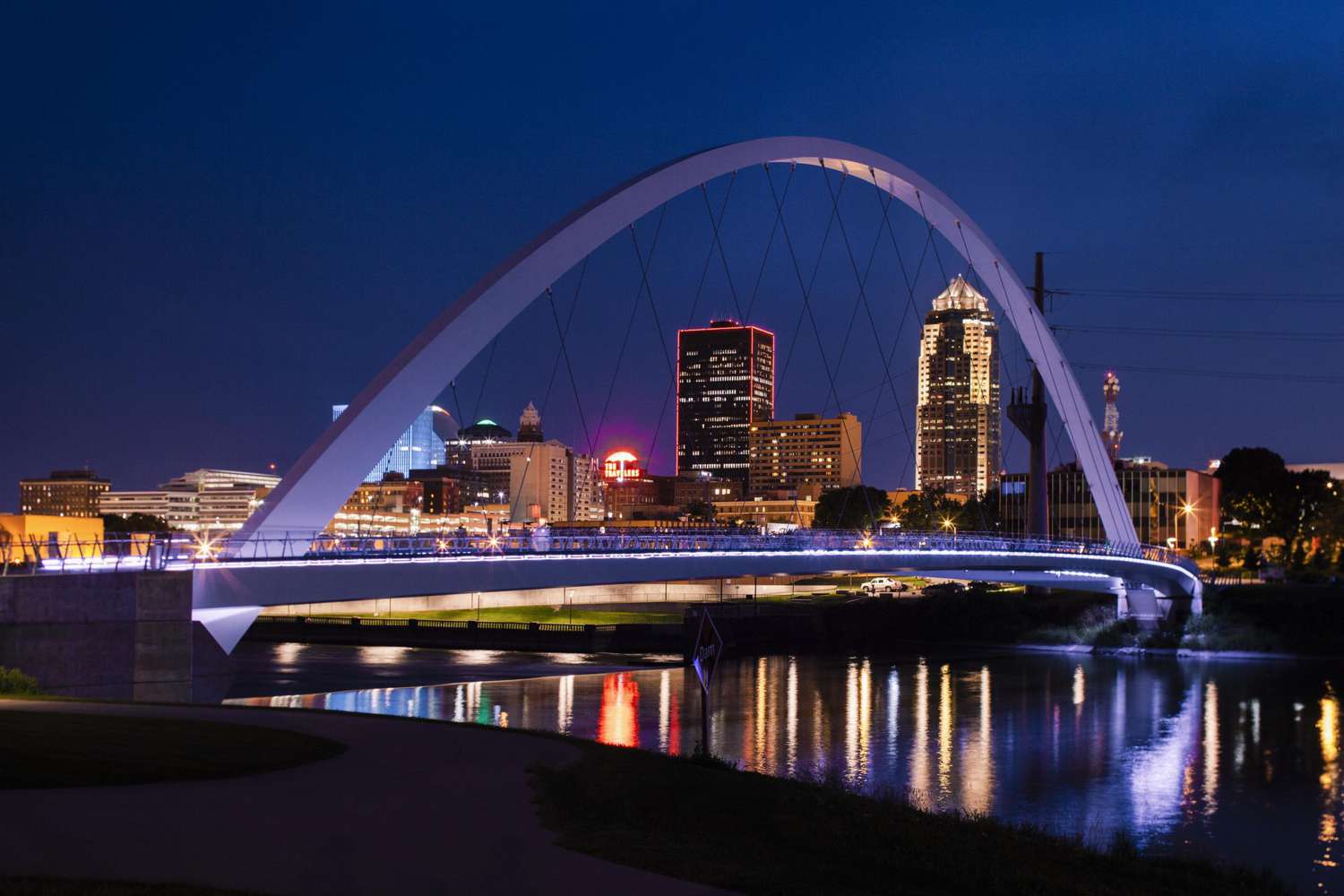
Later redevelopment efforts helped revive downtown. Office buildings, civic projects, entertainment venues, housing, restaurants, trails, bridges, and public spaces brought new energy. The Principal Riverwalk and other riverfront improvements helped reconnect the city to the rivers that shaped its origin.
Downtown Des Moines now reflects both history and reinvention. It remains the center of government and business, but it also includes arts, nightlife, festivals, apartments, hotels, and public spaces that make it more active beyond the traditional workday.
The Iowa State Capitol as a Symbol
The Iowa State Capitol is one of the most important buildings in Des Moines. Completed in the late 19th century, it stands on a hill overlooking downtown and is famous for its golden dome. The Capitol is not only a government building but also a symbol of Iowa’s civic identity.
Its architecture reflects ambition. The building was designed to show permanence, dignity, and democratic authority. It houses the Iowa Legislature, the governor’s office, and other state offices. For generations, laws have been debated, passed, challenged, and remembered within its walls.
The Capitol also plays a role in public life. Students visit on field trips, residents attend rallies, tourists take photographs, and citizens engage with government there. It reminds Des Moines residents that their city is not only a place to live, but the center of Iowa’s political life.
Des Moines in National Politics
Des Moines holds a special place in American politics because Iowa plays a major role in presidential campaigns. The Iowa caucuses have made the state an early testing ground for presidential candidates, and Des Moines often becomes a center of campaign activity.
Candidates visit the city, hold events, meet voters, speak to local media, and try to build momentum. Political reporters, campaign workers, activists, and national observers often focus on Des Moines during election seasons. This gives the city a level of political visibility beyond its size.
The caucus tradition has made Des Moines a place where national political stories begin. Restaurants, union halls, schools, convention spaces, and community centers have hosted campaign events that shaped presidential races. The city’s role in politics connects local voters to national history.
Culture, Arts and Education
Des Moines has developed a strong cultural identity through museums, theaters, music venues, public art, libraries, festivals, and educational institutions. The Des Moines Art Center, performing arts venues, historic theaters, and local galleries contribute to the city’s creative life.
Education has also shaped the city. Schools, colleges, libraries, and civic organizations helped create a culture of public learning. Drake University, founded in 1881, became one of the city’s important educational institutions. It has influenced law, journalism, athletics, politics, and community life in Des Moines.
Cultural growth helped change how people viewed the city. Des Moines became more than a government and insurance town. It became a place with arts, restaurants, music, festivals, sports, and creative neighborhoods.
Floods, Rivers and Resilience
Because Des Moines grew where two rivers meet, flooding has been an important part of its history. The Des Moines River and Raccoon River have brought beauty, transportation, and economic value, but they have also brought danger.
Major floods affected the city at different points in its history, damaging homes, businesses, roads, and public infrastructure. Flooding forced the city to rethink river management, levees, water systems, planning, and emergency response.
The 1993 flood was especially significant for Des Moines and much of the Midwest. It caused major disruptions and became one of the defining natural disasters in the region’s modern history. The experience reminded residents how powerful the rivers could be and how important infrastructure planning was for the city’s future.
Over time, Des Moines worked to improve flood control, riverfront planning, and water management. The rivers remain central to the city’s identity, but they also require respect.
Suburban Growth and Metropolitan Expansion
During the second half of the 20th century, Des Moines expanded along with its suburbs. Communities around the city grew as families moved outward, highways improved, and shopping centers followed population shifts. Suburban cities such as West Des Moines, Urbandale, Ankeny, Clive, Johnston, and others became part of the larger metro story.
This suburban growth changed Des Moines. Some residents and businesses left the central city, while the metro region as a whole became larger and more economically powerful. The relationship between the city and suburbs became important for transportation, schools, housing, jobs, and regional planning.
Even with suburban expansion, Des Moines remained the core of the metro area. It kept the state Capitol, downtown offices, major cultural institutions, hospitals, universities, and historic neighborhoods. The city continued to serve as the center of the region even as growth spread outward.
Modern Des Moines and Its Changing Identity
Modern Des Moines is a city that balances Midwestern tradition with urban change. It is still known for government, insurance, agriculture, and politics, but it has also developed a stronger reputation for arts, food, trails, live music, festivals, entrepreneurship, and quality of life.
The city has worked to improve downtown, strengthen neighborhoods, attract young professionals, welcome immigrants, and create public spaces. Farmers markets, bike trails, local restaurants, craft breweries, music events, and cultural festivals have helped make Des Moines feel more energetic and diverse.
At the same time, the city faces challenges. Like many growing cities, Des Moines must deal with housing affordability, infrastructure needs, racial and economic inequality, public safety, climate concerns, and the balance between growth and preservation. Its history shows that the city has always changed in response to pressure, opportunity, and new people.
Why the History of Des Moines Matters
The history of Des Moines matters because it tells the story of Iowa itself. The city grew from a river junction and military post into a capital, transportation center, agricultural service hub, insurance powerhouse, cultural center, and political stage. Its story reflects the larger history of the Midwest, including Native displacement, frontier settlement, farming, industrialization, immigration, civic growth, suburban expansion, and modern reinvention.
Des Moines is not only important because it is the capital of Iowa. It is important because it has repeatedly adapted. It adapted from fort to town, from town to capital, from river settlement to railroad city, from agricultural market to insurance center, and from traditional Midwestern city to a modern metro with a growing cultural voice.
The city’s past can still be seen in its rivers, Capitol, neighborhoods, institutions, fairgrounds, historic buildings, and civic traditions. Des Moines continues to carry the influence of its early geography and political role while building a future shaped by new residents, new industries, and new ideas.
Des Moines is a city rooted in the land and rivers of central Iowa, but its influence reaches across the state and into national politics. Its history is practical, complicated, resilient, and deeply Midwestern. From its early days near the riverbanks to its modern role as a capital and business center, Des Moines remains one of the most important cities in the American heartland.
Discover more from City Towner
Subscribe to get the latest posts sent to your email.