History of Rochester New York
Rochester, New York, is a city with a history shaped by waterpower, industry, invention, social reform, immigration, education, and reinvention. Located along the Genesee River near the southern shore of Lake Ontario, Rochester grew from a frontier settlement into one of the most important industrial and cultural cities in the northeastern United States. Its story is tied to flour mills, canals, abolitionists, women’s rights leaders, photography, optics, higher education, and generations of working families who helped build the city’s identity.
Rochester’s history is not a simple rise and decline story. It is a story of transformation. The city began as a place where natural resources and transportation routes created opportunity. It became known as the “Flour City” because of its early milling power, then later as the “Flower City” because of its nurseries, parks, and horticultural tradition. Over time, Rochester became home to major companies, influential reformers, strong neighborhoods, and world-class institutions. Even as manufacturing changed and some of its largest employers shrank, the city continued to evolve through education, health care, technology, arts, and community life.
Early Land and Native History
Long before Rochester became a city, the land around the Genesee River was part of a region deeply connected to Native communities, especially the Seneca people, one of the nations of the Haudenosaunee Confederacy. The Genesee Valley was valued for its fertile land, access to water, hunting grounds, fishing areas, and transportation routes. The river and surrounding landscape supported communities for generations before European American settlement expanded into western New York.
The Genesee River was central to the area’s future. It cut through the landscape and created waterfalls that later became powerful sources of energy for mills and factories. These falls would become one of the reasons Rochester developed so quickly in the 1800s. Before that industrial transformation, however, the river had cultural, practical, and environmental importance for Indigenous peoples who knew the land long before surveyors, settlers, and investors arrived.
After the American Revolution, western New York became a focus of land speculation and settlement. Treaties, land purchases, and forced displacement opened the region to new settlers, often at great cost to Native communities. The land that became Rochester was part of a broader pattern of westward expansion in New York, where fertile soil and access to waterways attracted farmers, merchants, and entrepreneurs.
The Founding of Rochester
Rochester’s formal beginnings are usually connected to the early 1800s, when settlers recognized the potential of the Genesee River’s waterfalls. In 1803, three men, Nathaniel Rochester, Charles Carroll, and William Fitzhugh, purchased a large tract of land along the river. Nathaniel Rochester became the figure most closely associated with the city’s name, although the community was built through the efforts of many people who settled, invested, farmed, milled, and traded in the area.
The settlement was first known by names connected to the falls and early landowners, but it eventually became Rochester. Its location gave it a major advantage. The Genesee River provided waterpower, and the surrounding region produced grain. As roads improved and settlement increased, the small village began to grow into a commercial center. The early years were marked by rough frontier conditions, but the area’s natural advantages made its future promising.
By the early 1800s, Rochester was already attracting millers, merchants, farmers, craftsmen, and laborers. The waterfalls powered mills that processed grain from the surrounding countryside. This helped turn Rochester into one of the most important flour-producing centers in the country. Its growth was fast enough to earn attention throughout New York and beyond.
The Erie Canal and the Rise of the Flour City
The opening of the Erie Canal in 1825 changed Rochester forever. The canal connected the Great Lakes region to the Hudson River and New York City, making it much easier and cheaper to move goods across the state. Rochester’s location along the canal gave it direct access to larger markets. Farmers could bring grain to the city, millers could turn it into flour, and merchants could ship that flour eastward and westward.
This transportation advantage helped Rochester become known as the “Flour City.” Its mills used the power of the Genesee River to produce massive amounts of flour, and the Erie Canal allowed that flour to reach distant customers. The city became one of the nation’s leading milling centers during the first half of the 1800s. The combination of river power, canal transportation, fertile farmland, and business ambition created rapid growth.
Rochester’s population expanded dramatically during this period. What had been a small settlement became a bustling city filled with mills, warehouses, shops, homes, churches, taverns, and public buildings. The canal brought goods, people, money, and ideas. It also connected Rochester to national economic trends and made the city part of a larger network of trade and migration.
Becoming a City
Rochester was incorporated as a city in 1834. By then, its growth had become impossible to ignore. The village had transformed into an energetic urban center with a strong commercial base. Its streets were busy with wagons, canal boats, workers, business owners, and newly arriving families seeking opportunity.
The city’s early economy depended heavily on milling, but it was already beginning to diversify. Related industries developed around agriculture, trade, manufacturing, and transportation. Rochester’s canal connections made it a place where raw materials could be processed and finished goods could be distributed. Its location also made it a stopping point for migrants moving westward and for reform movements moving through upstate New York.
Rochester’s early cityhood was marked by both opportunity and difficulty. Rapid growth brought jobs and wealth, but it also created crowded housing, labor challenges, public health problems, and social tensions. Like many growing 19th-century cities, Rochester had to build institutions, improve infrastructure, organize public services, and manage the needs of a changing population.
Abolitionism and Frederick Douglass
One of the most important parts of Rochester’s history is its role in the abolitionist movement. During the 1800s, Rochester became a center of anti-slavery activism, in part because of its location in western New York and its strong reform culture. The city was connected to the Underground Railroad, and many residents participated in efforts to help enslaved people escape to freedom.
Frederick Douglass, one of the most influential abolitionists in American history, moved to Rochester in 1847. From Rochester, he published his anti-slavery newspaper, The North Star, which became a powerful voice for freedom, equality, and human rights. Douglass used the newspaper to challenge slavery, expose injustice, and argue for the full humanity and citizenship of Black Americans.
Rochester became one of Douglass’s most important homes. He lived in the city for many years, raised his family there, and became deeply connected to its reform community. His presence helped make Rochester a nationally significant place in the struggle against slavery. The city was not free from racism, but it also had a strong network of abolitionists, activists, and citizens willing to resist the system of slavery.
Douglass’s legacy remains one of Rochester’s proudest historical connections. His work in the city helped shape national conversations about freedom, justice, and democracy. Today, Rochester continues to honor his memory as part of its civic identity.
Women’s Rights and Susan B. Anthony
Rochester also played a major role in the women’s rights movement, especially through the life and work of Susan B. Anthony. Anthony moved to Rochester with her family in the 1840s and became one of the most important leaders in the fight for women’s suffrage. Her work connected Rochester to a national movement that sought voting rights, property rights, educational access, labor rights, and legal equality for women.
Anthony’s activism was bold and persistent. She organized, spoke, wrote, traveled, and challenged laws that denied women full citizenship. One of the most famous moments in her life occurred in 1872, when she voted in the presidential election in Rochester, even though women did not yet have the legal right to vote. She was arrested, tried, and fined, turning the case into a powerful public statement about women’s rights.
Rochester became closely tied to Anthony’s legacy. Her home in the city served as a center for organizing and strategy. The city’s reform culture, which included abolitionists, religious reformers, educators, and activists, helped support the women’s rights movement. Anthony’s connection to Rochester gives the city an important place in the long struggle that led to the ratification of the 19th Amendment in 1920.
From Flour City to Flower City
As Rochester grew, its identity began to shift from the “Flour City” to the “Flower City.” This change reflected the rise of nurseries, seed companies, gardens, and horticultural businesses in the region. The fertile soil and favorable growing conditions of western New York helped make Rochester a center for the nursery industry.
The nickname “Flower City” became an important part of Rochester’s image. The city became known for beautiful gardens, parks, and plant cultivation. This horticultural tradition helped shape public spaces and civic pride. It also influenced events and institutions that celebrated the city’s connection to flowers, landscapes, and outdoor beauty.
Rochester’s parks became part of this identity. The city invested in green spaces that gave residents places to gather, walk, relax, and enjoy nature. This tradition remains visible today in Rochester’s parks, gardens, and seasonal celebrations. The shift from “Flour City” to “Flower City” also shows how Rochester adapted as its economy and image changed over time.
Industrial Growth and Manufacturing Power
By the late 1800s and early 1900s, Rochester had become a powerful manufacturing city. Its economy moved beyond flour milling into a wide range of industries, including clothing, shoes, machinery, precision instruments, photography, optics, and consumer goods. The city developed a reputation for skilled labor, innovation, and entrepreneurship.
One of Rochester’s most important strengths was its ability to support specialized manufacturing. The city had a strong workforce, access to transportation, and a culture of invention. Factories and workshops employed thousands of people, drawing immigrants and migrants who came looking for work. Neighborhoods grew around these industries, and the city developed a strong working-class character.
Manufacturing helped build Rochester’s middle class and gave the city a stable economic foundation for much of the 20th century. Many families depended on factory jobs that offered steady wages and a path to homeownership. The city’s industrial strength also supported schools, churches, stores, cultural organizations, and community institutions.
George Eastman and the Kodak Era
No company is more closely associated with Rochester than Eastman Kodak. Founded by George Eastman, Kodak transformed photography by making cameras and film accessible to everyday people. The company became one of the most influential businesses in the world, and Rochester became known as the center of the photography industry.
George Eastman was not only an industrialist. He was also a major philanthropist whose influence shaped Rochester’s cultural, educational, and medical institutions. His wealth supported music, health care, education, and civic improvements. The Eastman School of Music, the University of Rochester, and several cultural institutions benefited from his generosity.
Kodak’s rise made Rochester a global name. For much of the 20th century, the company provided thousands of jobs and helped define the city’s economy. Kodak workers filled factories, laboratories, offices, and research facilities. The company’s success supported generations of families and gave Rochester a reputation for innovation and technical expertise.
The Kodak era also shaped Rochester’s identity. Photography was not just an industry in the city. It became part of the city’s culture. Rochester was a place where science, art, memory, and technology came together through the camera.
Xerox, Bausch + Lomb, and a Culture of Innovation
Rochester’s industrial history was not limited to Kodak. Xerox also became one of the city’s most important companies, helping make Rochester a leader in copying and document technology. Xerox brought research, engineering, and office technology into the city’s economic story. Its influence added to Rochester’s reputation as a center of innovation.
Bausch + Lomb, another major Rochester company, helped make the city important in optics and eye care. The company produced lenses, optical instruments, and vision products that reached markets far beyond western New York. Its work connected Rochester to science, medicine, military technology, and consumer products.
Together, Kodak, Xerox, and Bausch + Lomb helped create a city known for imaging, optics, precision manufacturing, and research. These companies attracted scientists, engineers, technicians, factory workers, and business leaders. They helped build a local economy based on both skilled labor and advanced technology.
This culture of innovation continues to influence Rochester. Even as major companies changed, downsized, or shifted their operations, the city retained expertise in optics, imaging, photonics, health science, and engineering. Rochester’s history of invention remains one of its strongest assets.
Immigration and Neighborhood Life
Rochester’s growth was fueled by immigrants and migrants who built the city’s neighborhoods, worked in its factories, opened businesses, and shaped its culture. Irish, German, Italian, Polish, Jewish, African American, Latino, Caribbean, and many other communities contributed to the city’s development over time.
In the 19th and early 20th centuries, immigrants often settled in close-knit neighborhoods near factories, churches, markets, and social clubs. These communities helped newcomers find work, housing, language support, and cultural connection. Churches, synagogues, schools, mutual aid societies, and neighborhood businesses became important anchors of daily life.
African American history in Rochester is also deeply significant. The city’s connection to Frederick Douglass and abolitionism gave it an early place in Black freedom struggles, but Black residents still faced discrimination in housing, employment, education, and public life. During the 20th century, more African Americans moved to Rochester as part of broader migration patterns, seeking industrial jobs and better opportunities.
Neighborhood life in Rochester has always reflected both pride and struggle. Communities built strong identities, but they also faced inequality, segregation, economic change, and urban challenges. The history of Rochester cannot be understood without recognizing the people who lived in its neighborhoods and gave the city its character.
Education, Medicine, and Cultural Institutions
Rochester developed a strong tradition of education, medicine, and culture. The University of Rochester became one of the city’s most important institutions, contributing to research, health care, music, and professional education. The university helped strengthen Rochester’s intellectual life and became a major employer.
The Eastman School of Music gave Rochester a nationally respected place in the arts. Music became part of the city’s identity, supported by performance halls, students, faculty, and cultural organizations. The city also developed museums, galleries, theaters, libraries, and festivals that added depth to community life.
Health care became increasingly important to Rochester’s economy and identity. Medical institutions grew in size and reputation, providing care to residents while also supporting research, employment, and education. As manufacturing declined, education and health care became even more central to the city’s future.
Rochester’s cultural institutions reflect the wealth, philanthropy, civic ambition, and community creativity that shaped the city over many generations. They also show how Rochester adapted from an industrial economy to a more diversified urban center.
Social Tensions and the 1964 Uprising
Rochester’s history also includes serious social conflict. In July 1964, the city experienced a major uprising after tensions between Black residents and police reached a breaking point. The unrest exposed deep problems involving racial discrimination, poverty, housing inequality, unemployment, and policing.
The 1964 uprising shocked many people who had viewed Rochester as a prosperous and stable city. Beneath the image of industrial success, many Black residents faced limited opportunities and unequal treatment. The uprising forced the city to confront conditions that had been ignored or minimized by civic leaders.
The aftermath led to new conversations about civil rights, community development, policing, and economic opportunity. However, many of the deeper issues did not disappear quickly. The uprising remains an important moment in Rochester’s history because it revealed the gap between the city’s public image and the lived reality of many residents.
Understanding this event is essential to understanding modern Rochester. It shows that the city’s story includes both innovation and inequality, both reform and resistance, both prosperity and exclusion.
Economic Change and the Decline of Big Manufacturing
During the late 20th century and early 21st century, Rochester faced major economic challenges as large employers reduced their workforces and traditional manufacturing declined. Kodak, once a giant of the photography world, struggled as digital photography transformed the industry. Xerox and other companies also changed, moved operations, or reduced local employment.
These changes affected thousands of workers and families. Jobs that had once supported stable middle-class lives became harder to find. The city dealt with population loss, vacant properties, poverty, and shifting tax bases. Like many older industrial cities in the Northeast and Midwest, Rochester had to face the reality that its old economic model could no longer support the city in the same way.
However, Rochester did not stop evolving. The city began building on its strengths in education, medicine, technology, optics, photonics, higher education, small business, and the arts. The transition was not easy, and challenges remain, but Rochester’s history of adaptation helped it search for new paths forward.
The decline of big manufacturing changed the city’s identity, but it did not erase its legacy. The skills, institutions, and innovative spirit developed during the industrial era continue to influence Rochester’s future.
Modern Rochester and Reinvention
Modern Rochester is a city of contrasts. It has respected universities, strong medical institutions, historic neighborhoods, cultural attractions, parks, festivals, and a growing technology sector. It also faces challenges connected to poverty, education inequality, housing, public safety, and economic opportunity. Its history helps explain both its strengths and its struggles.
The city has continued to invest in downtown redevelopment, riverfront improvements, arts districts, business growth, and neighborhood revitalization. Former industrial spaces have been reused for housing, offices, studios, restaurants, and community spaces. Rochester’s location near Lake Ontario, the Finger Lakes, and western New York’s natural beauty also gives it regional appeal.
Rochester’s innovation economy has increasingly focused on optics, imaging, photonics, health care, research, and education. These fields connect directly to the city’s historic strengths. The same city that helped popularize photography and advance optical science continues to look for ways to build a future from knowledge, technology, and creativity.
The Genesee River’s Continuing Role
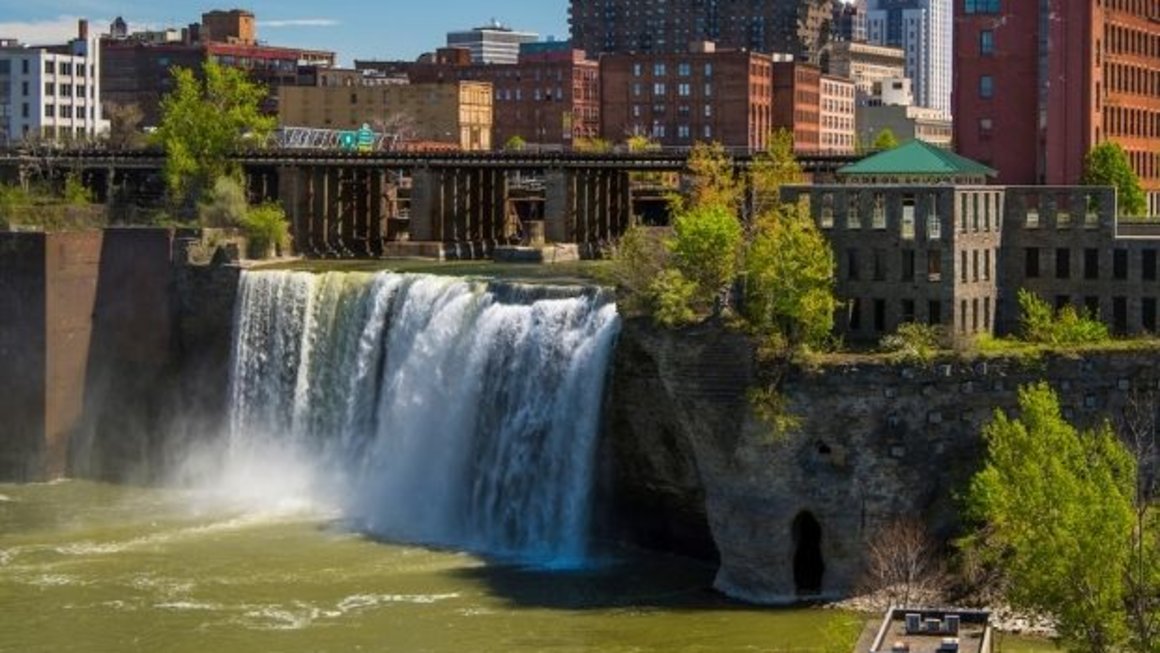
The Genesee River remains one of Rochester’s defining features. It helped create the city by providing waterpower for mills, and it continues to shape the city’s landscape. The river cuts through downtown and passes over waterfalls that remind residents of Rochester’s earliest industrial power.
For much of the city’s history, the river was treated mainly as a working resource. Mills, factories, bridges, rail lines, and infrastructure crowded its banks. Over time, as industry changed, Rochester began to rediscover the river as a public asset. Riverfront development, trails, parks, and scenic overlooks have become part of efforts to reconnect residents with the waterway that gave the city life.
The Genesee River symbolizes Rochester’s entire history. It represents natural beauty, industrial power, transportation, environmental change, and urban renewal. From early settlement to modern redevelopment, the river has remained at the center of the city’s story.
Rochester’s Lasting Legacy
Rochester’s legacy is larger than its size. It helped shape American photography through Kodak. It contributed to optics and vision care through Bausch + Lomb. It influenced office technology through Xerox. It gave Frederick Douglass a platform for abolitionist work and gave Susan B. Anthony a home base for women’s suffrage activism. It became a city of mills, nurseries, factories, universities, hospitals, music, reform, and invention.
The city’s history is also a reminder that progress is complicated. Rochester has been a place of opportunity, but also a place of inequality. It has produced wealth and innovation, but it has also faced racial tension, economic disruption, and urban hardship. Its story includes both civic pride and difficult lessons.
What makes Rochester important is its ability to keep changing. From frontier settlement to canal city, from Flour City to Flower City, from industrial powerhouse to knowledge-based economy, Rochester has repeatedly adapted to new realities. Its history shows how geography, technology, people, and social movements can shape a city over time.
Why Rochester’s History Still Matters
The history of Rochester, New York, still matters because it helps explain the city’s identity today. Its past is visible in its old industrial buildings, historic homes, riverfront, parks, neighborhoods, universities, museums, and cultural institutions. It is present in the names of Frederick Douglass, Susan B. Anthony, George Eastman, Kodak, Xerox, and Bausch + Lomb. It is also present in the stories of workers, immigrants, activists, families, artists, students, and entrepreneurs who made the city what it became.
Rochester is a city built on movement. Grain moved through mills. Boats moved along the Erie Canal. People moved into neighborhoods seeking work and freedom. Ideas moved through abolitionist newspapers and suffrage meetings. Images moved across the world through Kodak cameras and film. Technology moved from laboratories into everyday life. Even today, Rochester continues to move forward, carrying its history into each new chapter.
The city’s past is rich, complex, and deeply American. It reflects the rise of industry, the power of reform, the importance of innovation, and the challenge of building a fair and lasting urban future. Rochester’s story is not finished. It remains a city shaped by memory, resilience, and possibility.
Discover more from City Towner
Subscribe to get the latest posts sent to your email.