
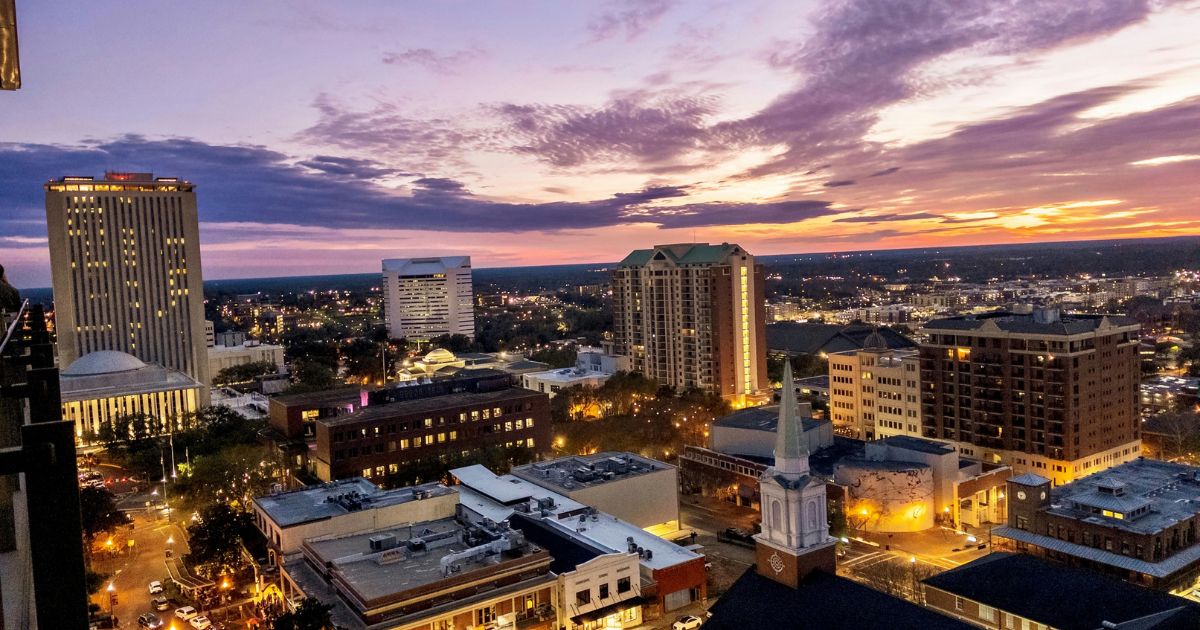
History of Tallahassee Florida
Tallahassee, Florida, is a city with a history shaped by Native peoples, Spanish exploration, plantation agriculture, territorial politics, Civil War conflict, higher education, civil rights activism, and its long role as the capital of Florida. Located in the rolling hills of the Florida Panhandle, Tallahassee has always been different from the beach centered image many people associate with the state. It is a city of live oaks, red clay, government buildings, historic neighborhoods, universities, and deep Southern roots.
Long before Tallahassee became a capital city, the area was home to Indigenous communities who lived on the rich land of North Florida. The region offered fertile soil, forests, wildlife, streams, and a climate suitable for farming and settlement. Native peoples cultivated crops, built communities, traded with neighboring groups, and shaped the land through generations of use.
The name Tallahassee is often understood to mean old fields or old town, a reference connected to earlier Indigenous settlements and cleared agricultural land. That meaning reflects the layered nature of the city’s history. Tallahassee was not created on empty ground. It grew in a place where people had already lived, worked, traveled, and built communities for centuries.
The Apalachee and Indigenous Foundations
One of the most important Indigenous groups in the Tallahassee region was the Apalachee. They were part of a highly organized society in North Florida and were known for agriculture, trade, settlement patterns, and political structure. The Apalachee cultivated crops such as corn, beans, and squash, and they lived in villages connected by social and economic networks.
The Apalachee region became significant to Spanish colonial interests because of its fertile land and established communities. Spanish missionaries entered the area and created a chain of missions during the colonial period. These missions were meant to spread Christianity and extend Spanish influence, but they also disrupted Indigenous life in major ways.
Disease, warfare, forced labor, mission control, and colonial conflict devastated many Native communities. The Apalachee and other Indigenous peoples experienced enormous loss as European powers competed for land and influence. Their history remains central to understanding Tallahassee, because the city’s later growth took place on land already marked by Indigenous presence and colonial disruption.
Spanish Exploration and Mission Era
Spanish influence in Florida began in the sixteenth century, and North Florida became part of a broader colonial world connected to St. Augustine, the Gulf Coast, and the Spanish empire. The Tallahassee area became important during the mission era, when Spanish authorities attempted to convert and control Native populations while also using the region as an agricultural base.
Mission San Luis became one of the most important mission settlements in the area. It served as a religious, military, and administrative center, bringing together Spanish friars, soldiers, officials, and Apalachee residents. The mission system changed local life through Christianity, labor demands, new political relationships, and exposure to European diseases.
The mission era did not last forever. Conflicts involving European powers, Native groups, and colonial expansion weakened Spanish control in the region. Raids and military pressure eventually contributed to the collapse of the mission system in North Florida. Still, the Spanish period left a lasting mark on the region’s history and helped shape the later development of Tallahassee.
Territorial Florida and the Search for a Capital
After Florida became a United States territory in 1821, officials needed a permanent capital. At that time, Florida’s two main population centers were St. Augustine in the east and Pensacola in the west. Travel between them was difficult, slow, and inconvenient. Territorial leaders wanted a capital located between the two cities, somewhere more practical for government meetings.
Tallahassee was chosen as the territorial capital in 1824. Its location in the center of North Florida made it a compromise between Pensacola and St. Augustine. The selection of Tallahassee changed the city’s future. What might have remained a small settlement became the political center of Florida.
The decision also reflected the importance of North Florida at the time. During the territorial period, the region was one of the most developed parts of Florida, especially compared with much of the peninsula. Tallahassee’s fertile land, political location, and growing population helped it become the seat of government.
The Birth of a Capital City
Once Tallahassee was chosen as the capital, the city began developing around government. A simple log building first served as the territorial capitol, and over time more permanent structures were built. Streets were planned, public buildings were constructed, and the city became a gathering place for politicians, lawyers, merchants, planters, workers, and travelers.
Government gave Tallahassee a stable role from its earliest years. Legislative sessions brought people to town. Political debates shaped public life. Hotels, boarding houses, shops, newspapers, and professional offices grew to serve the needs of the capital.
Tallahassee’s identity as a capital city became one of its defining traits. Unlike many Florida cities that grew primarily from ports, tourism, railroads, or real estate booms, Tallahassee grew from government and plantation agriculture. That gave it a slower, more formal, and more political character than many other parts of the state.
Plantation Economy and Antebellum Society
During the antebellum period, Tallahassee and the surrounding Red Hills region became part of the plantation South. The area’s fertile soil supported cotton plantations, and wealthy planters established large estates around the city. These plantations depended on the forced labor of enslaved African Americans, whose work created much of the region’s wealth.
Tallahassee’s antebellum society was shaped by slavery, agriculture, class divisions, and political power. Planters held major influence in government and social life. The city became a center for commerce tied to cotton production, with goods moving through regional trade networks.
The lives of enslaved people were central to the city’s history, even though older public narratives often ignored them. Enslaved men, women, and children cleared land, planted and harvested crops, built structures, worked in homes, cared for animals, cooked meals, and performed skilled labor. Their forced labor sustained the plantation economy and allowed Tallahassee’s elite society to flourish.
The legacy of this period remains visible in historic sites, old roads, cemeteries, plantation landscapes, and the region’s social history. Understanding Tallahassee requires recognizing both the wealth built by plantation owners and the suffering endured by enslaved people.
Statehood and Growing Political Power
Florida became a state on March 03, 1845, and Tallahassee became the state capital. This strengthened the city’s political importance and confirmed its role as the center of Florida government. As the new state developed, Tallahassee remained the place where laws were debated, governors served, and public decisions were made.
Statehood brought new ambitions and new challenges. Florida was still a young state with large undeveloped areas, difficult transportation routes, and a small population compared with older states. Tallahassee’s leaders worked to maintain the city’s importance as settlement expanded into other parts of Florida.
The city’s political culture was shaped by debates over slavery, land, transportation, banking, education, and state development. As tensions grew across the United States in the decades before the Civil War, Tallahassee became part of the wider conflict over slavery and states’ rights.
Tallahassee During the Civil War
When the Civil War began in 1861, Florida seceded from the Union and joined the Confederacy. Tallahassee, as the state capital, became an important political and military center for Confederate Florida. The city supported the war effort through government activity, supplies, military organization, and local defense.
One of the most notable events connected to Tallahassee during the Civil War was the Battle of Natural Bridge, fought on March 06, 1865, southeast of the city. Confederate forces, including local militia, students, and volunteers, defeated Union troops attempting to move toward Tallahassee. Because of that Confederate victory, Tallahassee was the only Confederate state capital east of the Mississippi River that was not captured by Union forces during the war.
Although the city avoided direct occupation during the war, the conflict still brought hardship. Families lost loved ones, the economy suffered, enslaved people sought freedom, and the region faced uncertainty as the Confederacy collapsed. The end of the war marked a major turning point in Tallahassee’s history.
Reconstruction and the End of Slavery
The end of the Civil War brought emancipation and the beginning of Reconstruction. Enslaved African Americans were legally freed, and the entire social and economic order of Tallahassee had to change. Formerly enslaved people sought family reunification, education, land, work, political participation, and community independence.
Reconstruction was a period of hope and conflict. African Americans in Tallahassee and across Florida worked to build churches, schools, businesses, civic organizations, and political power. Black men gained voting rights and participated in government, and new institutions were created to support education and community development.
At the same time, white resistance to Black freedom and political power was intense. Violence, intimidation, discriminatory laws, and economic control were used to limit the gains of emancipation. Reconstruction eventually gave way to segregation and Jim Crow, but the period remains important because it showed the determination of African Americans to claim freedom and citizenship.
Education and the Rise of Florida A&M University
Education became one of Tallahassee’s most important legacies after the Civil War. Florida A&M University, one of the nation’s most important historically Black universities, traces its roots to 1887. It grew from efforts to provide higher education for African Americans in a segregated society that denied equal access to many institutions.
Florida A&M became a center of scholarship, leadership, culture, activism, and professional development. It educated generations of teachers, lawyers, doctors, engineers, scientists, public servants, artists, and community leaders. The university became one of the strongest institutions in Tallahassee and a major part of the city’s identity.
FAMU’s influence extends far beyond academics. Its marching band, traditions, alumni network, civil rights contributions, and cultural presence have made it a national institution. Tallahassee’s history cannot be separated from the history of Florida A&M and the Black community that helped build and sustain it.
Florida State University and Higher Education Growth
Florida State University also plays a major role in Tallahassee’s history. The institution’s roots go back to the nineteenth century, and over time it evolved into one of Florida’s largest and most influential public universities. Its growth helped transform Tallahassee from a small capital town into a major college city.
FSU brought students, faculty, research, athletics, cultural events, and economic activity to Tallahassee. The university expanded the city’s population, shaped its neighborhoods, and added energy to its social and cultural life. College football, academic programs, performing arts, and research all became major parts of the city’s identity.
Together, Florida State University and Florida A&M University make Tallahassee one of the most important education centers in Florida. Their presence gives the city a unique combination of state government, student life, historic Black education, research, athletics, and cultural influence.
Segregation and Civil Rights Struggles
Like many Southern cities, Tallahassee experienced the harsh realities of segregation. Jim Crow laws and customs separated Black and white residents in schools, transportation, housing, public spaces, employment, and political life. African Americans faced discrimination, voter suppression, economic inequality, and social restrictions.
Tallahassee also became an important site of civil rights activism. Students, clergy, community leaders, and ordinary citizens challenged segregation through boycotts, protests, legal action, and organizing. The Tallahassee bus boycott, which began in 1956, was one of the important civil rights actions in Florida. It showed the power of organized resistance and the courage of Black residents who demanded equal treatment.
Florida A&M students played a major role in civil rights activism. Their courage helped push the city and state toward change. Sit ins, marches, voter registration efforts, and community organizing challenged the old order and helped expand civil rights.
The civil rights history of Tallahassee is one of struggle and persistence. It reminds people that the city’s story is not only about politics and government buildings. It is also about people fighting for dignity, justice, and equal access.
Government and the Modern Capital
Tallahassee’s role as Florida’s capital has remained central to its modern development. The Florida Capitol complex, state agencies, courts, lobbying firms, law offices, professional associations, and political organizations all shape the city’s economy and daily life. When the Legislature is in session, Tallahassee becomes the center of statewide political attention.
The city’s capital identity gives it a different rhythm from many other Florida cities. It is deeply connected to public policy, elections, law, education, and administration. People come to Tallahassee to work in government, advocate for causes, attend hearings, serve in public office, or influence state decisions.
The modern Capitol building, completed in the 1970s, changed the city’s skyline and became a major symbol of state government. The historic Capitol was preserved nearby, creating a contrast between old and new Florida. Together, the buildings reflect Tallahassee’s long political role and the state’s growth over time.
Growth Beyond the Old City
As Florida’s population expanded in the twentieth century, Tallahassee also grew. New neighborhoods, roads, schools, shopping centers, parks, hospitals, and suburbs developed around the older city. The population became more diverse, and the economy broadened beyond government and education.
Tallahassee’s growth was not as explosive as that of Miami, Orlando, Tampa, or Jacksonville, but it steadily became a larger regional center. Its location in North Florida made it important to surrounding rural counties, while its universities and government institutions drew people from across the state and beyond.
The city’s landscape changed as farmland, forests, and older neighborhoods gave way to development. Growth brought opportunity, but it also raised questions about preservation, traffic, housing, inequality, environmental protection, and the balance between tradition and change.
Historic Neighborhoods and Architecture
Tallahassee has many historic neighborhoods and buildings that reflect its long past. The city’s architecture includes antebellum structures, Victorian homes, early twentieth century buildings, university landmarks, churches, government buildings, and modern developments. Live oaks, canopy roads, and red clay hills give many parts of the city a distinctive look.
Neighborhoods such as Frenchtown, Myers Park, Lafayette Park, and areas near the universities all carry different pieces of Tallahassee’s story. Frenchtown, in particular, has a deep African American history and was once a thriving center of Black business, music, culture, and community life.
Historic preservation has become an important part of Tallahassee’s identity. The city’s older buildings and neighborhoods help maintain a sense of continuity in a state often associated with rapid growth and constant reinvention. Tallahassee’s historic character gives it a depth that sets it apart.
The Natural Beauty of the Red Hills
Tallahassee is known for its natural beauty. Unlike much of flat coastal Florida, the city sits among rolling hills, wooded areas, lakes, and canopy roads. The surrounding Red Hills region is one of the most scenic parts of the state, known for its clay soil, forests, plantations, wildlife, and conservation lands.
The natural environment has shaped Tallahassee’s culture and lifestyle. Parks, trails, lakes, gardens, and outdoor recreation are important parts of daily life. Places such as Alfred B. Maclay Gardens State Park, Lake Jackson, Cascades Park, and nearby forests help connect residents to the landscape.
The city’s trees and canopy roads are especially beloved. They give Tallahassee a sense of age, shade, and Southern beauty. This landscape also reflects the city’s layered history, including Indigenous land use, plantation estates, conservation efforts, and modern recreation.
Culture, Music, and Community Life
Tallahassee’s culture reflects its role as a capital, college town, historic Southern city, and diverse community. Government workers, students, professors, artists, musicians, activists, families, and longtime residents all contribute to the city’s personality.
Music has played an important role in Tallahassee’s cultural life, from church music and student performances to jazz, blues, marching bands, rock, hip hop, country, and local festivals. Florida A&M’s Marching 100 and Florida State’s athletic traditions add sound, color, and energy to the city.
The city also has museums, theaters, restaurants, galleries, historic sites, farmers markets, and community events that reflect its mix of influences. Tallahassee’s culture is not only tied to government or universities. It is also built through neighborhoods, faith communities, local businesses, family traditions, and civic life.
Tallahassee’s Place in Florida History
Tallahassee holds a unique place in Florida history because it represents the older, inland, Southern part of the state. While much of Florida’s modern image is shaped by beaches, theme parks, retirement communities, and tourism, Tallahassee’s identity is rooted in government, education, plantations, civil rights, and North Florida culture.
The city has been at the center of major decisions affecting the entire state. Laws passed in Tallahassee have shaped education, civil rights, development, transportation, environmental policy, taxation, criminal justice, and public health. As the capital, the city has influenced the lives of millions of Floridians.
Tallahassee also reminds people that Florida is not one simple place. It is a state with many regions and histories. The story of Tallahassee is different from the story of Miami, Key West, Orlando, Tampa, or Pensacola. Its hills, politics, universities, and historic communities give it a distinct identity.
The Legacy of Tallahassee
The history of Tallahassee, Florida, is a story of continuity and change. It began with Indigenous communities who lived on and shaped the land long before European arrival. It passed through the Spanish mission era, territorial politics, plantation society, statehood, Civil War, Reconstruction, segregation, civil rights activism, university growth, and modern government.
Tallahassee’s legacy is complex. It includes beauty, education, public service, and cultural strength, but it also includes slavery, racial injustice, and political conflict. To understand the city honestly, both sides of that history must be remembered.
Today, Tallahassee remains a capital city, a college town, a historic community, and a regional center in North Florida. Its oak shaded streets, government buildings, campuses, historic sites, and natural landscapes all tell pieces of the same story. The city continues to evolve, but its past remains visible in the land, architecture, institutions, and people who call it home.
Tallahassee is more than the seat of Florida government. It is one of the state’s most historically important cities, a place where old fields became a capital, where education became a force for change, and where generations of residents have shaped the political and cultural life of Florida.
Discover more from City Towner
Subscribe to get the latest posts sent to your email.