
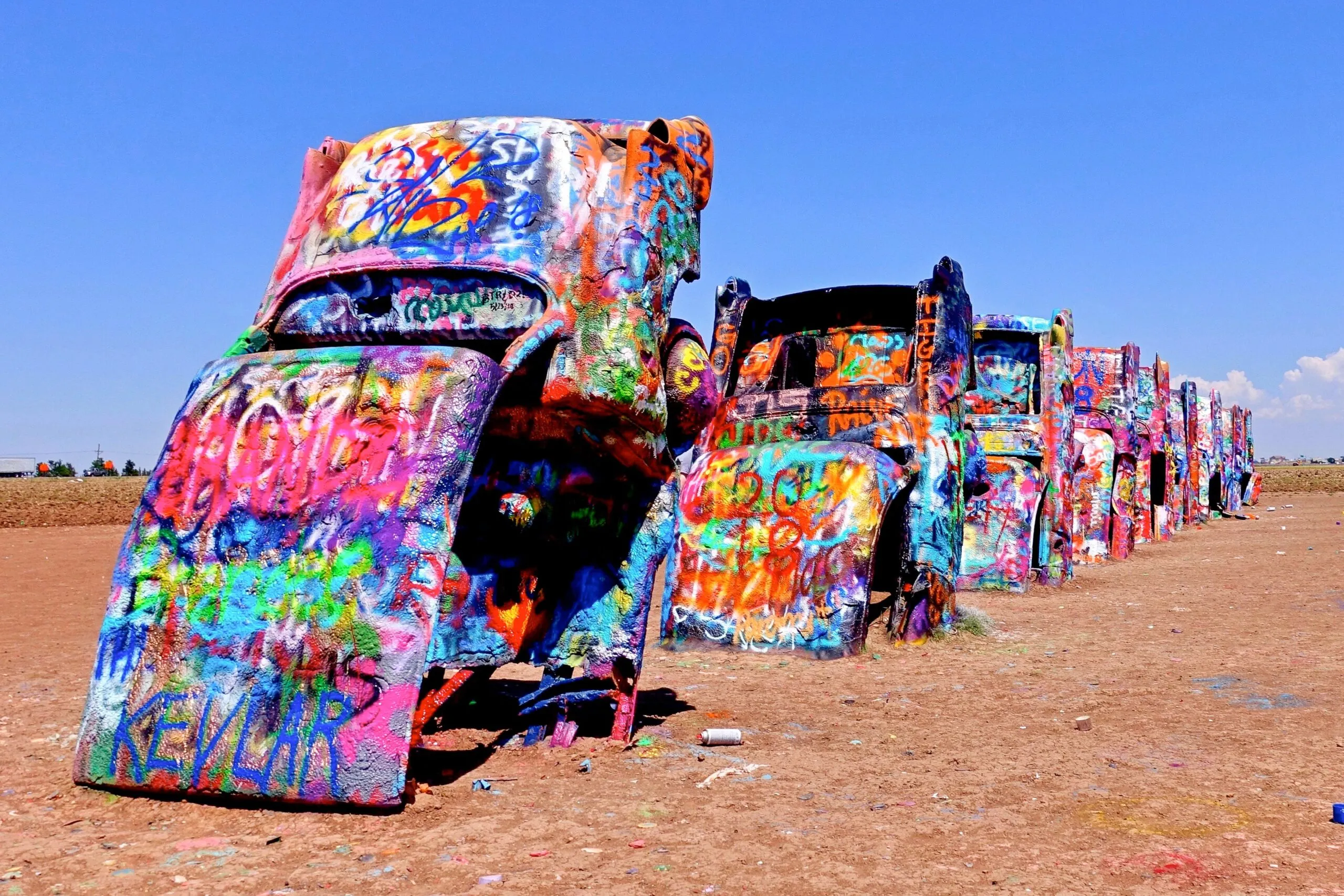
The Colorful and Unique Cadillac Ranch in Amarillo Texas
Cadillac Ranch in Amarillo, Texas, is one of the most recognizable roadside attractions in the United States. It is strange, bold, colorful, simple, and unforgettable. At first glance, it may look like a row of old cars buried in a field, but Cadillac Ranch has become much more than that. It is public art, Route 66 history, pop culture, travel tradition, and a symbol of Amarillo’s creative personality.
Located west of Amarillo along the Interstate 40 corridor, Cadillac Ranch draws visitors from across the country and around the world. People stop to take photos, walk across the open field, spray paint the cars, and experience a landmark that feels both playful and meaningful. It is one of those places that does not require a long explanation to enjoy, but the more a person learns about it, the more interesting it becomes.
Cadillac Ranch represents the spirit of roadside America. It belongs to the world of long highways, quirky attractions, car culture, road trips, neon signs, open skies, and unexpected stops. It also fits Amarillo perfectly. The city is known for Route 66 history, cattle country, wide plains, big skies, and a personality that mixes western tradition with unusual creativity. Cadillac Ranch captures all of that in one colorful row of buried Cadillacs.
The Creation of Cadillac Ranch
Cadillac Ranch was created in 1974 by the art group Ant Farm, with support from Amarillo millionaire and patron Stanley Marsh 3. Ant Farm was known for experimental art, architecture, media projects, and bold cultural statements. The group did not create traditional museum art. Instead, it made work that questioned American culture, technology, media, and the built environment.
The idea behind Cadillac Ranch was both simple and unusual. A line of Cadillac cars would be buried nose first in the ground at an angle, with their tail fins pointing toward the sky. The cars represented different years of Cadillac design, especially the era when tail fins became a major symbol of American automobile style. By placing the cars in the earth, the artists turned everyday vehicles into a strange monument.
The installation was placed in a field west of Amarillo. The cars were positioned at an angle often described as matching the Great Pyramid of Giza. That unexpected reference gave the work a sense of humor and mystery. It was both a tribute to American car culture and a playful challenge to traditional ideas about monuments.
From the beginning, Cadillac Ranch was meant to be noticed. It was not hidden inside a gallery or museum. It stood in the open landscape, where travelers could see it from the road. This made it democratic in a way. Anyone passing by could stop, look, and form an opinion.
Why Cadillacs Were Chosen
The choice of Cadillac was important. For much of the twentieth century, Cadillac represented luxury, success, status, and American design ambition. A Cadillac was more than transportation. It was a symbol of arrival. It suggested wealth, style, confidence, and the promise of the open road.
The Cadillacs used in the installation were from a period when tail fins helped define the brand’s dramatic look. Tail fins were inspired partly by jet age design and reflected an era when American cars were large, decorative, and expressive. They were not only machines. They were statements.
By burying Cadillacs in a Texas field, the artists changed their meaning. Cars once associated with status and movement became fixed in place. Luxury vehicles became weathered objects. A symbol of American success became part of a surreal roadside scene. The installation invited people to think about consumption, design, freedom, and the passing of time.
At the same time, Cadillac Ranch does not feel cold or overly serious. It is fun. People enjoy it because it is visually striking and easy to understand on the surface. The cars are beautiful, odd, and approachable. That balance between deeper meaning and simple enjoyment is one reason the landmark has lasted.
A Route 66 Icon
Cadillac Ranch is strongly connected to Route 66 culture, even though its current setting is closely tied to Interstate 40. Amarillo was one of the major Texas stops along historic Route 66, and the city’s identity still carries the spirit of that famous highway. Route 66 represented movement, possibility, tourism, roadside businesses, diners, motels, gas stations, and the dream of traveling west.
Cadillac Ranch fits perfectly into that world. It is the kind of attraction people remember from a road trip. It is not polished like a theme park or formal like a museum. It is open, odd, and easy to visit. Travelers can stop for a short time, take photos, leave a mark, and continue down the highway with a story to tell.
For many visitors, Cadillac Ranch is a must see stop on a Route 66 journey. It has become part of the modern mythology of the road. People planning cross country trips often include it because it represents the freedom and weirdness that made roadside America famous.
The attraction also helps keep Amarillo connected to its highway history. Route 66 once brought a steady stream of travelers through the city. Cadillac Ranch continues that tradition by pulling people off the road and giving them a reason to remember Amarillo.
The Role of Stanley Marsh 3
Stanley Marsh 3 played a major role in making Cadillac Ranch possible. He was an Amarillo businessman, art patron, and public figure known for supporting unusual creative projects. His willingness to fund and encourage experimental public art helped give Amarillo one of its most famous landmarks.
Marsh had a reputation for eccentricity and for wanting to bring unexpected art into the public landscape. Cadillac Ranch reflected that spirit. It was not a safe or ordinary project. It required imagination, money, land, and a willingness to accept that some people might not understand it at first.
Without Marsh’s support, Cadillac Ranch likely would not have taken shape in the same way. His role shows how public art often depends on collaboration between artists and patrons. Ant Farm created the concept, but Marsh helped make the idea real in Amarillo.
Over time, the landmark became larger than any one person. It belongs now to travelers, locals, artists, photographers, road trip enthusiasts, and everyone who has added paint to the cars. Still, the story of Cadillac Ranch cannot be told without acknowledging the role of the patron who helped bring it to the plains.
The Ever Changing Layers of Paint
One of the most famous features of Cadillac Ranch is the spray paint. Visitors are allowed to paint the cars, and over the years, countless people have added names, messages, symbols, colors, dates, and designs. The cars are covered in thick layers of paint, with new artwork constantly replacing what came before.
This makes Cadillac Ranch different from many public artworks. Instead of staying the same, it changes every day. A visitor may paint a heart, a name, or a phrase, but it may be covered by someone else within hours. The artwork is temporary, but the act of participating becomes part of the experience.
The layers of paint tell a story of movement and memory. People come from different places, leave a mark, take a picture, and move on. The paint becomes a record of thousands of visits, even though individual messages rarely last. In that sense, Cadillac Ranch is both permanent and temporary at the same time.
The changing paint also gives the attraction a living quality. No two visits are exactly alike. The colors, designs, and surface textures are always different. This keeps people coming back and makes every photograph a snapshot of a particular moment.
A Landmark Built for Photographs
Cadillac Ranch is one of the most photographed places in Amarillo. The visual appeal is obvious. Ten Cadillacs stand in a row, half buried in the ground, covered with bright paint, set against a wide Texas sky. The contrast between the colorful cars and the open plains creates a powerful image.
The site is especially popular with road trip travelers, photographers, influencers, families, artists, and tourists looking for a memorable picture. People pose in front of the cars, hold spray paint cans, take close up shots of the paint texture, or capture the entire row against the horizon.
The best photographs often include the sky. Amarillo’s High Plains location gives Cadillac Ranch a dramatic backdrop. Sunsets, storm clouds, blue skies, and golden light can completely change the mood of the scene. A photo taken in the morning may feel different from one taken near dusk.
The landmark’s popularity in photographs has helped spread its fame. Images of Cadillac Ranch appear in travel blogs, postcards, documentaries, music videos, social media posts, and tourism materials. Its look is instantly recognizable, which is a major reason it has remained culturally important.
The Move to a New Location
Cadillac Ranch was originally installed in a field west of Amarillo, but it was later moved to another nearby location in 1997. The move was necessary because of development near the original site. The cars were relocated to a field along Interstate 40, where visitors continue to see them today.
Moving a public art installation made of buried cars was not a small task. The Cadillacs had to be removed from the ground and placed again in their familiar formation. Even after the move, the spirit of the installation remained the same. It was still open to the public, still visible from the road, and still connected to Amarillo’s landscape.
The relocation shows the flexibility of Cadillac Ranch. Although the exact ground changed, the meaning of the work continued. The attraction remained tied to the plains, the highway, and the experience of discovery.
Today, many visitors may not realize that Cadillac Ranch was moved. What matters most is the feeling of the place: the walk through the field, the row of cars, the paint, the wind, and the open sky.
The Walk Across the Field
Part of the Cadillac Ranch experience is the walk from the roadside parking area across the field to the cars. The walk is usually short, but it helps create anticipation. Visitors leave their vehicles, step into the open landscape, and approach the colorful installation on foot.
The field can be dusty, muddy, windy, dry, or uneven depending on the weather. That is part of the character of the place. Cadillac Ranch is not a polished indoor attraction. It is exposed to the elements. Visitors experience the Panhandle environment directly.
This setting helps make the landmark feel authentic. The cars are not separated from the land. They are planted in it. The grass, soil, weather, and sky are part of the artwork. The walk reminds visitors that Cadillac Ranch belongs to Amarillo’s open plains, not to a controlled gallery space.
For many people, the physical act of walking out to the cars makes the visit more memorable. It feels like discovering something unusual in the middle of a wide, windswept landscape.
Cadillac Ranch And Amarillo’s Identity
Cadillac Ranch has become one of the strongest symbols of Amarillo. It appears in travel guides, promotional materials, photo collections, and conversations about the city. Along with Palo Duro Canyon, Route 66, and the Big Texan Steak Ranch, it helps define Amarillo’s image for visitors.
The attraction works so well for Amarillo because it combines several parts of the city’s identity. It connects to highways, car culture, open land, creativity, humor, and western independence. It is modern art, but it does not feel distant or exclusive. It is weird, colorful, and public.
Amarillo has long been a crossroads for travelers. Cadillac Ranch gives those travelers a reason to stop. It turns the city from a place on the way to somewhere else into a destination with a story. That is a powerful thing for any roadside city.
For locals, Cadillac Ranch can mean different things. Some may see it as a tourist landmark. Others may view it as a symbol of the city’s quirky side. Either way, it has become part of Amarillo’s cultural identity.
Pop Culture and National Recognition
Cadillac Ranch has appeared in pop culture, travel writing, photography, television, music references, and road trip storytelling. Its image is easy to recognize and easy to remember. The buried Cadillacs have become part of the visual language of American roadside culture.
The installation appeals to people because it feels both nostalgic and rebellious. Cadillacs represent old American luxury and automobile pride, while the act of burying and painting them transforms that image into something unexpected. This contrast gives the landmark cultural power.
Artists, musicians, filmmakers, and writers have been drawn to Cadillac Ranch because it says a lot without needing many words. It suggests travel, decay, beauty, freedom, humor, and the strange romance of the American road.
Its fame has lasted for decades because it remains accessible. People do not only look at it from a distance. They touch it, paint it, photograph it, and become part of its story. That kind of participation keeps the landmark alive in public imagination.
Visiting Cadillac Ranch Today
Visiting Cadillac Ranch today is usually simple. Travelers park near the site, walk across the field, and spend time around the cars. Many bring spray paint, though visitors should be respectful of the land and dispose of cans and trash properly. The experience is casual, free flowing, and self guided.
The attraction is outdoors, so weather matters. Amarillo can be windy, hot, cold, dusty, or muddy depending on the season. Comfortable shoes are helpful, especially if the field is wet. A camera or phone is almost essential because the site is so visual.
Visitors should also remember that Cadillac Ranch is popular. At busy times, there may be families, road trippers, photographers, and groups all trying to enjoy the cars. The open setting usually makes it easy for everyone to have space, but patience helps when taking photos.
The best time to visit often depends on what kind of experience a person wants. Bright daylight shows the colors clearly, while sunrise or sunset can add drama to the scene. Cloudy skies can also create interesting photos because the colors of the cars stand out against the muted landscape.
Why People Love Cadillac Ranch
People love Cadillac Ranch because it is fun, strange, and easy to connect with. It does not require deep knowledge of art history to enjoy. A person can understand it instantly: old Cadillacs buried in the ground, covered in paint, standing in a field beside the highway. That simple visual idea is powerful.
At the same time, Cadillac Ranch rewards deeper thought. It can be read as a comment on car culture, consumerism, American luxury, the passage of time, public participation, and the way objects change meaning when placed in a new context. It is both playful and thoughtful.
The landmark also gives visitors a sense of participation. People are not only observers. They can add color, leave a temporary mark, and become part of the ongoing history of the site. That makes the experience personal.
Most of all, Cadillac Ranch feels like a road trip memory waiting to happen. It is the kind of place people tell others about later. It is unexpected, photogenic, and tied to the feeling of movement across the American landscape.
The Legacy of Cadillac Ranch
The legacy of Cadillac Ranch is larger than the cars themselves. It helped redefine what public art could be in a roadside setting. It showed that an open field near Amarillo could become an art destination known around the world. It also proved that unusual ideas can become beloved landmarks when they connect with people’s imagination.
Cadillac Ranch has survived weather, changing paint, relocation, tourism, criticism, and time. Its continued popularity shows that people still crave places that feel original. In a world of polished attractions and carefully managed experiences, Cadillac Ranch remains refreshingly imperfect.
The cars are weathered, painted, repainted, touched, photographed, and constantly transformed. That is the point. The installation lives through change. It is not frozen in 1974. It keeps becoming new because visitors keep interacting with it.
For Amarillo, Cadillac Ranch remains a cultural treasure. It draws attention to the city, supports tourism, and gives the Panhandle one of its most famous images. It stands as a reminder that art does not always need walls, tickets, or silence. Sometimes it only needs an open field, a bold idea, and a row of Cadillacs pointing toward the Texas sky.
A Must See Stop in Amarillo
Cadillac Ranch is one of the essential things to see in Amarillo, Texas. It may be simple in form, but it carries a rich story. It connects art, travel, automobiles, Route 66, local identity, and public participation in a way few landmarks can match.
For visitors crossing the Texas Panhandle, it offers a chance to pause and experience something truly unique. For art lovers, it is an important example of experimental public art. For families, it is a fun and colorful stop. For photographers, it is a dream setting. For Amarillo, it is an icon.
The beauty of Cadillac Ranch is that it does not try too hard to explain itself. It stands in the field, bright and strange, letting each visitor decide what it means. Some see humor. Some see history. Some see art. Some see a perfect photo opportunity. All of them are right.
In the end, Cadillac Ranch remains one of the great symbols of Amarillo because it captures the city’s spirit so well. It is open, bold, creative, a little wild, and impossible to forget.
Discover more from City Towner
Subscribe to get the latest posts sent to your email.